National Research Center for Protozoan Diseases, Obihiro University of Agriculture and Veterinary Medicine, Obihiro, Hokkaido, Japan.
Department of Pharmacology and Therapeutics, Faculty of Veterinary Medicine, Damanhour University, Damanhour, Al-Beheira, Egypt.
PLoS One. 2020 Feb 13;15(2):e0228996. doi: 10.1371/journal.pone.0228996. eCollection 2020.
The plenteous resistance to and undesirable consequences of the existing antipiroplasmic therapies have emphasized the urgent need for new chemotherapeutics and drug targets for both prophylaxis and chemotherapy. Hydroxyurea (HYD) is an antineoplastic agent with antitrypanosomal activity. Eflornithine (α-difluoro-methyl ornithine, DFMO) is the best choice therapy for the treatment of late-stage Gambian human African trypanosomiasis.
In this study, the inhibitory and combination efficacy of HYD and DFMO with existing babesicidal drugs (diminazene aceturate (DA), atovaquone (ATV), and clofazimine (CLF)) deoxyribonucleotide in vitro against the multiplication of Babesia and Theileria. As well as, their chemotherapeutic effects were assessed on B. microti strain that infects rodents. The Cell Counting Kits-8 (CCK-8) test was used to examine their cytotoxicity on human foreskin fibroblast (HFF), mouse embryonic fibroblast (NIH/3T3), and Madin-Darby bovine kidney (MDBK) cells.
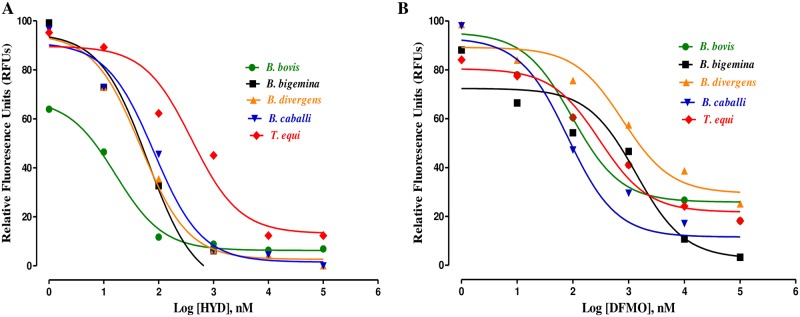
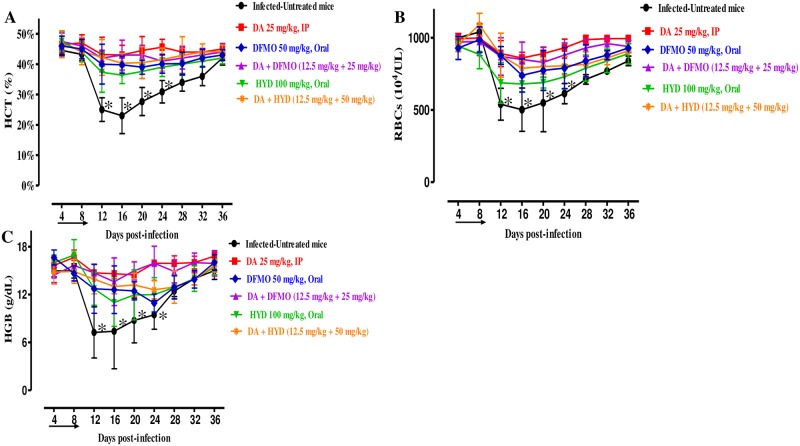
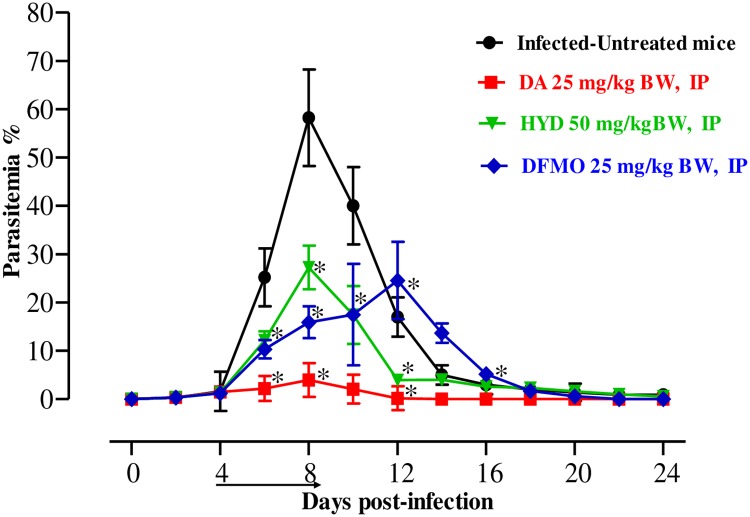
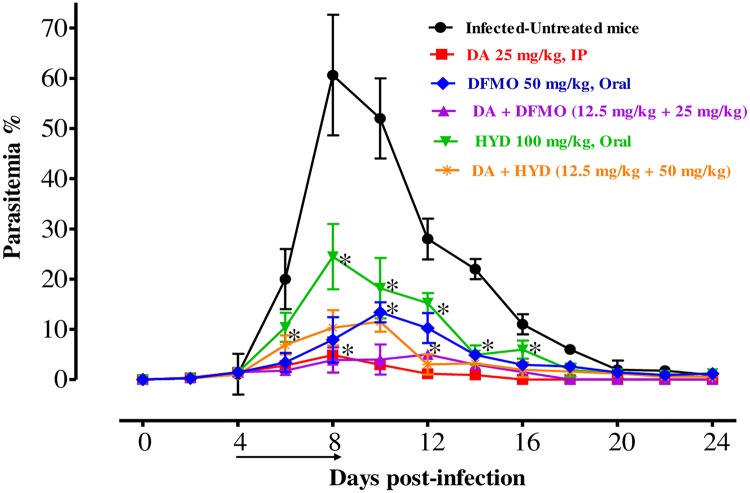
HYD and DFMO suppressed the multiplication of all tested species (B. bigemina, B. bovis, B. caballi, B. divergens, and T. equi) in a dose-related manner. HFF, NIH/3T3, or MDBK cell viability was not influenced by DFMO at 1000 μM, while HYD affected the MDBK cell viability at EC50 value of 887.5±14.4 μM. The in vitro combination treatments of DFMO and HYD with CLF, DA, and ATV exhibited synergistic and additive efficacy toward all tested species. The in vivo experiment revealed that HYD and DFMO oral administration at 100 and 50 mg/kg inhibited B. microti multiplication in mice by 60.1% and 78.2%, respectively. HYD-DA and DFMO-DA combined treatments showed higher chemotherapeutic efficacy than their monotherapies.
These results indicate the prospects of HYD and DFMO as drug candidates for piroplasmosis treatment, when combined mainly with DA, ATV, and CLF. Therefore, further studies are needed to combine HYD or DFMO with either ATV or CLF and examine their impact on B. microti infection in mice.
现有抗梨形虫疗法存在大量耐药性和不良后果,这强调了迫切需要新的化疗药物和药物靶点,以进行预防和化疗。羟基脲(HYD)是一种具有抗锥虫活性的抗肿瘤药物。依氟鸟氨酸(α-二氟甲基鸟氨酸,DFMO)是治疗晚期冈比亚人体非洲锥虫病的最佳选择疗法。
在这项研究中,评估了 HYD 和 DFMO 与现有的杀巴贝斯虫药物(二脒那嗪(DA)、阿托伐醌(ATV)和氯法齐明(CLF))脱氧核苷酸体外对巴贝斯虫和泰勒虫增殖的抑制和联合疗效。以及它们对感染啮齿动物的微小巴贝斯虫株的化学治疗效果。使用细胞计数试剂盒-8(CCK-8)试验检测它们对人包皮成纤维细胞(HFF)、小鼠胚胎成纤维细胞(NIH/3T3)和牛肾 Madin-Darby(MDBK)细胞的细胞毒性。
HYD 和 DFMO 以剂量相关的方式抑制所有测试物种(双芽巴贝斯虫、牛巴贝斯虫、马巴贝斯虫、分歧巴贝斯虫和马泰勒虫)的增殖。DFMO 在 1000μM 时不影响 HFF、NIH/3T3 或 MDBK 细胞活力,而 HYD 以 EC50 值 887.5±14.4μM 影响 MDBK 细胞活力。DFMO 与 CLF、DA 和 ATV 的体外联合治疗对所有测试物种均表现出协同和相加疗效。体内实验表明,HYD 和 DFMO 口服 100 和 50mg/kg 分别抑制小鼠微小巴贝斯虫的增殖 60.1%和 78.2%。HYD-DA 和 DFMO-DA 联合治疗比单独治疗具有更高的化疗疗效。
这些结果表明,HYD 和 DFMO 作为梨形虫病治疗的候选药物具有前景,主要与 DA、ATV 和 CLF 联合使用。因此,需要进一步研究将 HYD 或 DFMO 与 ATV 或 CLF 联合使用,并检查它们对小鼠微小巴贝斯虫感染的影响。