Brandenburger Adam, Steverson Kai
1Stern School of Business, Tandon School of Engineering, NYU Shanghai, New York University, 44 West 4th Street, New York, NY 10012 USA.
2Center for Neural Science, New York University, 4 Washington Place, Room 809, New York, NY 10012 USA.
Found Phys. 2019;49(5):444-456. doi: 10.1007/s10701-019-00257-z. Epub 2019 May 4.
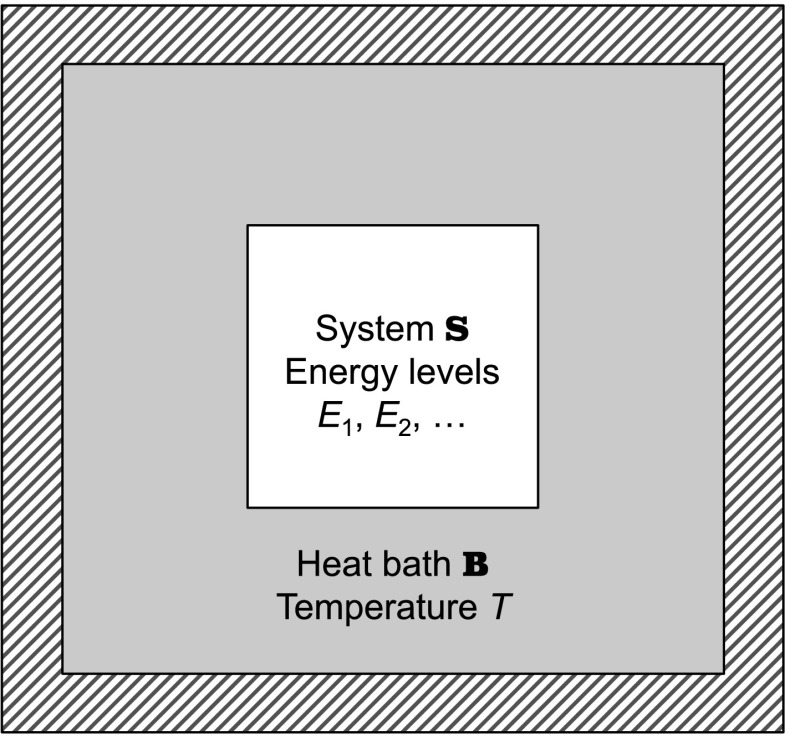
A fundamental postulate of statistical mechanics is that all microstates in an isolated system are equally probable. This postulate, which goes back to Boltzmann, has often been criticized for not having a clear physical foundation. In this note, we provide a derivation of the canonical (Boltzmann) distribution that avoids this postulate. In its place, we impose two axioms with physical interpretations. The first axiom (thermal equilibrium) ensures that, as our system of interest comes into contact with different heat baths, the ranking of states of the system by probability is unchanged. Physically, this axiom is a statement that in thermal equilibrium, population inversions do not arise. The second axiom (energy exchange) requires that, for any heat bath and any probability distribution on states, there is a universe consisting of a system and heat bath that can achieve this distribution. Physically, this axiom is a statement that energy flows between system and heat bath are unrestricted. We show that our two axioms identify the Boltzmann distribution.
统计力学的一个基本假设是,孤立系统中的所有微观状态具有同等的概率。这个可以追溯到玻尔兹曼的假设,经常因缺乏明确的物理基础而受到批评。在本笔记中,我们给出了一个避免该假设的正则(玻尔兹曼)分布的推导。取而代之的是,我们引入了两个具有物理解释的公理。第一个公理(热平衡)确保,当我们感兴趣的系统与不同的热库接触时,按概率对系统状态进行的排序不变。从物理角度看,这个公理表明在热平衡中不会出现粒子数反转。第二个公理(能量交换)要求,对于任何热库和任何状态上的概率分布,都存在一个由系统和热库组成的宇宙,它可以实现这种分布。从物理角度看,这个公理表明系统与热库之间的能量流动是不受限制的。我们证明,我们的这两个公理确定了玻尔兹曼分布。