University/ BHF Centre for Cardiovascular Science, University of Edinburgh, Edinburgh, United Kingdom.
Edinburgh Imaging, University of Edinburgh, Edinburgh, United Kingdom.
PLoS One. 2019 May 31;14(5):e0217515. doi: 10.1371/journal.pone.0217515. eCollection 2019.
Positron Emission Tomography (PET) imaging with selective 18 kDa translocator protein (TSPO) radiotracers has contributed to our understanding on the role of inflammation in disease development and progression. With an increasing number of rodent models of human disease and expansion of the preclinical PET imaging base worldwide, accurate quantification of longitudinal rodent TSPO PET datasets is necessary. This is particularly relevant as TSPO PET quantification relies on invasive blood sampling due to lack of a suitable tissue reference region. Here we investigate the kinetics and quantification bias of a novel TSPO radiotracer [18F]AB5186 in rats using automatic, manual and image derived input functions.
[18F]AB5186 was administered intravenously and dynamic PET imaging was acquired over 2 hours. Arterial blood was collected manually to derive a population based input function or using an automatic blood sampler to derive a plasma input function. Manually sampled blood was also used to analyze the [18F]AB5186 radiometabolite profile in plasma and applied to all groups as a population based dataset. Kinetic models were used to estimate distribution volumes (VT) and [18F]AB5186 outcome measure bias was determined.
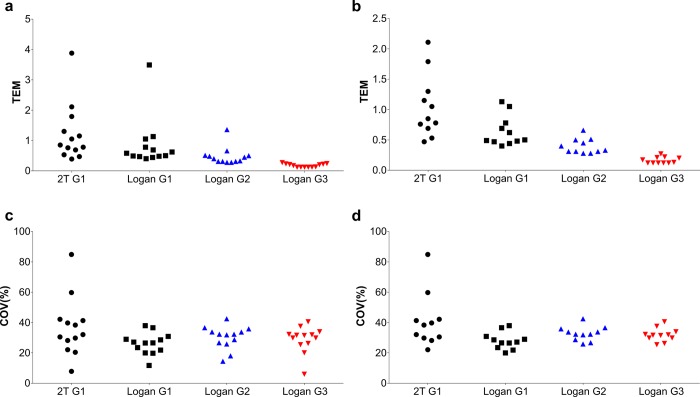
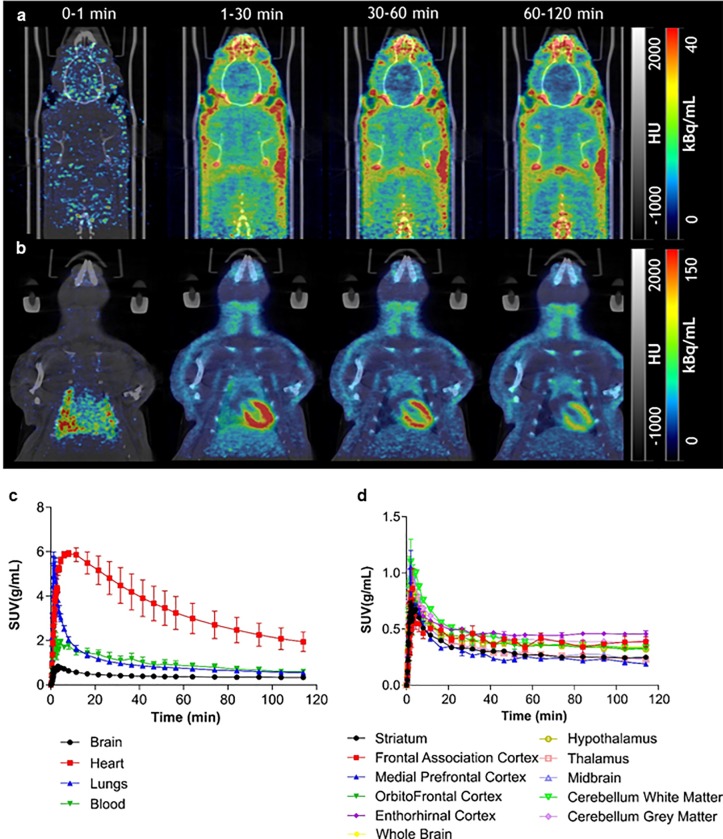
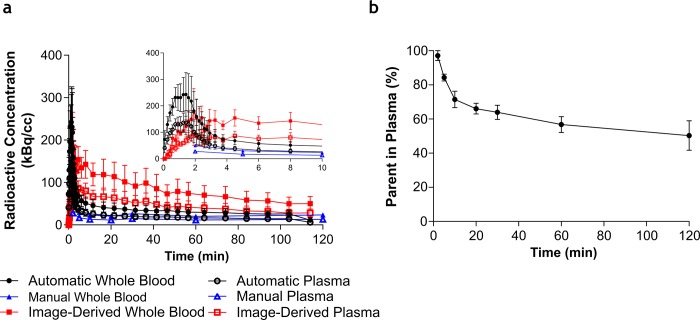
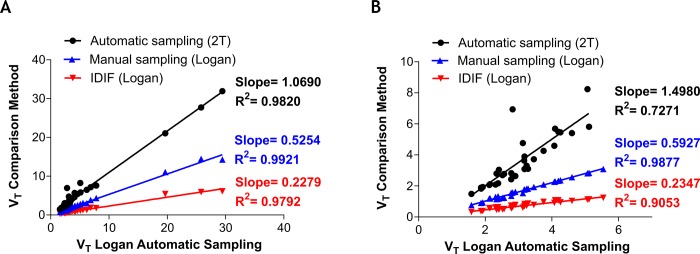
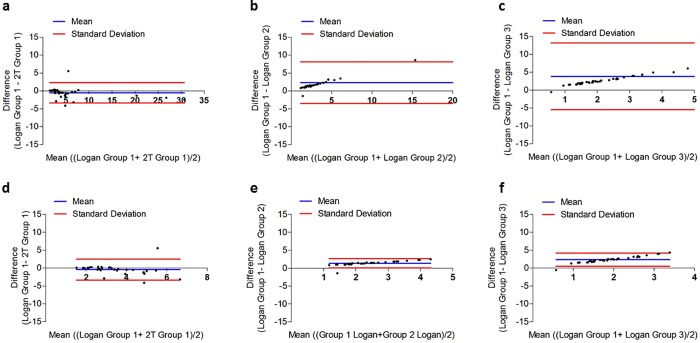
[18F]AB5186 distribution in rats was consistent with TSPO expression and at 2 h post-injection 50% of parent compound was still present in plasma. Population based manual sampling methods and image derived input function (IDIF) underestimated VT by ~50% and 88% compared with automatic blood sampling, respectively. The VT variability was lower when using IDIF versus arterial blood sampling methods and analysis of the Bland-Altman plots showed a good agreement between methods of analysis.
Quantification of TSPO PET rodent data using image-derived methods, which are more amenable for longitudinal scanning of small animals, yields outcome measures with reduced variability and good agreement, albeit biased, compared with invasive blood sampling methods.
正电子发射断层扫描(PET)成像使用选择性 18 kDa 转位蛋白(TSPO)放射性示踪剂,有助于我们了解炎症在疾病发展和进展中的作用。随着越来越多的人类疾病啮齿动物模型和全球临床前 PET 成像基础的扩展,准确量化纵向啮齿动物 TSPO PET 数据集是必要的。由于缺乏合适的组织参考区域,TSPO PET 定量依赖于侵入性的血液采样,因此这一点尤其重要。在这里,我们使用自动、手动和图像衍生输入函数研究新型 TSPO 放射性示踪剂[18F]AB5186 在大鼠中的动力学和定量偏差。
[18F]AB5186 经静脉给药,并在 2 小时内进行动态 PET 成像。通过手动采集动脉血来推导出群体基础输入函数,或使用自动血液采样器来推导出血浆输入函数。还使用手动采样的血液来分析血浆中[18F]AB5186 放射性代谢产物谱,并将其作为群体数据集应用于所有组。使用动力学模型估计分布容积(VT),并确定[18F]AB5186 结果测量的偏差。
[18F]AB5186 在大鼠中的分布与 TSPO 表达一致,在注射后 2 小时,仍有 50%的母体化合物存在于血浆中。与自动血液采样相比,基于群体的手动采样方法和图像衍生输入函数(IDIF)分别低估了 VT 约 50%和 88%。使用 IDIF 与动脉血采样方法相比,VT 变异性更低,并且分析 Bland-Altman 图表明分析方法之间具有良好的一致性。
使用更适合小动物纵向扫描的图像衍生方法对 TSPO PET 啮齿动物数据进行定量,与侵入性血液采样方法相比,可获得具有降低变异性和良好一致性的结果测量值,尽管存在偏差。