Pereira Felicidade Mota, de Almeida Maria da Conceição Chagas, Santos Fred Luciano Neves, Carreiro Roberto Perez, Regis-Silva Carlos Gustavo, Galvão-Castro Bernardo, Grassi Maria Fernanda Rios
Laboratório Avançado de Saúde Pública, Fundação Oswaldo Cruz, Salvador, Brazil.
Laboratório Central de Saúde Pública Prof. Gonçalo Moniz - Secretaria da Saúde do Estado da Bahia, Salvador, Brazil.
Front Microbiol. 2019 May 14;10:1002. doi: 10.3389/fmicb.2019.01002. eCollection 2019.
Salvador, Bahia (northeastern Brazil), has been identified as the epicenter of Human T-cell leukemia virus Human T-cell leukemia virus (HTLV) type 1 infection in the country. This study aims to estimate the rate of HTLV infection and the geographical distribution of this virus in this state.
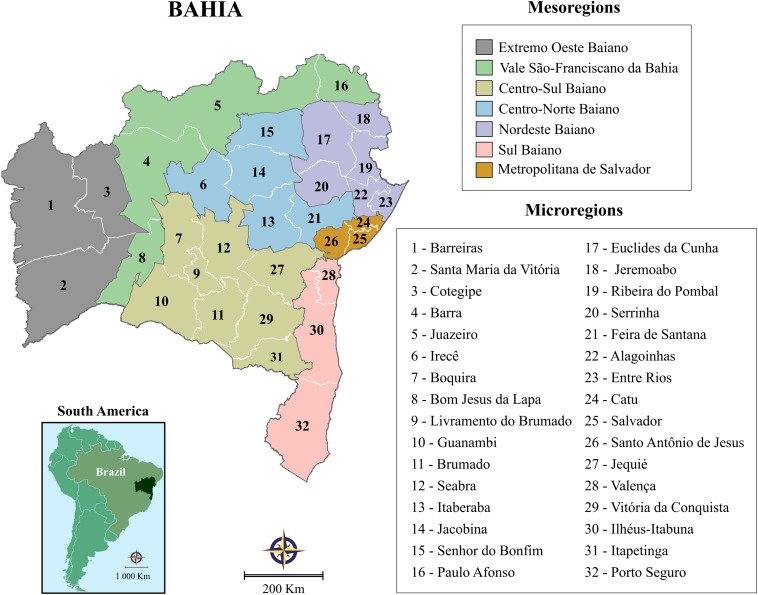
All HTLV tests (chemiluminescence/ELISA assays/Western Blotting) performed in the Central Laboratory of Public Health of Bahia (LACEN) from 2004 to 2013 were included. Data was extracted from LACEN's database using high volume extract, transformation and load throughput. Infection rate was expressed as the number of infected individuals per 100,000 inhabitants considering municipalities grouped in microregions and/or mesoregions as the unit of analysis.
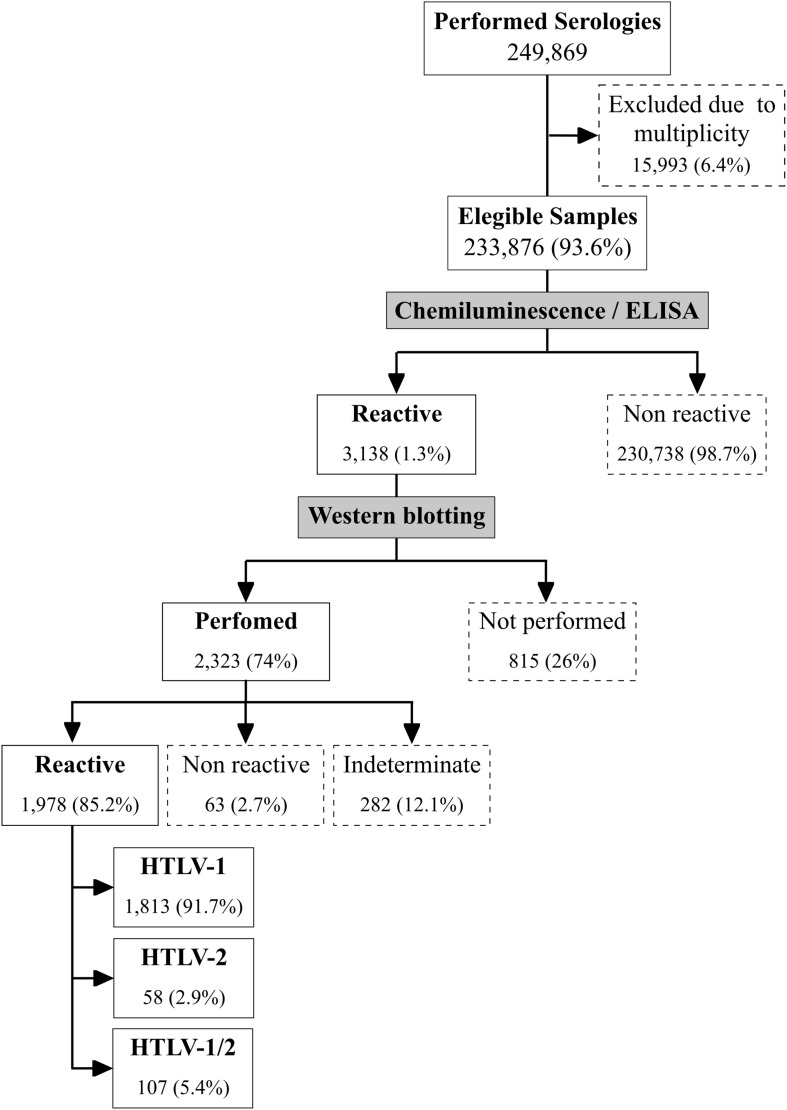
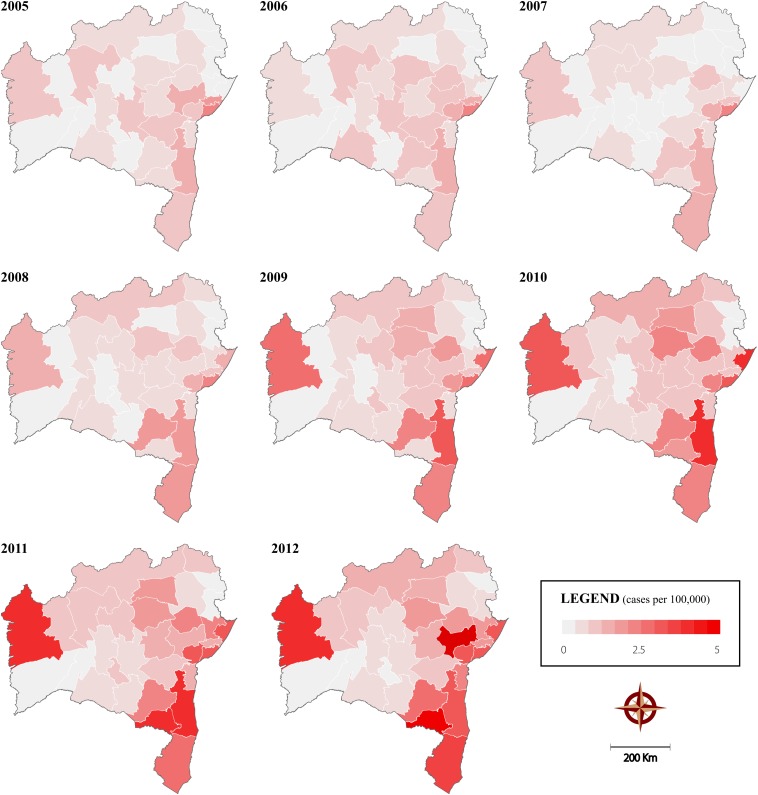
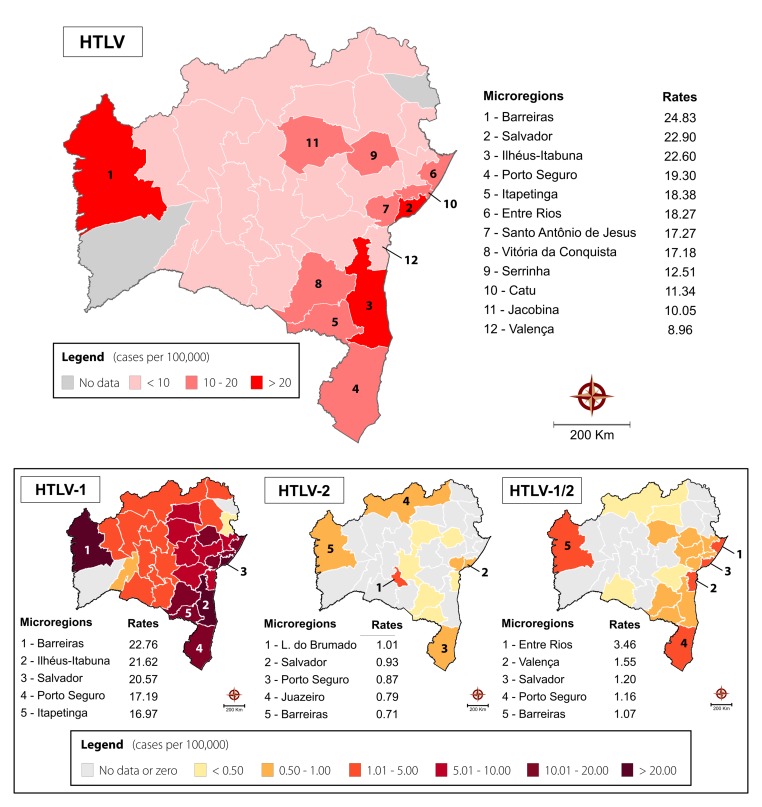
A total of 233,876 individuals were evaluated. Individuals were from 394 out of 417 municipalities of Bahia (94.5%). HTLV chemiluminescence/ELISA assay was found to be reactive for 3,138 individuals from whom 2,323 had WB results (1,978 positives, 62 negative and 282 indeterminate). Out of 1978 reactive samples, 1,813 (91.7%) were positive for HTLV-1, 58 (2.9%) for HTLV-2 and 107 (5.4%) were for both HTLV-1 and HTLV-2. The cumulative mean rate of HTLV-positive cases in Bahia was 14.4 per 100,000 inhabitants. Three microregions presented rates >20 HTLV-positive cases/100,000 inhabitants: Barreiras (24.83 cases per 100,000 inhabitants), Salvador (22.90 cases per 100,000 inhabitants), and Ilhéus-Itabuna (22.60 cases per 100,000 inhabitants).
HTLV infection is disseminated in the state of Bahia, with an overall moderate rate of infection. Further studies should be conducted to characterize the epidemiological and clinical profile of HTLV-infected individuals better and to propose effective prevention measures.
巴西东北部的巴伊亚州萨尔瓦多市被确定为该国人类T细胞白血病病毒1型(HTLV)感染的中心。本研究旨在估计该州HTLV感染率及其病毒的地理分布。
纳入2004年至2013年在巴伊亚州公共卫生中心实验室(LACEN)进行的所有HTLV检测(化学发光/酶联免疫吸附测定/蛋白质印迹法)。使用大容量提取、转换和加载吞吐量从LACEN数据库中提取数据。感染率表示为每10万居民中感染个体的数量,分析单位为按微区域和/或中区域分组的市。
共评估了233,876人。这些个体来自巴伊亚州417个市中的394个(94.5%)。发现HTLV化学发光/酶联免疫吸附测定对3138人呈反应性,其中2323人有蛋白质印迹结果(1978例阳性,62例阴性,282例不确定)。在1978份反应性样本中,1813份(91.7%)HTLV-1阳性,58份(2.9%)HTLV-2阳性,107份(5.4%)HTLV-1和HTLV-2均阳性。巴伊亚州HTLV阳性病例的累积平均率为每10万居民14.4例。三个微区域的HTLV阳性病例率>20例/10万居民:巴雷拉(每10万居民24.83例)、萨尔瓦多(每10万居民22.90例)和伊列乌斯-伊塔布纳(每10万居民22.60例)。
HTLV感染在巴伊亚州广泛传播,总体感染率中等。应进一步开展研究,以更好地描述HTLV感染个体的流行病学和临床特征,并提出有效的预防措施。