Yu Hua, Nie Lu, Liu Aibo, Wu Kuihai, Hsein Yenh-Chen, Yen Debra W, Lee Meng-Tse G, Lee Chien-Chang
Department of Laboratory Medicine, Sichuan Academy of Medical Sciences and Sichuan Provincial People's Hospital, Chengdu, Sichuan.
Department of Laboratory Medicine, The First People's Hospital of Foshan, Foshan, Guangdong, China.
Medicine (Baltimore). 2019 Jun;98(23):e15981. doi: 10.1097/MD.0000000000015981.
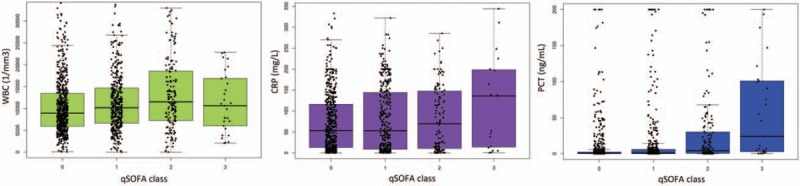
To investigate whether procalcitonin (PCT) can improve the performance of quick sequential organ failure assessment (SOFA) score in predicting sepsis mortality, we conducted a retrospective multicenter cohort study with independent validation in a prospectively collected cohort in 3 tertiary medical centers. Patients with presumed sepsis were included. Serum PCT levels were measured at admission. Quick SOFA score and systemic inflammatory response syndrome (SIRS) criteria were calculated for each patient. PCT levels were assigned into 0, 1, and 2 points for a serum level of <0.25, 0.25 to 2, and >2 ng/mL, and added to the quick sepsis-related organ failure assessment (qSOFA) score. The incremental value of PCT to qSOFA was then evaluated by logistic regression, receiver-operating characteristic (ROC) curve, and reclassification analysis.In all, 1318 patients with presumed severe infection were enrolled with a 30-day mortality of 13.5%. Serum level of PCT showed a high correlation with qSOFA score and 30-day inhospital mortality. The area under the ROC curve was 0.56 for SIRS criteria, 0.67 for qSOFA score, and 0.73 for qSOFA_PCT in predicting 30-day mortality. The risk prediction improvement was reflected by a net reclassification improvement of 35% (17%-52%). Incorporation of PCT into the qSOFA model could raise the sensitivity to 86.5% (95% confidence interval 80.6%-91.2%). In the validation cohort, qSOFA_PCT greatly improved the sensitivity to 90.9%.A simple modification of qSOFA score by adding the ordinal scale of PCT value to qSOFA could greatly improve the suboptimal sensitivity problem of qSOFA and may serve as a quick screening tool for early identification of sepsis.
为了研究降钙素原(PCT)是否能改善快速序贯器官衰竭评估(SOFA)评分预测脓毒症死亡率的性能,我们在3家三级医疗中心对前瞻性收集的队列进行了一项具有独立验证的回顾性多中心队列研究。纳入疑似脓毒症患者。入院时测定血清PCT水平。为每位患者计算快速SOFA评分和全身炎症反应综合征(SIRS)标准。血清PCT水平<0.25、0.25至2、>2 ng/mL分别计为0、1、2分,并加到快速脓毒症相关器官衰竭评估(qSOFA)评分中。然后通过逻辑回归、受试者工作特征(ROC)曲线和重新分类分析评估PCT对qSOFA的增量价值。
总共纳入1318例疑似严重感染患者,30天死亡率为13.5%。血清PCT水平与qSOFA评分及30天住院死亡率高度相关。在预测30天死亡率方面,SIRS标准的ROC曲线下面积为0.56,qSOFA评分为0.67,qSOFA_PCT为0.73。净重新分类改善率为35%(17%-52%),反映了风险预测的改善。将PCT纳入qSOFA模型可使敏感性提高到86.5%(95%置信区间80.6%-91.2%)。在验证队列中,qSOFA_PCT使敏感性大幅提高到90.9%。
通过将PCT值的序数量表加到qSOFA中对qSOFA评分进行简单修改,可大大改善qSOFA敏感性欠佳的问题,并可作为早期识别脓毒症的快速筛查工具。