Department of General, Visceral and Transplantation Surgery, University Hospital Heidelberg, Im Neuenheimer Feld 110, 69120, Heidelberg, Germany.
Institute of Medical Biometry and Informatics, University of Heidelberg, Im Neuenheimer Feld 130.3, 69120, Heidelberg, Germany.
Trials. 2019 Jun 7;20(1):332. doi: 10.1186/s13063-019-3442-0.
The placement of prophylactic intra-abdominal drains has been common practice in abdominal operations including pancreatic surgery. The PANDRA trial showed that the omission of drains following pancreatic head resection was non-inferior to intra-abdominal drainage in terms of postoperative reinterventions and superior in terms of clinically relevant pancreatic fistula rate and fistula-associated complications. The aim of the present PANDRA II trial is to evaluate the clinical outcome with versus without prophylactic drain placement after distal pancreatectomy.
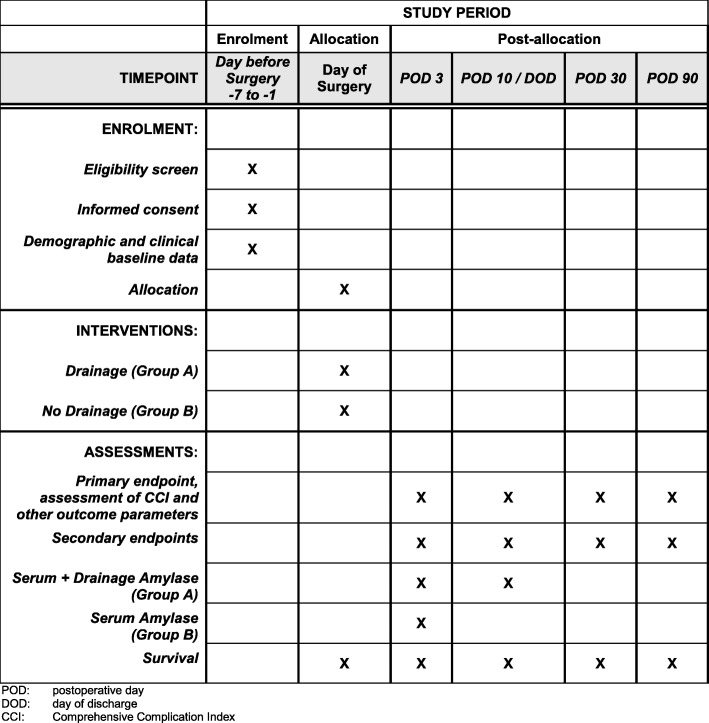
The PANDRA II trial is a mono-center, randomized controlled, non-inferiority trial with two parallel study groups. In the control group at least one passive intra-abdominal drain is placed at the pancreatic resection margin. In the experimental group no drains are placed. The primary endpoint of this trial will be the Comprehensive Complication Index (CCI) measuring all postoperative complications within 90 days. Secondary endpoints are in-hospital mortality and morbidity, including the rates of postoperative pancreatic fistula, chyle leak, postpancreatectomy hemorrhage, delayed gastric emptying, reinterventions and reoperations, surgical site infection, and abdominal fascia dehiscence. Moreover, length of hospital stay, duration of intensive care unit stay, and the rate of readmission after discharge from hospital (up to day 90 after surgery) are assessed. We will need to analyze 252 patients to test the hypothesis that no drainage is non-inferior to drain placement in terms of the CCI (δ 7.5 points) in a one-sided t test with a one-sided level of significance of 2.5% and a power of 80%.
The results of the PANDRA II trial will help to evaluate the effect of an omission of prophylactic intraperitoneal drainage on the rate of complications after open or minimally invasive distal pancreatectomy.
German Clinical Trials Register (DRKS), DRKS00013763 . Registered on 6 March 2018.
预防性腹腔引流在包括胰腺手术在内的腹部手术中已被广泛应用。PANDRA 试验表明,与腹腔引流相比,胰腺头切除术后不放置引流在术后再次干预方面没有劣势,在临床相关胰瘘发生率和瘘管相关并发症方面具有优势。本研究旨在评估预防性引流在胰体尾切除术后的临床效果。
PANDRA II 试验是一项单中心、随机对照、非劣效性试验,分为两个平行的研究组。对照组至少在胰腺切除缘放置一个被动腹腔引流管,实验组不放置引流管。本试验的主要终点是综合并发症指数(CCI),用于评估术后 90 天内所有术后并发症。次要终点包括住院死亡率和发病率,包括术后胰瘘、乳糜漏、胰切除术后出血、胃排空延迟、再次干预和再次手术、手术部位感染和腹壁筋膜裂开的发生率。此外,还评估了住院时间、重症监护病房停留时间以及出院后(术后 90 天内)的再入院率。我们需要分析 252 例患者,以单侧 t 检验(单侧显著性水平为 2.5%,效力为 80%)来检验无引流在 CCI 方面不劣于引流放置的假设(差值为 7.5 分)。
PANDRA II 试验的结果将有助于评估开腹或微创胰体尾切除术后预防性腹腔引流对并发症发生率的影响。
德国临床试验注册中心(DRKS),DRKS00013763。注册于 2018 年 3 月 6 日。