School of Geographical Sciences, University of Bristol, Bristol BS8 1SS, UK.
Cabot Institute for the Environment, University of Bristol, Bristol BS5 9LT, UK.
Sci Adv. 2019 Jun 5;5(6):eaau4373. doi: 10.1126/sciadv.aau4373. eCollection 2019 Jun.
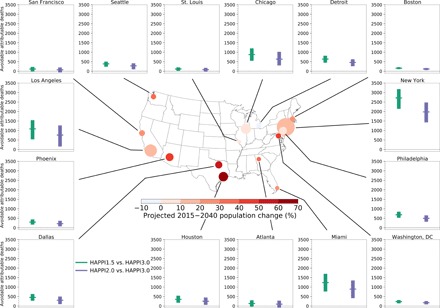
Current greenhouse gas mitigation ambition is consistent with ~3°C global mean warming above preindustrial levels. There is a clear need to strengthen mitigation ambition to stabilize the climate at the Paris Agreement goal of warming of less than 2°C. We specify the differences in city-level heat-related mortality between the 3°C trajectory and warming of 2° and 1.5°C. Focusing on 15 U.S. cities where reliable climate and health data are available, we show that ratcheting up mitigation ambition to achieve the 2°C threshold could avoid between 70 and 1980 annual heat-related deaths per city during extreme events (30-year return period). Achieving the 1.5°C threshold could avoid between 110 and 2720 annual heat-related deaths. Population changes and adaptation investments would alter these numbers. Our results provide compelling evidence for the heat-related health benefits of limiting global warming to 1.5°C in the United States.
目前的温室气体减排力度与工业化前水平相比,只能将全球平均升温控制在约 3°C 以内。显然,需要加强减排力度,才能将气候稳定在《巴黎协定》规定的升温低于 2°C 的目标上。我们具体说明了在 3°C 轨迹和升温 2°C 和 1.5°C 的情况下,城市层面与热相关的死亡率的差异。我们关注了美国 15 个拥有可靠气候和健康数据的城市,结果表明,提高减排力度以实现 2°C 的阈值,可以避免每个城市在极端事件(30 年重现期)中每年发生 70 至 1980 例与热相关的死亡事件。实现 1.5°C 的阈值可以避免每年发生 110 至 2720 例与热相关的死亡事件。人口变化和适应投资会改变这些数字。我们的研究结果为美国将全球变暖限制在 1.5°C 可带来与热相关的健康益处提供了有力的证据。