Kang Xiaowen, Kong Fanwu, Huang Kun, Li Lu, Li Zhaoguo, Wang Xinyan, Zhang Wei, Wu Xiaomei
Department of Pulmonology, The Second Affiliated Hospital, Harbin Medical University, Harbin, People's Republic of China.
Department of Nephrology, The Second Affiliated Hospital, Harbin Medical University, Harbin, People's Republic of China.
Onco Targets Ther. 2019 May 16;12:3779-3790. doi: 10.2147/OTT.S189468. eCollection 2019.
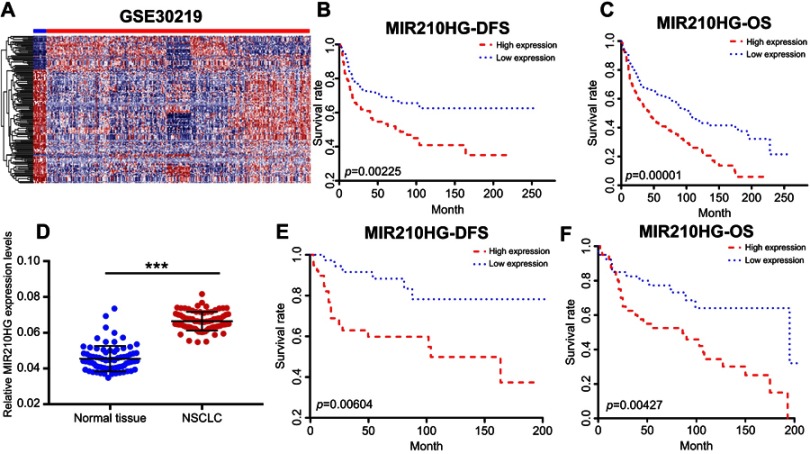
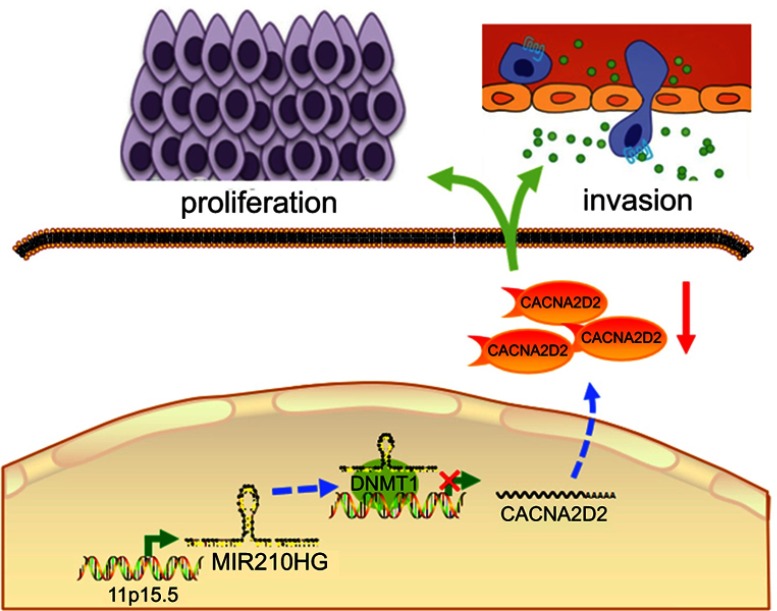
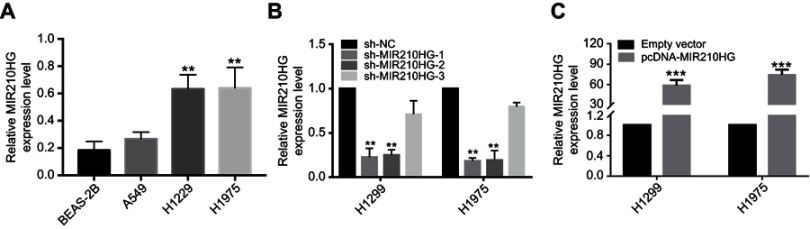
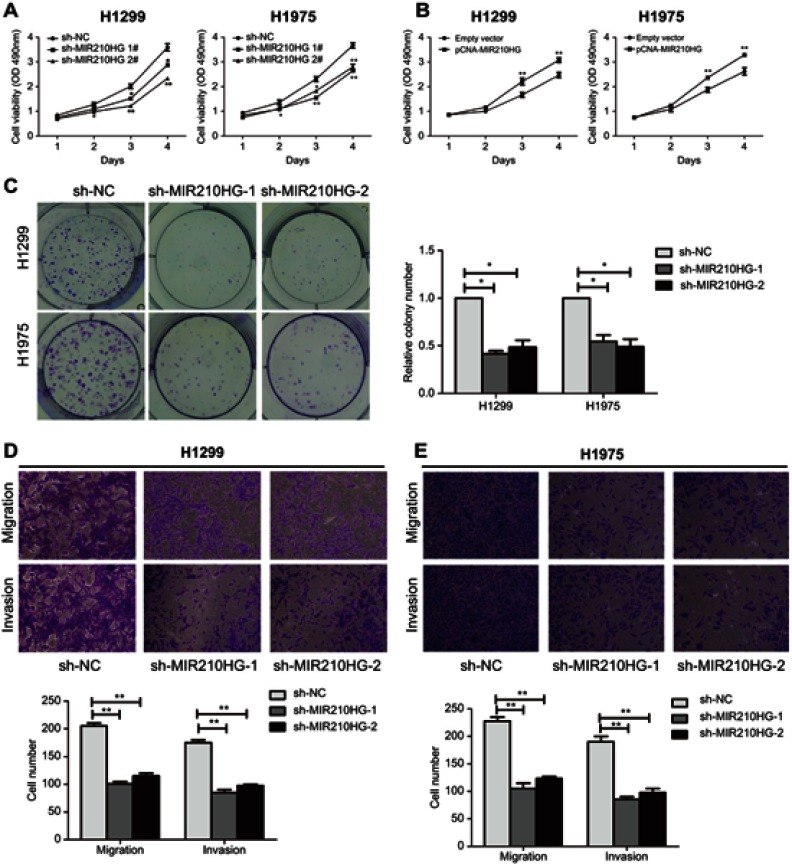
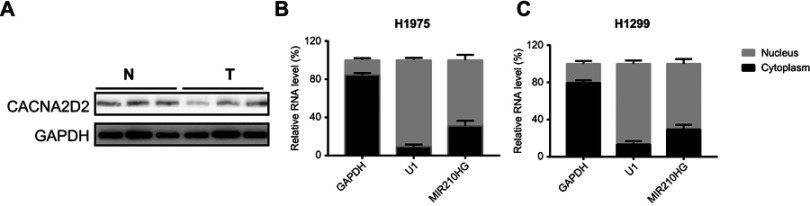
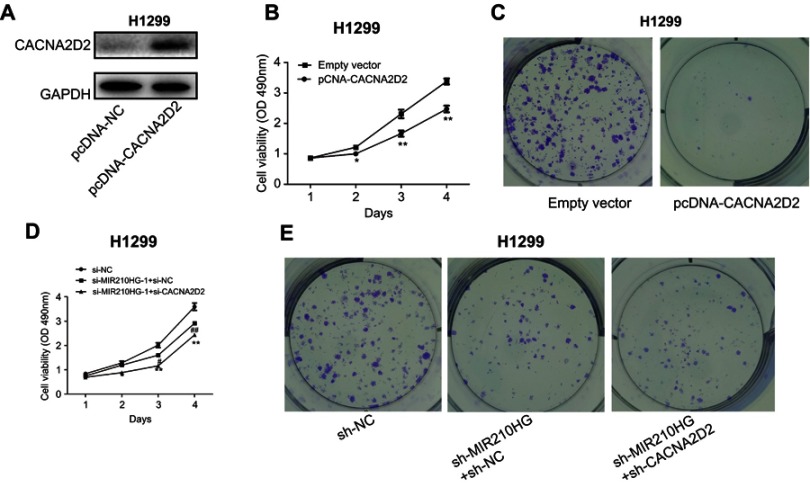
In recent years, a large number of studies have shown that differentially expressed lncRNAs are capable of promoting the occurrence and development of tumors by regulating cell proliferation and differentiation. However, the biological effects of lncRNAs in non-small cell lung cancer (NSCLC) are still needed to be further investigated. The differentially expressed lncRNAs in NSCLC tissues in the downloaded profiles from GEO database were analyzed and further verified in 100 pairs of NSCLC samples collected in our hospital. After identification of the target gene MIR210HG, the relationship between MIR210HG expression and clinical data of NSCLC patients was analyzed. Regulatory effects of MIR210HG on proliferation, migration, and invasion of NSCLC cells were detected by CCK-8, colony formation, and transwell assay, respectively. The binding condition of MIR210HG and DNA methyltransferase 1 (DNMT1) was detected by RNA binding protein immunoprecipitation. Subsequently, chromatin immunoprecipitation assay assessed the promoter binding of DNMT1 to CACNA2D2. Rescue experiments were conducted to assess whether CACNA2D2 can reverse the function of MIR210HG. MIR210HG was highly expressed in NSCLC tissues not only in GSE30219 dataset but also in our collected NSCLC tissues. MIR210HG expression was correlated to tumor stage and lymph node metastasis of NSCLC patients. Besides, lower disease-free survival (DFS) and overall survival (OS) were found in NSCLC patients with high-level MIR210HG compared with those with low-level MIR210HG. Regression analysis indicated that MIR210HG was the independent risk factor for DFS and OS of NSCLC patients. In vitro experiments demonstrated that MIR210HG knockdown remarkably inhibited proliferation and migration of NSCLC cells. MIR210HG could recruit DNMT1, thereafter promoting methylation of CACNA2D2 promoter region. CACNA2D2 overexpression remarkably inhibited cell proliferation. Moreover, inhibited proliferation induced by MIR210HG knockdown was reversed by CACNA2D2 knockdown. MIR210HG can promote the tumorigenesis of NSCLC by inhibiting the expression of CACNA2D2. Our findings provide new therapeutic strategies for the future treatment of NSCLC.
近年来,大量研究表明,差异表达的长链非编码RNA(lncRNAs)能够通过调节细胞增殖和分化来促进肿瘤的发生和发展。然而,lncRNAs在非小细胞肺癌(NSCLC)中的生物学作用仍有待进一步研究。对从GEO数据库下载的资料中NSCLC组织中差异表达的lncRNAs进行分析,并在我院收集的100对NSCLC样本中进一步验证。在鉴定出靶基因MIR210HG后,分析了MIR210HG表达与NSCLC患者临床资料之间的关系。分别通过CCK-8、集落形成和transwell实验检测MIR210HG对NSCLC细胞增殖、迁移和侵袭的调控作用。通过RNA结合蛋白免疫沉淀检测MIR210HG与DNA甲基转移酶1(DNMT1)的结合情况。随后,染色质免疫沉淀实验评估DNMT1与CACNA2D2的启动子结合情况。进行挽救实验以评估CACNA2D2是否能逆转MIR210HG的功能。MIR210HG不仅在GSE30219数据集中的NSCLC组织中高表达,在我们收集的NSCLC组织中也高表达。MIR210HG表达与NSCLC患者的肿瘤分期和淋巴结转移相关。此外,与低水平MIR210HG的NSCLC患者相比,高水平MIR210HG的患者无病生存期(DFS)和总生存期(OS)更低。回归分析表明,MIR210HG是NSCLC患者DFS和OS的独立危险因素。体外实验表明,敲低MIR210HG可显著抑制NSCLC细胞的增殖和迁移。MIR210HG可招募DNMT1,从而促进CACNA2D2启动子区域的甲基化。过表达CACNA2D2可显著抑制细胞增殖。此外,敲低CACNA2D2可逆转敲低MIR210HG诱导的增殖抑制。MIR210HG可通过抑制CACNA2D2的表达促进NSCLC的肿瘤发生。我们的研究结果为NSCLC的未来治疗提供了新的治疗策略。