Department of Orthopaedics, First Affiliated Hospital of Guangxi Medical University, Nanning, Guangxi, China.
Department of Pharmacy, First Affiliated Hospital of Guangxi Medical University, Nanning, Guangxi, China.
World J Surg Oncol. 2019 Jun 17;17(1):106. doi: 10.1186/s12957-019-1642-4.
To retrospectively analyze the tumor resection method used in 20 patients with clavicular tumors and evaluate its clinical efficacy.
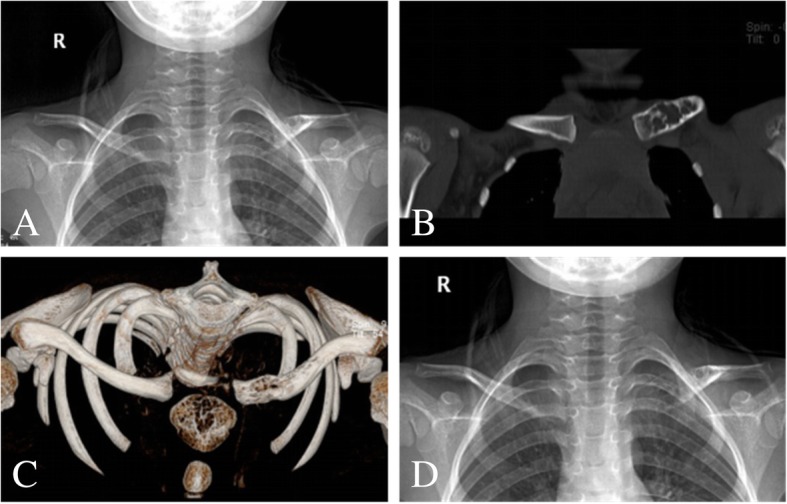
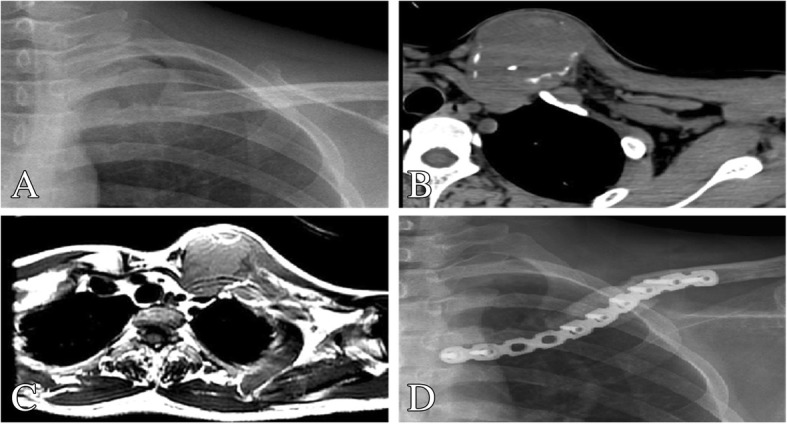
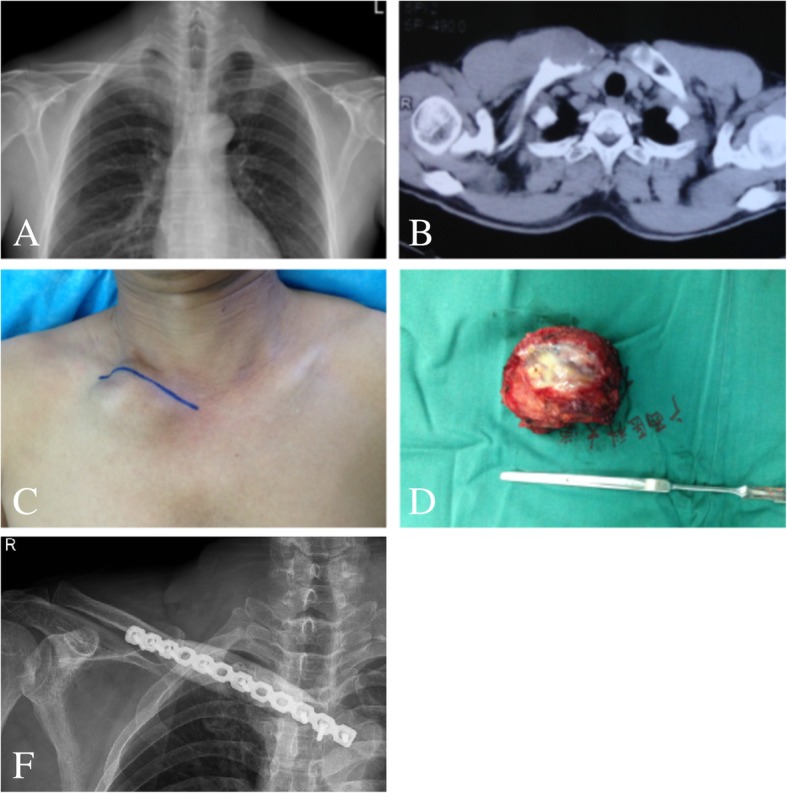
A total of 9 patients with clavicular benign tumors underwent intracapsular resection, and 11 patients with clavicular malignant tumors underwent tumor resection from May 2012 to May 2017. Of the 11 patients, 5 underwent clavicular reconstruction using the plate-cement complex. Surgical efficacy was assessed using the Musculoskeletal Tumor Society, Constant-Murley, and American Shoulder and Elbow Surgeons shoulder outcome scores preoperatively until 12 months postoperatively.
The average duration of follow-up care was 33.7 (12-71) months. Of the 20 patients, 3 patients died, 3 survived with tumor recurrence or metastasis, and 14 survived with no tumor recurrence. Among the 5 patients who underwent resection of malignant clavicular tumors and reconstruction, 2 underwent a re-operation because of a loose screw and plate displacement. In the functional assessment of the shoulder joint, patients with benign and malignant clavicular tumors showed significantly higher scores postoperatively compared with preoperative scores. For malignant clavicular tumors, no significant improvement was observed when comparing the non-reconstruction and reconstruction groups.
Surgery is an optimal treatment for clavicular tumors. In patients with benign clavicular tumors, simple intracapsular resection can achieve a satisfactory prognosis. Reconstruction of a clavicular defect after resection of a clavicular malignant tumor is not recommended.
回顾性分析 20 例锁骨肿瘤患者的肿瘤切除方法,并评估其临床疗效。
2012 年 5 月至 2017 年 5 月,9 例锁骨良性肿瘤患者行囊内切除术,11 例锁骨恶性肿瘤患者行肿瘤切除术。其中 5 例锁骨恶性肿瘤患者采用钢板-骨水泥复合体进行锁骨重建。采用肌肉骨骼肿瘤学会(Musculoskeletal Tumor Society,MSTS)评分、Constant-Murley 评分和美国肩肘外科医生(American Shoulder and Elbow Surgeons,ASES)肩关节评分评估手术疗效,术前至术后 12 个月。
平均随访时间为 33.7(12-71)个月。20 例患者中,3 例死亡,3 例因肿瘤复发或转移而存活,14 例无肿瘤复发而存活。5 例锁骨恶性肿瘤患者行肿瘤切除和重建,2 例因螺钉和钢板松动而再次手术。在肩关节功能评估中,良性和恶性锁骨肿瘤患者术后评分均明显高于术前评分。对于恶性锁骨肿瘤,非重建组和重建组之间比较无显著改善。
手术是治疗锁骨肿瘤的最佳方法。对于良性锁骨肿瘤,单纯囊内切除可获得满意的预后。不建议对锁骨恶性肿瘤切除后的锁骨缺损进行重建。