De Ternay Julia, Naassila Mickaël, Nourredine Mikail, Louvet Alexandre, Bailly François, Sescousse Guillaume, Maurage Pierre, Cottencin Olivier, Carrieri Patrizia Maria, Rolland Benjamin
Service Universitaire d'Addictologie de Lyon (SUAL), Bron, France.
Université de Picardie Jules Verne, Centre Universitaire de Recherche en Santé, INSERM UMR 1247, Groupe de Recherche sur l'Alcool & les Pharmacodépendances, Amiens, France.
Front Pharmacol. 2019 May 31;10:627. doi: 10.3389/fphar.2019.00627. eCollection 2019.
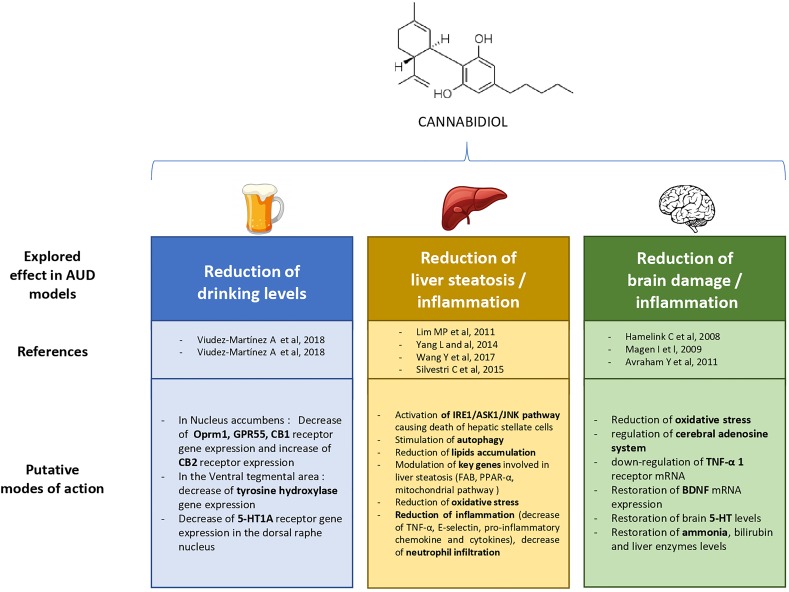
Cannabidiol (CBD) is a natural component of cannabis that possesses a widespread and complex immunomodulatory, antioxidant, anxiolytic, and antiepileptic properties. Much experimental data suggest that CBD could be used for various purposes in alcohol use disorder (AUD) and alcohol-related damage on the brain and the liver. To provide a rationale for using CBD to treat human subjects with AUD, based on the findings of experimental studies. Narrative review of studies pertaining to the assessment of CBD efficiency on drinking reduction, or on the improvement of any aspect of alcohol-related toxicity in AUD. Experimental studies find that CBD reduces the overall level of alcohol drinking in animal models of AUD by reducing ethanol intake, motivation for ethanol, relapse, anxiety, and impulsivity. Moreover, CBD reduces alcohol-related steatosis and fibrosis in the liver by reducing lipid accumulation, stimulating autophagy, modulating inflammation, reducing oxidative stress, and by inducing death of activated hepatic stellate cells. Finally, CBD reduces alcohol-related brain damage, preventing neuronal loss by its antioxidant and immunomodulatory properties. CBD could directly reduce alcohol drinking in subjects with AUD. Any other applications warrant human trials in this population. By reducing alcohol-related steatosis processes in the liver, and alcohol-related brain damage, CBD could improve both hepatic and neurocognitive outcomes in subjects with AUD, regardless of the individual's drinking trajectory. This might pave the way for testing new harm reduction approaches in AUD, in order to protect the organs of subjects with an ongoing AUD.
大麻二酚(CBD)是大麻的一种天然成分,具有广泛而复杂的免疫调节、抗氧化、抗焦虑和抗癫痫特性。大量实验数据表明,CBD可用于酒精使用障碍(AUD)以及酒精对大脑和肝脏造成的相关损害的多种治疗目的。基于实验研究结果,为使用CBD治疗AUD患者提供理论依据。对有关评估CBD在减少饮酒量或改善AUD中与酒精相关毒性的任何方面的效率的研究进行叙述性综述。实验研究发现,CBD通过减少乙醇摄入量、对乙醇的动机、复发、焦虑和冲动性,降低了AUD动物模型中的总体饮酒水平。此外,CBD通过减少脂质积累、刺激自噬、调节炎症、减少氧化应激以及诱导活化的肝星状细胞死亡,减轻肝脏中与酒精相关的脂肪变性和纤维化。最后,CBD通过其抗氧化和免疫调节特性预防神经元丢失,从而减轻与酒精相关的脑损伤。CBD可以直接减少AUD患者的饮酒量。任何其他应用都需要在该人群中进行人体试验。通过减少肝脏中与酒精相关的脂肪变性过程以及与酒精相关的脑损伤,CBD可以改善AUD患者的肝脏和神经认知结局,而不论个体的饮酒轨迹如何。这可能为在AUD中测试新的减少伤害方法铺平道路,以保护患有持续性AUD的患者的器官。