Department of Mechanical and Aerospace Engineering, Monash University, 3800 Clayton, Australia.
Monash Institute of Medical Engineering, Monash University, 3800 Clayton, Australia.
Int J Mol Sci. 2019 Jun 18;20(12):2967. doi: 10.3390/ijms20122967.
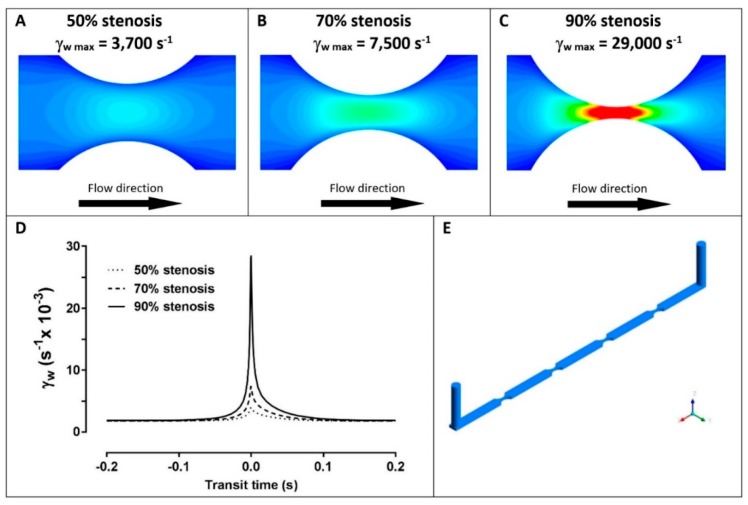
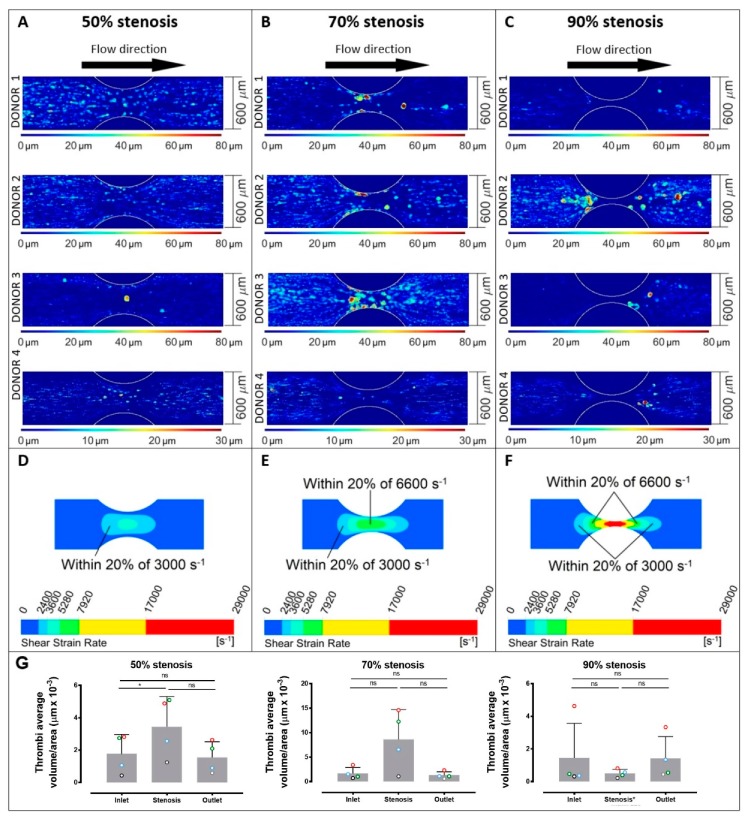
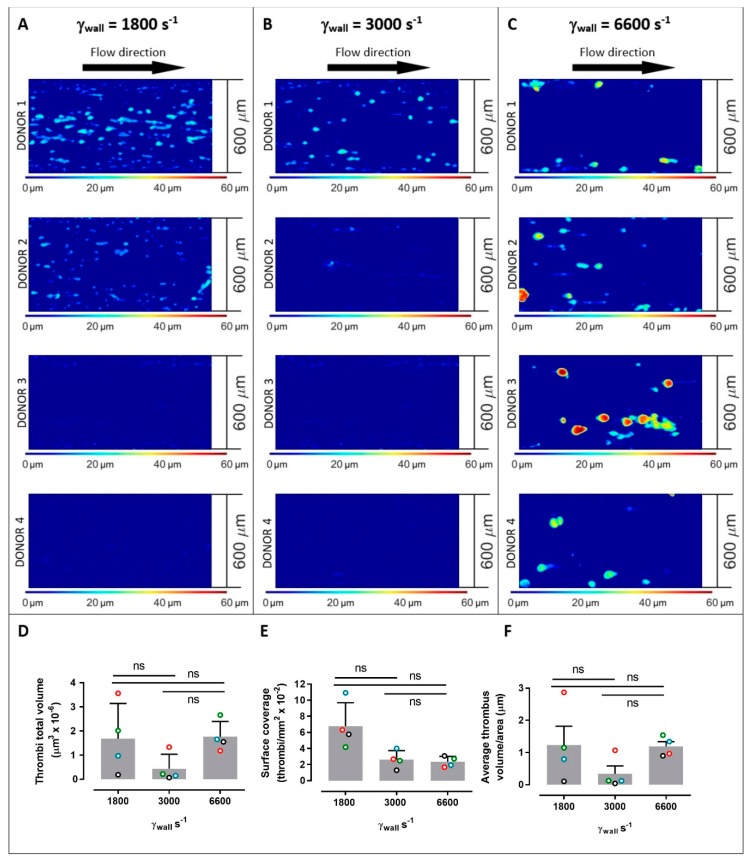
Thrombus formation in hemostasis or thrombotic disease is initiated by the rapid adhesion, activation, and aggregation of circulating platelets in flowing blood. At arterial or pathological shear rates, for example due to vascular stenosis or circulatory support devices, platelets may be exposed to highly pulsatile blood flow, while even under constant flow platelets are exposed to pulsation due to thrombus growth or changes in vessel geometry. The aim of this study is to investigate platelet thrombus formation dynamics within flow conditions consisting of either constant or variable shear. Human platelets in anticoagulated whole blood were exposed ex vivo to collagen type I-coated microchannels subjected to constant shear in straight channels or variable shear gradients using different stenosis geometries (50%, 70%, and 90% by area). Base wall shears between 1800 and 6600 s, and peak wall shears of 3700 to 29,000 s within stenoses were investigated, representing arterial-pathological shear conditions. Computational flow-field simulations and stenosis platelet thrombi total volume, average volume, and surface coverage were analysed. Interestingly, shear gradients dramatically changed platelet thrombi formation compared to constant base shear alone. Such shear gradients extended the range of shear at which thrombi were formed, that is, platelets became hyperthrombotic within shear gradients. Furthermore, individual healthy donors displayed quantifiable differences in extent/formation of thrombi within shear gradients, with implications for future development and testing of antiplatelet agents. In conclusion, here, we demonstrate a specific contribution of blood flow shear gradients to thrombus formation, and provide a novel platform for platelet functional testing under shear conditions.
止血或血栓性疾病中的血栓形成是由循环血小板在流动血液中的快速黏附、激活和聚集引发的。例如,在动脉或病理切变率下,由于血管狭窄或循环支持装置,血小板可能会暴露于高度脉动的血流中,而即使在恒定流动下,由于血栓生长或血管几何形状的变化,血小板也会受到脉动的影响。本研究的目的是研究在恒定或变化的切变条件下血小板血栓形成的动力学。在体外,将抗凝全血中的人血小板暴露于涂有 I 型胶原的微通道中,这些微通道在直通道中或使用不同狭窄几何形状(面积的 50%、70%和 90%)产生可变切变梯度。研究了基底壁切变率在 1800 到 6600 s 之间,狭窄处的峰值壁切变率在 3700 到 29000 s 之间,代表动脉病理切变条件。分析了计算的流场模拟和狭窄处血小板血栓的总体积、平均体积和表面积覆盖率。有趣的是,与单独的恒定基底切变相比,切变梯度极大地改变了血小板血栓的形成。这种切变梯度扩展了形成血栓的切变范围,也就是说,血小板在切变梯度内变得过度血栓形成。此外,个体健康供体在切变梯度内血栓形成的程度/形成方面显示出可量化的差异,这对未来抗血小板药物的开发和测试具有重要意义。总之,我们在这里证明了血流切变梯度对血栓形成的特定贡献,并为在切变条件下进行血小板功能测试提供了一个新的平台。