Section of Infection and Immunity, Herman Ostrow School of Dentistry, Norris Comprehensive Cancer Center, University of Southern California, 925 W 34th Street, Los Angeles, CA 90089, USA.
Viruses. 2019 Jun 21;11(6):572. doi: 10.3390/v11060572.
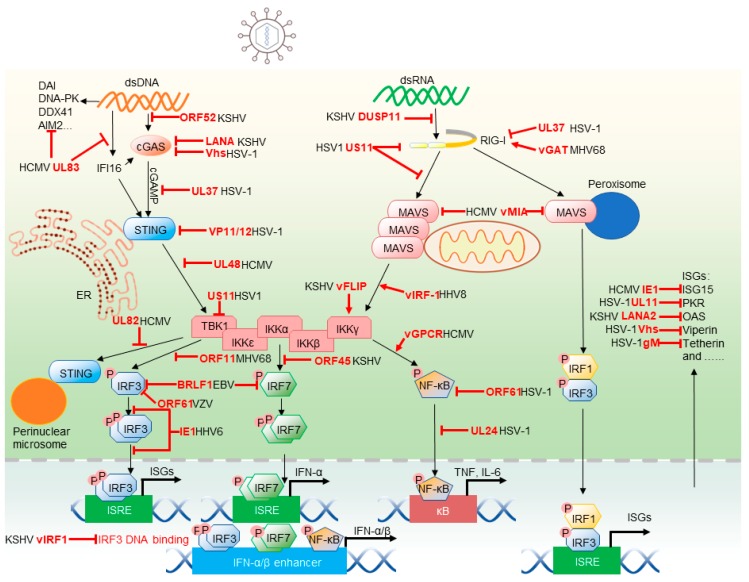
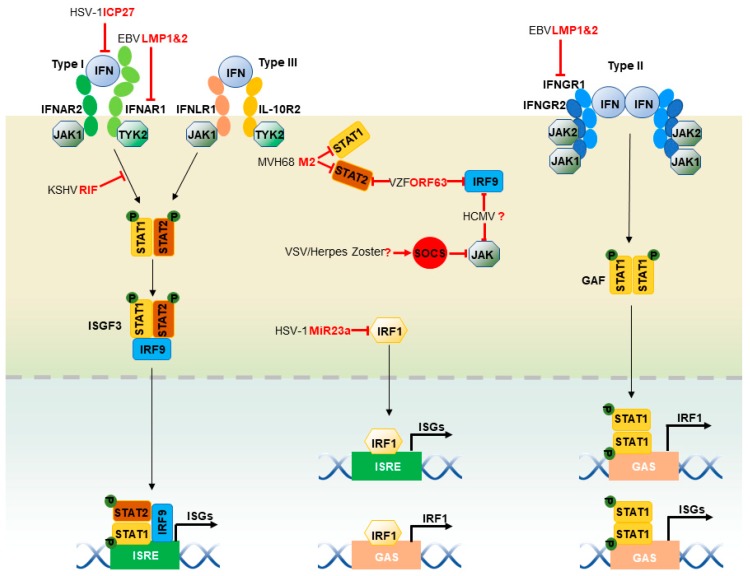
Herpesviruses can be detected by pattern recognition receptors (PRRs), which then activate downstream adaptors, kinases and transcription factors (TFs) to induce the expression of interferons (IFNs) and inflammatory cytokines. IFNs further activate the Janus kinase-signal transducer and activator of transcription (JAK-STAT) pathway, inducing the expression of interferon-stimulated genes (ISGs). These signaling events constitute host innate immunity to defeat herpesvirus infection and replication. A hallmark of all herpesviruses is their ability to establish persistent infection in the presence of active immune response. To achieve this, herpesviruses have evolved multiple strategies to suppress or exploit host innate immune signaling pathways to facilitate their infection. This review summarizes the key host innate immune components and their regulation by herpesviruses during infection. Also we highlight unanswered questions and research gaps for future perspectives.
疱疹病毒可以被模式识别受体(PRRs)检测到,然后这些受体激活下游衔接蛋白、激酶和转录因子(TFs),诱导干扰素(IFNs)和炎症细胞因子的表达。IFNs 进一步激活 Janus 激酶-信号转导和转录激活因子(JAK-STAT)途径,诱导干扰素刺激基因(ISGs)的表达。这些信号事件构成了宿主固有免疫,以抵抗疱疹病毒感染和复制。所有疱疹病毒的一个显著特征是它们在存在活跃免疫反应的情况下能够建立持续性感染。为了实现这一目标,疱疹病毒已经进化出多种策略来抑制或利用宿主固有免疫信号通路,以促进其感染。本综述总结了宿主固有免疫的关键成分及其在感染过程中被疱疹病毒的调控。我们还强调了未来研究中需要回答的问题和研究空白。