1Faculty of Sciences, Laboratory of Plant Physiology, University of Neuchâtel, 2000 Neuchâtel, Switzerland.
2Faculty of Sciences, Chemical Analytical Service of the Swiss Plant Science Web, Neuchâtel Platform for Analytical Chemistry (NPAC), University of Neuchâtel, 2000 Neuchâtel, Switzerland.
Commun Biol. 2019 Jun 20;2:220. doi: 10.1038/s42003-019-0477-4. eCollection 2019.
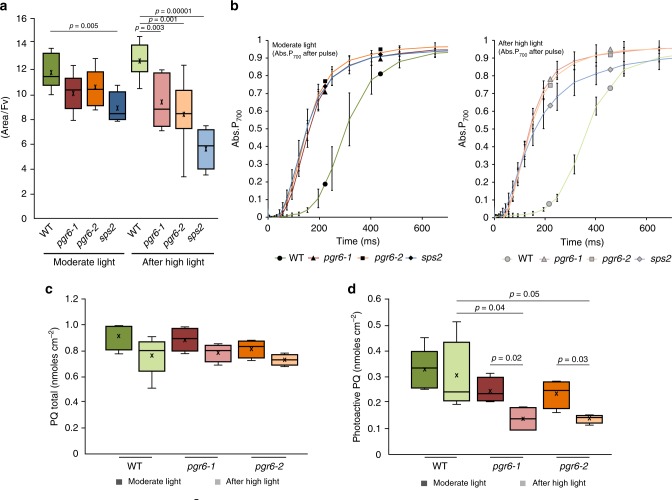
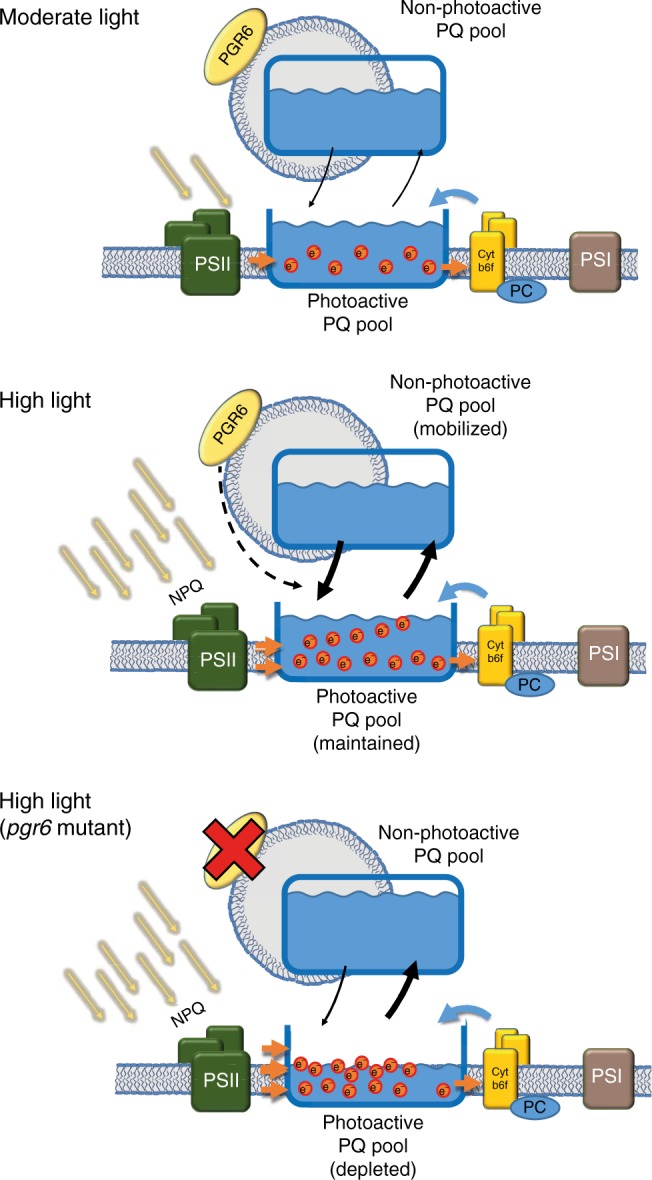
Photosynthesis produces organic carbon via a light-driven electron flow from HO to CO that passes through a pool of plastoquinone molecules. These molecules are either present in the photosynthetic thylakoid membranes, participating in photochemistry (photoactive pool), or stored (non-photoactive pool) in thylakoid-attached lipid droplets, the plastoglobules. The photoactive pool acts also as a signal of photosynthetic activity allowing the adaptation to changes in light condition. Here we show that, in , proton gradient regulation 6 (PGR6), a predicted atypical kinase located at plastoglobules, is required for plastoquinone homoeostasis, i.e. to maintain the photoactive plastoquinone pool. In a mutant, the photoactive pool is depleted and becomes limiting under high light, affecting short-term acclimation and photosynthetic efficiency. In the long term, seedlings fail to adapt to high light and develop a conditional variegated leaf phenotype. Therefore, PGR6 activity, by regulating plastoquinone homoeostasis, is required to cope with high light.
光合作用通过从 H2O 到 CO 的光驱动电子流产生有机碳,该电子流穿过质体醌分子池。这些分子要么存在于光合类囊体膜中,参与光化学反应(光活性池),要么储存在与类囊体相连的脂滴(质体小球)中,即质体小球。光活性池还充当光合作用活性的信号,允许适应光条件的变化。在这里,我们表明,在 中,位于质体小球上的预测非典型激酶质子梯度调节 6(PGR6)对于质体醌同型平衡是必需的,即维持光活性质体醌池。在 突变体中,光活性池耗尽,在高光下变得有限,影响短期适应和光合作用效率。从长远来看, 幼苗无法适应高光并表现出条件斑驳叶表型。因此,PGR6 活性通过调节质体醌同型平衡来应对高光。