Department of Bacteriology and Epidemiology, Wageningen Bioveterinary Research, Lelystad, the Netherlands.
Department of Infectious Diseases and Immunology, Faculty of Veterinary Medicine, Utrecht University, Utrecht, the Netherlands.
Euro Surveill. 2019 Jun;24(25). doi: 10.2807/1560-7917.ES.2019.24.25.1800438.
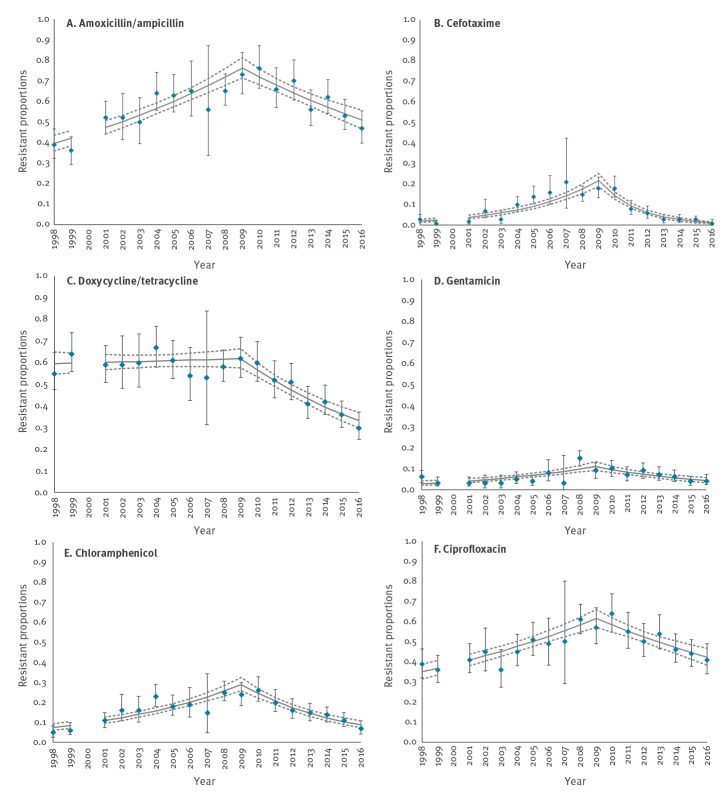
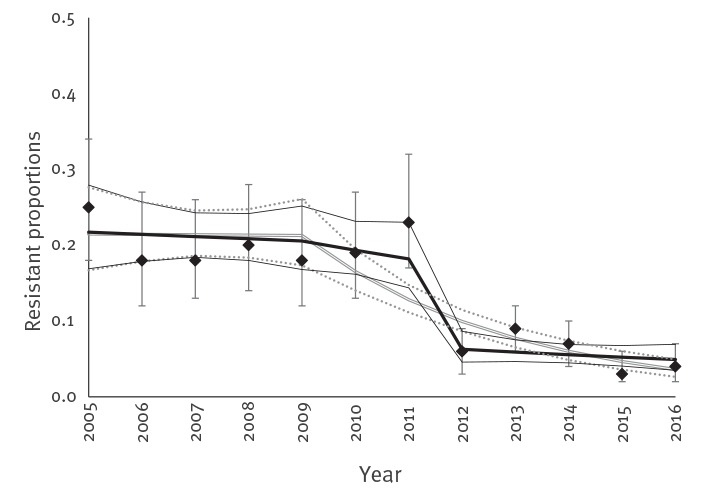
BackgroundMonitoring of antimicrobial resistance (AMR) in animals is essential for public health surveillance. To enhance interpretation of monitoring data, evaluation and optimisation of AMR trend analysis is needed.AimsTo quantify and evaluate trends in AMR in commensal , using data from the Dutch national AMR monitoring programme in livestock (1998-2016).MethodsFaecal samples were collected at slaughter from broilers, pigs and veal calves. Minimum inhibitory concentration values were obtained by broth microdilution for for 15 antimicrobials of eight antimicrobial classes. A Poisson regression model was applied to resistant isolate counts, with explanatory variables representing time before and after 2009 (reference year); for veal calves, sampling changed from 2012 represented by an extra explanatory variable.ResultsResistant counts increased significantly from 1998-2009 in broilers and pigs, except for tetracyclines and sulfamethoxazole in broilers and chloramphenicol and aminoglycosides in pigs. Since 2009, resistant counts decreased for all antimicrobials in broilers and for all but the phenicols in pigs. In veal calves, for most antimicrobials no significant decrease in resistant counts could be determined for 2009-16, except for sulfamethoxazole and nalidixic acid. Within animal species, antimicrobial-specific trends were similar.ConclusionsUsing Dutch monitoring data from 1998-2016, this study quantified AMR trends in broilers and slaughter pigs and showed significant trend changes in the reference year 2009. We showed that monitoring in commensal useful to quantify trends and detect trend changes in AMR. This model is applicable to similar data from other European countries.
背景
对动物的抗菌药物耐药性(AMR)进行监测对于公共卫生监测至关重要。为了增强对监测数据的解释,需要评估和优化 AMR 趋势分析。
目的
利用荷兰家畜抗菌药物耐药性监测计划(1998-2016 年)的数据,量化并评估共生动物 AMR 的趋势。
方法
从肉鸡、猪和小牛肉牛屠宰时采集粪便样本。通过肉汤微量稀释法获得 15 种抗菌药物的最小抑菌浓度值,这些药物来自 8 个抗菌药物类别。采用泊松回归模型分析耐药分离株计数,解释变量代表 2009 年前后(参考年)的时间;对于小牛肉牛,2012 年采样发生变化,用一个额外的解释变量来表示。
结果
1998-2009 年,肉鸡和猪的耐药分离株计数显著增加,除了肉鸡中的四环素和磺胺甲恶唑以及猪中的氯霉素和氨基糖苷类。自 2009 年以来,除了猪中的苯氧青霉素类和氨基糖苷类外,肉鸡中所有抗菌药物和猪中除了苯氧青霉素类之外的所有抗菌药物的耐药分离株计数均下降。在小牛肉牛中,除了磺胺甲恶唑和萘啶酸外,2009-2016 年期间,大多数抗菌药物的耐药分离株计数没有明显下降。在不同的动物物种中,抗菌药物特异性趋势相似。
结论
本研究利用 1998-2016 年荷兰监测数据,量化了肉鸡和屠宰猪的 AMR 趋势,并在参考年 2009 年显示出显著的趋势变化。我们表明,在共生动物中进行监测有助于量化 AMR 趋势并检测趋势变化。该模型适用于来自其他欧洲国家的类似数据。