Department of Computational Biology, University of Lausanne, Lausanne, Switzerland.
SIB Swiss Institute of Bioinformatics, Lausanne, Switzerland.
Mol Biol Evol. 2019 Oct 1;36(10):2157-2164. doi: 10.1093/molbev/msz150.
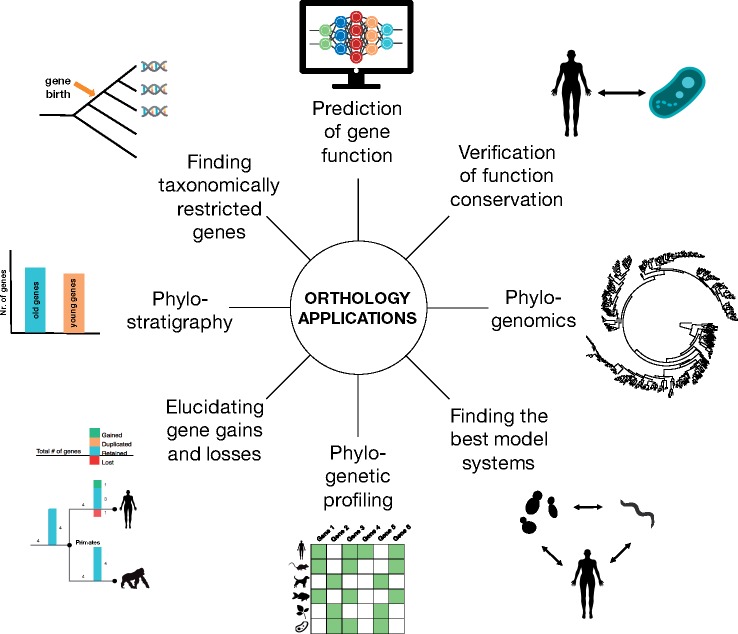
Gene families evolve by the processes of speciation (creating orthologs), gene duplication (paralogs), and horizontal gene transfer (xenologs), in addition to sequence divergence and gene loss. Orthologs in particular play an essential role in comparative genomics and phylogenomic analyses. With the continued sequencing of organisms across the tree of life, the data are available to reconstruct the unique evolutionary histories of tens of thousands of gene families. Accurate reconstruction of these histories, however, is a challenging computational problem, and the focus of the Quest for Orthologs Consortium. We review the recent advances and outstanding challenges in this field, as revealed at a symposium and meeting held at the University of Southern California in 2017. Key advances have been made both at the level of orthology algorithm development and with respect to coordination across the community of algorithm developers and orthology end-users. Applications spanned a broad range, including gene function prediction, phylostratigraphy, genome evolution, and phylogenomics. The meetings highlighted the increasing use of meta-analyses integrating results from multiple different algorithms, and discussed ongoing challenges in orthology inference as well as the next steps toward improvement and integration of orthology resources.
基因家族通过物种形成(产生同源基因)、基因复制(产生旁系同源基因)和水平基因转移(产生异源基因)以及序列分歧和基因丢失等过程进化。同源基因在比较基因组学和系统基因组分析中起着至关重要的作用。随着生命之树中越来越多的生物被测序,我们获得了重建数万个基因家族独特进化历史的数据。然而,准确重建这些历史是一个具有挑战性的计算问题,也是 Quest for Orthologs 联盟的重点。我们回顾了 2017 年在南加州大学举行的研讨会和会议上揭示的该领域的最新进展和突出挑战。在同源基因算法开发和算法开发者社区以及同源基因最终用户之间的协调方面都取得了重要进展。应用范围广泛,包括基因功能预测、系统发生年代学、基因组进化和系统基因组学。会议强调了越来越多地使用整合来自多个不同算法的结果的荟萃分析,并讨论了同源基因推断中持续存在的挑战,以及朝着改进和整合同源基因资源的下一步发展。