ZIEL-Institute for Food & Health, TUM School of Life Sciences Weihenstephan, Technical University of Munich, 85354 Freising, Germany.
Fraunhofer Institute for Process Engineering and Packaging (IVV), 85354 Freising, Germany.
Nutrients. 2019 Jun 25;11(6):1424. doi: 10.3390/nu11061424.
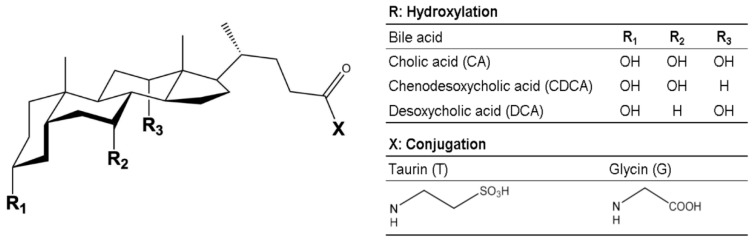
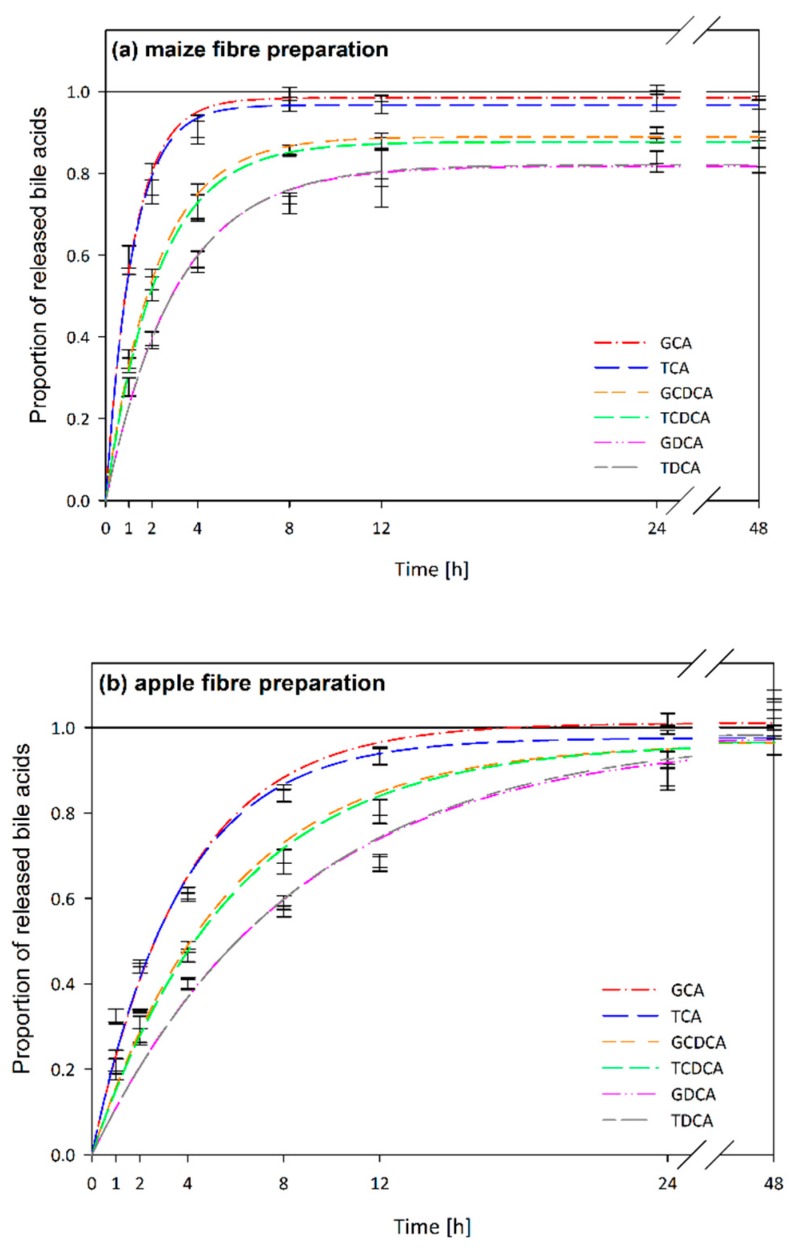
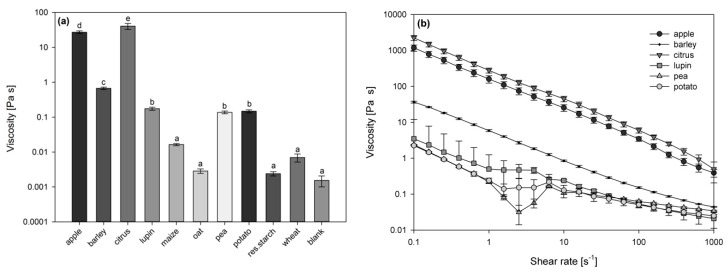
Dietary fibres are reported to interact with bile acids, preventing their reabsorption and promoting their excretion into the colon. We used a method based on in vitro digestion, dialysis, and kinetic analysis to investigate how dietary fibre enriched food ingredients affect the release of primary and secondary bile acids as related to viscosity and adsorption. As the main bile acids abundant in humans interactions with glyco- and tauroconjugated cholic acid, chenodesoxycholic acid and desoxycholic acid were analysed. Viscous interactions were detected for apple, barley, citrus, lupin, pea, and potato derived ingredients, which slowed the bile acid release rate by up to 80%. Adsorptive interactions of up to 4.7 μmol/100 mg DM were significant in barley, oat, lupin, and maize preparations. As adsorption directly correlated to the hydrophobicity of the bile acids the hypothesis of a hydrophobic linkage between bile acids and dietary fibre is supported. Delayed diffusion in viscous fibre matrices was further associated with the micellar properties of the bile acids. As our results indicate changes in the bile acid pool size and composition due to interactions with dietary fibre rich ingredients, the presented method and results could add to recent fields of bile acid research.
膳食纤维据报道可与胆汁酸相互作用,防止其重吸收并促进其排入结肠。我们使用了一种基于体外消化、透析和动力学分析的方法,研究了富含膳食纤维的食物成分如何影响主要和次要胆汁酸的释放,这与它们的粘性和吸附有关。作为人类中丰富的主要胆汁酸,分析了甘氨和牛磺结合的胆酸、鹅脱氧胆酸和脱氧胆酸的相互作用。苹果、大麦、柑橘、羽扇豆、豌豆和土豆来源的成分表现出粘性相互作用,将胆汁酸的释放速率减缓了多达 80%。大麦、燕麦、羽扇豆和玉米制剂中存在高达 4.7 μmol/100 mg DM 的吸附相互作用。由于吸附直接与胆汁酸的疏水性相关,因此支持胆汁酸与膳食纤维之间存在疏水键的假设。粘性纤维基质中扩散的延迟进一步与胆汁酸的胶束性质有关。由于我们的结果表明,由于与富含膳食纤维的成分相互作用,胆汁酸库的大小和组成发生了变化,因此所提出的方法和结果可以补充最近的胆汁酸研究领域。