Dept of Chemical Engineering and Russell Berrie Nanotechnology Institute, Technion - Israel Institute of Technology, Haifa, Israel.
Inserm UMR_S 999, Hôpital Marie Lannelongue, Le Plessis-Robinson, France.
Eur Respir Rev. 2019 Jun 26;28(152). doi: 10.1183/16000617.0002-2019. Print 2019 Jun 30.
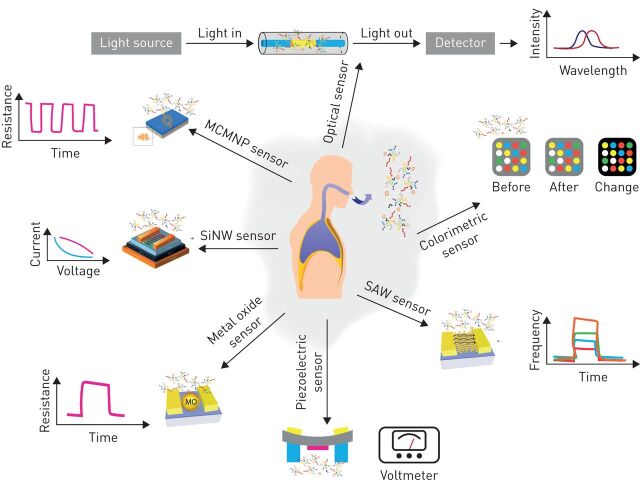
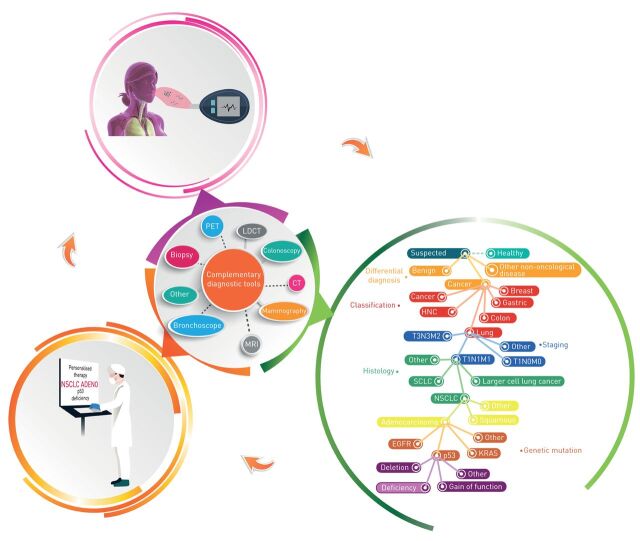
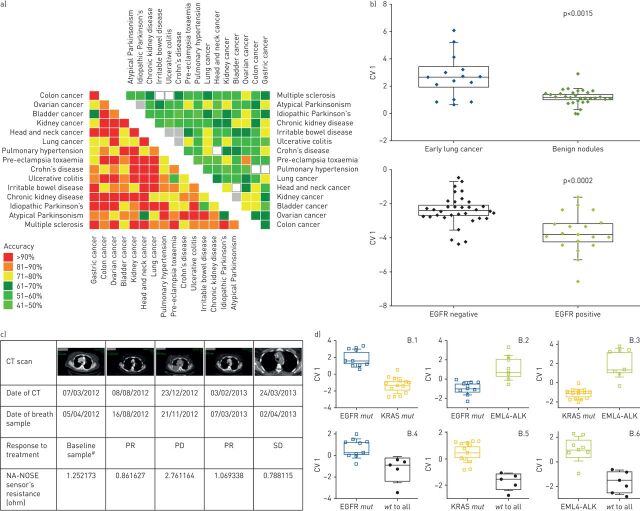
Most of the currently used diagnostics for cancerous diseases have yet to meet the standards of screening, as they are insufficiently accurate and/or invasive and risky. In this review, we describe the rationale, the progress made to date, and the potential of analysing the exhaled volatile organic compounds as a pathway for enabling early diagnosis of cancer and, therefore, for achieving better clinical prognosis and survival rates. The review highlights the major advancements made in this field, from fundamentals, up to translational phases and clinical trials, with a special emphasis on sensing platforms based on nanomaterials. The prospects for breath analysis in early cancerous disease are presented and discussed.
目前用于癌症诊断的大多数方法都尚未达到筛查的标准,因为它们的准确性和/或侵入性和风险性不足。在这篇综述中,我们描述了分析呼气挥发性有机化合物作为实现癌症早期诊断的途径的基本原理、迄今为止取得的进展和潜力,从而实现更好的临床预后和生存率。该综述重点介绍了该领域从基础到转化阶段和临床试验的主要进展,特别强调了基于纳米材料的传感平台。还提出并讨论了呼气分析在早期癌症疾病中的应用前景。