Institute of Environmental Sciences, Jagiellonian University, Gronostajowa 7, 30-387, Kraków, Poland.
Institute of Nature Conservation, Polish Academy of Sciences, Mickiewicza 33, 31-120, Kraków, Poland.
Environ Sci Pollut Res Int. 2019 Aug;26(24):24933-24945. doi: 10.1007/s11356-019-05753-3. Epub 2019 Jun 26.
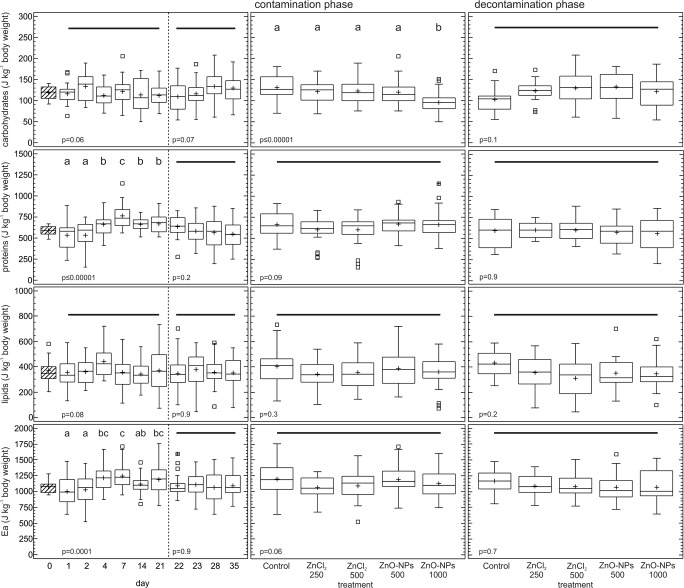
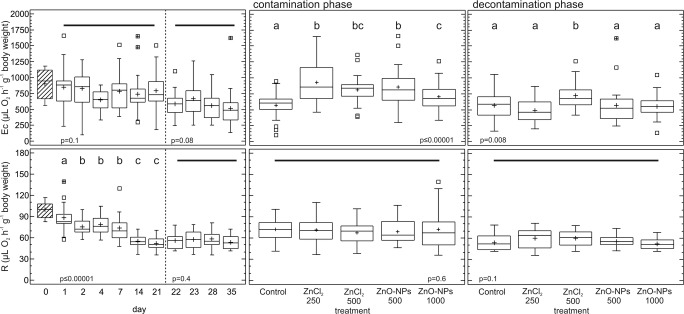
The energy budget is an indicator of an organism's overall condition. Changes in energy reserves and/or energy consumption have been used as biomarkers of toxic stress. To understand the effects of different forms and concentrations of Zn and the costs of effective Zn regulation by the earthworm Eisenia andrei, we performed a toxicokinetic experiment in which individuals were sampled over time to determine the available energy reserves (total carbohydrate, protein, and lipid content), energy consumption (measured at the cellular level and as the whole-animal respiration rate), and internal Zn concentration. The earthworms were exposed to ZnCl or zinc nanoparticles (ZnO-NPs) in Lufa 2.2 soil for 21 days (contamination phase), followed by 14 days of elimination in clean soil (decontamination phase). Carbohydrates were the only energy reserves with significantly lower levels following ZnO-NP 1000 treatment than following other treatments (p ≤ 0.00001) in the contamination phase. The total available energy reserves and protein content did not differ among treatments, but a significant effect of exposure time was observed (p ≤ 0.0001). Exposure to Zn (both ions and NPs) increased energy consumption at the cellular level, reflecting the high energy demand of the stress response. The results indicated that E. andrei can regulate internal Zn concentrations efficiently, regardless of form or concentration, without considerable impact on energy reserves or respiration rate.
能量预算是生物体整体状况的一个指标。能量储备和/或能量消耗的变化已被用作毒性应激的生物标志物。为了了解不同形式和浓度的 Zn 以及蚯蚓 Eisenia andrei 对有效 Zn 调节的成本的影响,我们进行了一项毒代动力学实验,在该实验中,随着时间的推移对个体进行采样,以确定可用的能量储备(总碳水化合物、蛋白质和脂质含量)、能量消耗(在细胞水平上测量和作为整个动物呼吸率)和内部 Zn 浓度。将蚯蚓暴露于 ZnCl 或锌纳米粒子 (ZnO-NPs) 在 Lufa 2.2 土壤中 21 天(污染阶段),然后在清洁土壤中进行 14 天的消除(脱污染阶段)。在污染阶段,与其他处理相比,只有碳水化合物在 ZnO-NP 1000 处理后能量储备水平显著降低(p ≤ 0.00001)。总可用能量储备和蛋白质含量在处理之间没有差异,但暴露时间有显著影响(p ≤ 0.0001)。暴露于 Zn(离子和 NPs)会增加细胞水平的能量消耗,反映出应激反应的高能量需求。结果表明,E. andrei 可以有效地调节内部 Zn 浓度,无论形式或浓度如何,而不会对能量储备或呼吸率产生显著影响。