Department of Chemical & Biomolecular Engineering, University of Notre Dame, Notre Dame, IN 46556 USA.
Theranostics. 2019 May 15;9(11):3017-3040. doi: 10.7150/thno.31913. eCollection 2019.
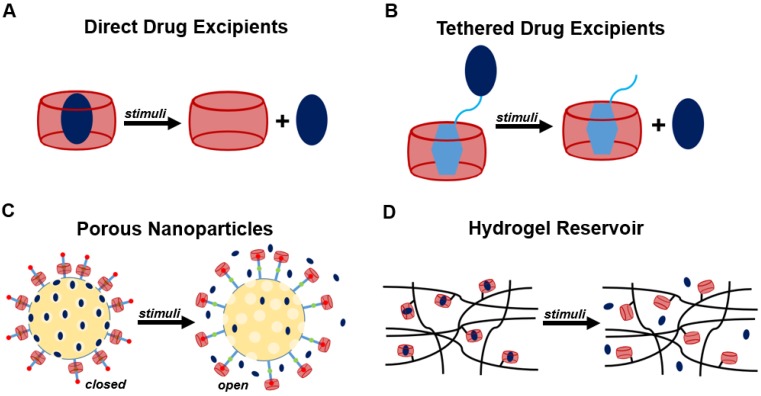
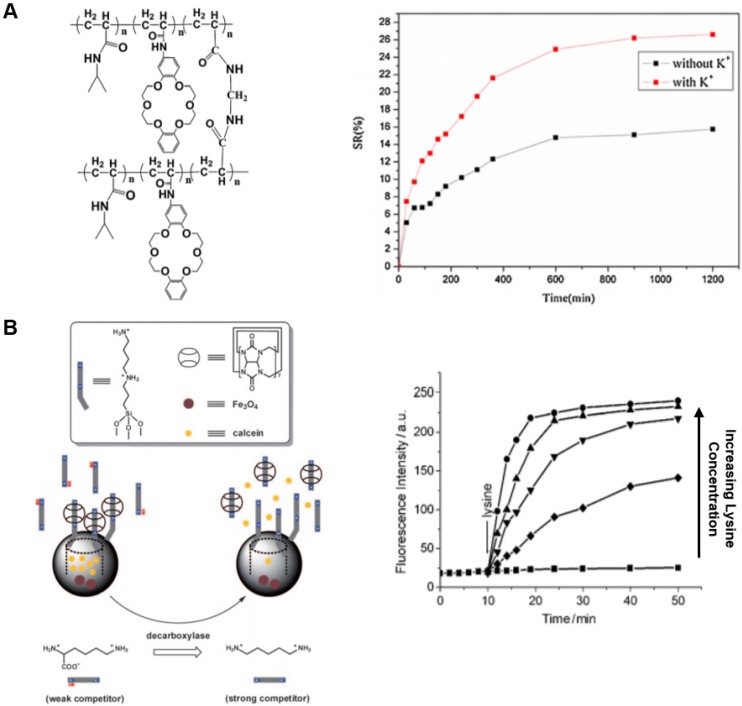
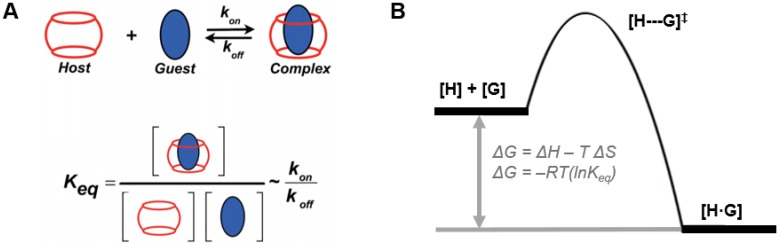
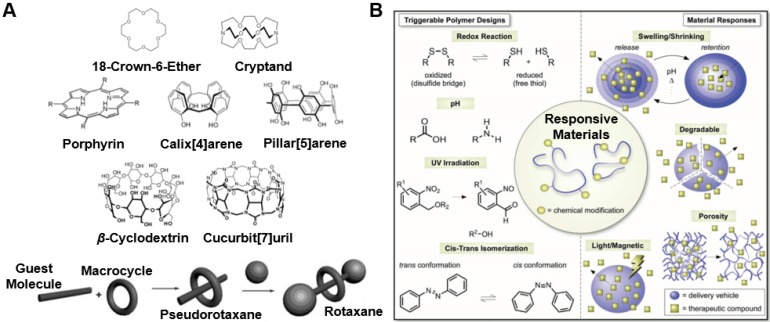
Host-guest motifs are likely the most recognizable manifestation of supramolecular chemistry. These complexes are characterized by the organization of small molecules on the basis of preferential association of a guest within the portal of a host. In the context of their therapeutic use, the primary application of these complexes has been as excipients which enhance the solubility or improve the stability of drug formulations, primarily in a vial. However, there may be opportunities to go significantly beyond such a role and leverage key features of the affinity, specificity, and dynamics of the interaction itself toward "smarter" therapeutic designs. One approach in this regard would seek stimuli-responsive host-guest recognition, wherein a complex forms in a manner that is sensitive to, or can be governed by, externally applied triggers, disease-specific proteins and analytes, or the presence of a competing guest. This review will highlight the general and phenomenological design considerations governing host-guest recognition and the specific types of chemistry which have been used and are available for different applications. Finally, a discussion of the molecular engineering and design approaches which enable sensitivity to a variety of different stimuli are highlighted. Ultimately, these molecular-scale approaches offer an assortment of new chemistry and material design tools toward improving precision in drug delivery.
主体-客体结构基元可能是超分子化学最具代表性的体现。这些配合物的特点是根据客体在主体的入口处的优先结合,组织小分子。在治疗用途方面,这些配合物的主要应用一直是作为赋形剂,以提高药物制剂的溶解度或改善其稳定性,主要是在小瓶中。然而,可能有机会大大超越这种作用,并利用相互作用本身的亲和力、特异性和动态性的关键特征,实现“更智能”的治疗设计。在这方面的一种方法是寻求对刺激有响应的主体-客体识别,其中配合物以对外部施加的触发因素、疾病特异性蛋白质和分析物敏感的方式形成,或者可以受其控制,或者存在竞争客体。这篇综述将重点介绍控制主体-客体识别的一般和现象学设计考虑因素,以及已用于不同应用的特定类型的化学。最后,讨论了能够对各种不同刺激产生敏感性的分子工程和设计方法。最终,这些分子尺度的方法提供了一系列新的化学和材料设计工具,以提高药物输送的精度。