Asiri Mohammed, Alokby Ghassan
Otolaryngology, King Abdulaziz Medical City, Ministry of National Guard Health Affairs, Riyadh, SAU.
Otolaryngology, Prince Sultan Military Medical City, Riyadh, SAU.
Cureus. 2019 Apr 12;11(4):e4447. doi: 10.7759/cureus.4447.
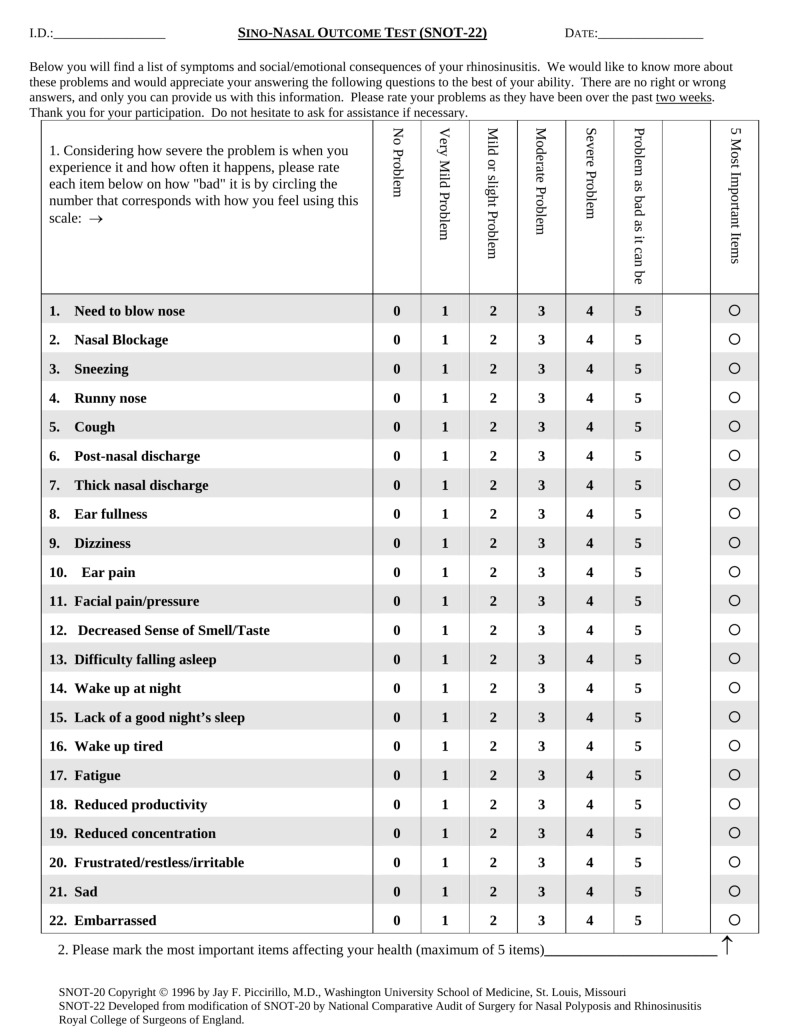
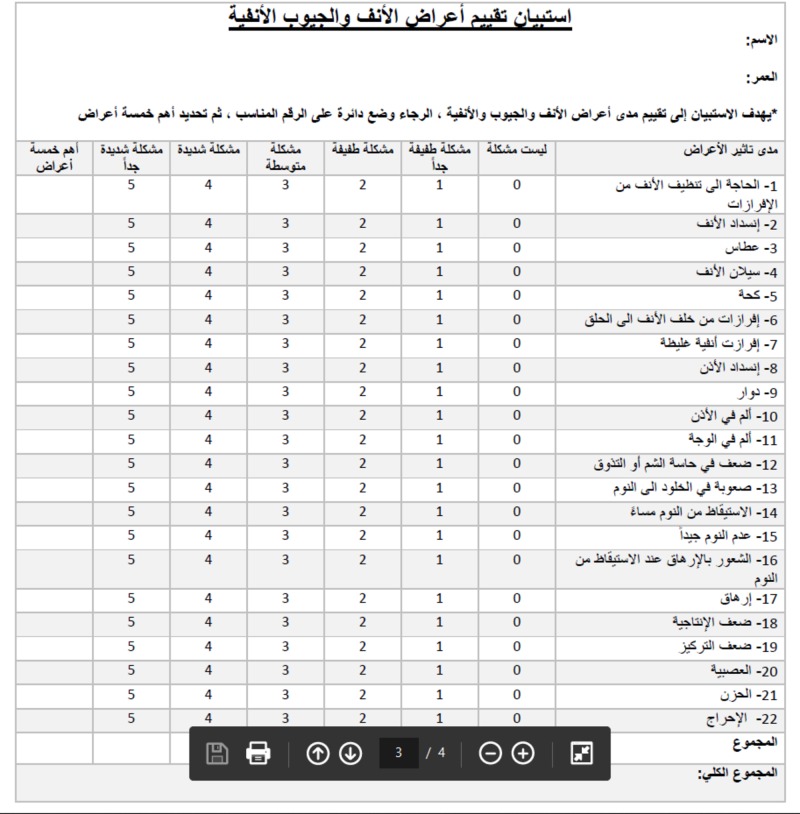
Background and objective Quality of life measurement is an essential element of healthcare evaluation. The Sino-Nasal Outcome Test 22 (SNOT-22) has been validated in different languages, and in this study we validated the SNOT-22 in Arabic language. The objective of this study is to provide a validated, cross-culturally adapted version of the SNOT-22 for the Arabic speaking population. Materials, methods, and main outcome measures This was a prospective cohort study set in a tertiary hospital in Riyadh, Saudi Arabia. The SNOT-22 was translated into Arabic by two native Arabic speakers. A total of 30 patients with chronic rhinosinusitis (CRS) with/without nasal polyps were included in test-retest study. Following that, a prospective study was conducted where the translated SNOT-22 was distributed to a different set of 30 CRS patients before and three months after endoscopic sinus surgery. Another 50 healthy individuals were included as a control group. The main outcome measure was the translation and validation of the SNOT-22 in Arabic. Results Internal consistency was assessed by performing a test-retest study. Cronbach's alpha was 0.803 at both the initial examination and at the retest, showing good internal consistency. There was a statistically significant difference between the results of the control group and the preoperative results of the CRS group (p<.001). The preoperative mean (SD) SNOT-22 score for the CRS group was 64.8 (20.3) and it dropped to 29.2 (11.8) postoperatively showing statistically significant change (p<.001), indicating the responsiveness of the SNOT-22. Conclusion The Arabic version of the SNOT-22 has internal consistency, reliability, and reproducibility that is needed for it to be a valid instrument to be used in research and clinical practice.
背景与目的 生活质量测量是医疗保健评估的重要组成部分。鼻-鼻窦结局测试22(SNOT-22)已在多种语言中得到验证,在本研究中,我们对阿拉伯语版的SNOT-22进行了验证。本研究的目的是为讲阿拉伯语的人群提供一个经过验证的、跨文化适应的SNOT-22版本。材料、方法及主要结局指标 这是一项在沙特阿拉伯利雅得一家三级医院开展的前瞻性队列研究。SNOT-22由两名以阿拉伯语为母语的人翻译成阿拉伯语。共有30例患有/不患有鼻息肉的慢性鼻-鼻窦炎(CRS)患者纳入重测研究。在此之后,进行了一项前瞻性研究,将翻译后的SNOT-22分发给另一组30例CRS患者,分别在鼻内镜鼻窦手术前和术后三个月进行。另外纳入50名健康个体作为对照组。主要结局指标是SNOT-22阿拉伯语版的翻译与验证。结果 通过重测研究评估内部一致性。初次检查和重测时的Cronbach's α均为0.803,显示出良好的内部一致性。对照组与CRS组术前结果之间存在统计学显著差异(p<0.001)。CRS组术前SNOT-22平均(标准差)评分为64.8(20.3),术后降至29.2(11.8),显示出统计学显著变化(p<0.001),表明SNOT-22具有反应性。结论 SNOT-22阿拉伯语版具有内部一致性、可靠性和可重复性,使其成为可用于研究和临床实践的有效工具。