Tsuyuki Kenichiro, Yano Kazuo, Watanabe Natsumi, Aruga Atsushi, Yamato Masayuki
Cooperative Major in Advanced Biomedical Sciences, Joint Graduate School of Tokyo Women's Medical University and Waseda University, 8-1 Kawada-cho, Shinjuku-ku, Tokyo 162-8666, Japan.
Institute of Advanced Biomedical Engineering and Science, Tokyo Women's Medical University, 8-1 Kawada-cho, Shinjuku-ku, Tokyo 162-8666, Japan.
Regen Ther. 2016 Feb 15;4:18-26. doi: 10.1016/j.reth.2015.11.002. eCollection 2016 Jun.
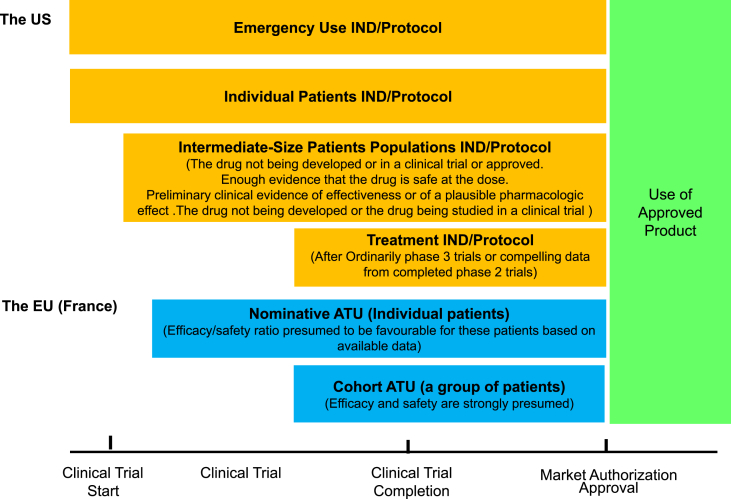
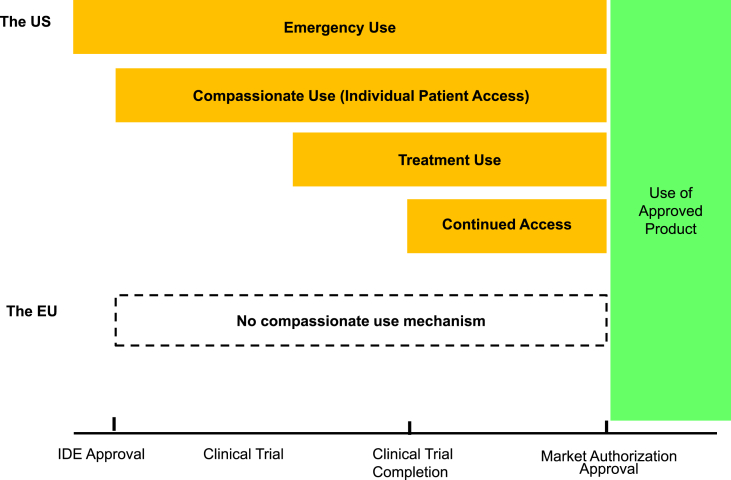
Compassionate use, also called expanded access, provides an important pathway for patients with life-threatening conditions to gain access to unapproved investigational drugs, biologics and medical devices. Although the United States (US) and the countries of the Europe Union (EU) have mechanisms that are associated with the use of unapproved products, as of May 2015 there was no such mechanism in Japan. Instead, unapproved products are used under a physician's discretion in conjunction with the Japan Medical Practitioners' Act or Advanced Medical Care B. However, there are some issues and questions to consider under the current circumstances in Japan as follows: (A) it is difficult for the local regulator to monitor the use of unapproved products; (B) there is no information collected on the safety of these products to protect patients; (C) it is difficult to assure the quality of the products; (D) it is difficult for patients to obtain detailed information about unapproved products and their availability; and (E) it is not clear who should cover the cost of the unapproved products. In this paper, we assess the current compassionate use, or expanded access-related mechanisms, of the US, the EU and Japan in regard to drugs, medical devices and biologics, including human cells and tissue products, and discuss the benefits and issues of these mechanisms. The purpose of these mechanisms is principally to save patients with life-threatening condition. However, the information obtained after the compassionate use is potentially useful to facilitate marketing authorization. In fact, the data from compassionate use cases are employed in some approval review reports to indicate the product safety.
同情用药,也称为扩大使用途径,为患有危及生命疾病的患者提供了获取未经批准的研究性药物、生物制品和医疗器械的重要途径。尽管美国和欧盟国家设有与使用未经批准产品相关的机制,但截至2015年5月,日本尚无此类机制。取而代之的是,未经批准的产品在医生的酌情决定下,依据《日本医师法》或《先进医疗保健B》使用。然而,在日本当前的情况下,有一些问题和事项需要考虑,如下所述:(A)当地监管机构难以监测未经批准产品的使用情况;(B)没有收集这些产品安全性的信息以保护患者;(C)难以确保产品质量;(D)患者难以获取有关未经批准产品及其可用性的详细信息;以及(E)不清楚谁应承担未经批准产品的费用。在本文中,我们评估了美国、欧盟和日本目前在药物、医疗器械和生物制品(包括人类细胞和组织产品)方面的同情用药或扩大使用途径相关机制,并讨论了这些机制的益处和问题。这些机制的主要目的是挽救患有危及生命疾病的患者。然而,同情用药后获得的信息可能有助于促进上市许可。事实上,一些批准审查报告中采用了同情用药案例的数据来表明产品安全性。