Instituto de Investigaciones en Ciencias de la Salud, Universidad Nacional de Asunción (IICS-UNA), San Lorenzo, Paraguay.
Hospital Materno Infantil de San Lorenzo, Ministerio de Salud Pública y Bienestar Social, San Lorenzo, Paraguay.
PLoS One. 2019 Jun 27;14(6):e0218016. doi: 10.1371/journal.pone.0218016. eCollection 2019.
Cervical cancer (CC) is one of the leading causes of cancer mortality among women from Paraguay, with high incidence and mortality rates (31.2 and 16 per 100 000 women, respectively). Although the risk factors associated with high-risk human papillomavirus (hrHPV) infection and preneoplastic cervical lesions are widely studied, population-based characteristics of particular settings may influence the feasibility of HPV-based CC screening implementation. This study aimed to explore factors associated with hrHPV infection and high-grade cervical neoplasia in hrHPV-positive (hrHPV+) women from Paraguay.
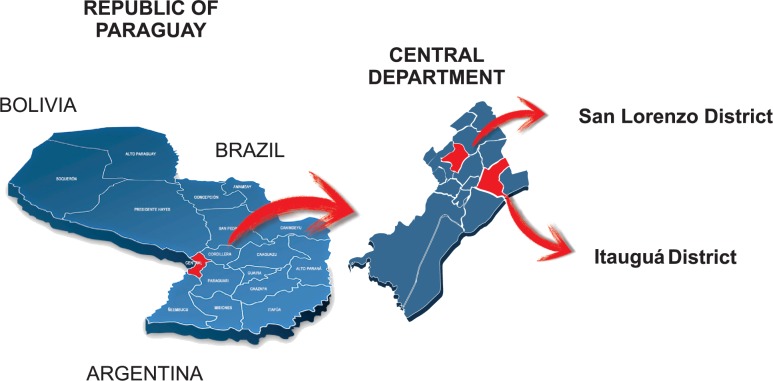
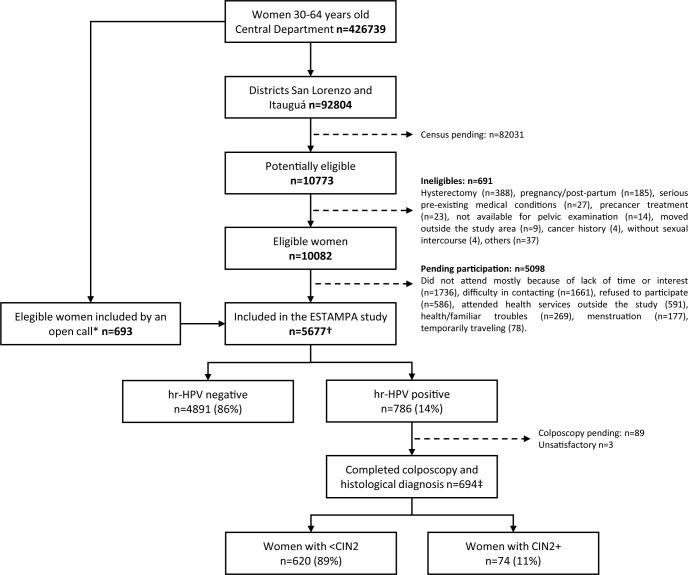
A total of 5677 women aged 30-64 years from the Central Department of Paraguay were screened with HPV test (Hybrid Capture 2) and Pap smear. Sociodemographic and risk factor interviews were conducted. hrHPV+ women were referred to colposcopy and women with an abnormal colposcopy had a biopsy taken. The outcomes recorded were the hrHPV status and the presence of high-grade cervical intraepithelial neoplasia or worse (CIN2+) among hrHPV+ women. Associations were investigated using multivariate logistic regressions.
hrHPV prevalence was 13.8% (95%CI 13.0-14.8). This value decreased with the age of women (p-trend<0.001) and increased with the lifetime number of sexual partners (p-trend<0.001) and number of previous female partners of their current male partner if women had had one lifetime sexual partner (p-trend<0.001), increasing from 3.06 (95%CI 0.073-20.9) if partners had had one previous female partner to 9.19 (95%CI 2.36-61.1) if they had had eight or more. In hrHPV+ women, CIN2+ prevalence was 10.7% (95%CI 8.58-13.2) and increased with time since the last Pap smear (p-trend<0.001) and with the increasing number of pregnancies (p-trend = 0.05).
In these settings, the sexual behavior of women and their male partners is associated with hrHPV infection. In hrHPV+ women, underscreening practices and multiple pregnancies are associated with CIN2+. This knowledge can contribute to public health policies for CC prevention and control in Paraguay.
宫颈癌(CC)是巴拉圭女性癌症死亡的主要原因之一,发病率和死亡率均较高(分别为 31.2 和 16 例/每 10 万女性)。尽管与高危型人乳头瘤病毒(hrHPV)感染和癌前宫颈病变相关的危险因素已得到广泛研究,但特定人群的人口统计学特征可能会影响基于 HPV 的 CC 筛查的实施可行性。本研究旨在探讨与巴拉圭 hrHPV 阳性(hrHPV+)女性的 hrHPV 感染和高级别宫颈病变相关的因素。
共对巴拉圭中央省 5677 名 30-64 岁的女性进行了 HPV 检测(杂交捕获 2 法)和巴氏涂片筛查。进行了社会人口学和危险因素访谈。对 hrHPV+ 女性进行阴道镜检查,如果阴道镜检查异常,则进行活检。记录的结果是 hrHPV+ 女性的 hrHPV 状态以及高级别宫颈上皮内瘤变或更高级别病变(CIN2+)的存在情况。使用多变量逻辑回归分析了相关性。
hrHPV 流行率为 13.8%(95%CI 13.0-14.8)。该值随女性年龄的增加而降低(p-趋势<0.001),随终生性伴侣数量的增加而增加(p-趋势<0.001),且随当前男性伴侣的前女性伴侣数量的增加而增加(如果女性有过一个性伴侣)(p-趋势<0.001),从有一个前女性伴侣的 3.06(95%CI 0.073-20.9)增加到有八个或更多前女性伴侣的 9.19(95%CI 2.36-61.1)。在 hrHPV+ 女性中,CIN2+ 的患病率为 10.7%(95%CI 8.58-13.2),并随上次巴氏涂片检查后的时间(p-趋势<0.001)和妊娠次数的增加而增加(p-趋势=0.05)。
在这些环境中,女性及其男性伴侣的性行为与 hrHPV 感染相关。在 hrHPV+ 女性中,筛查不足和多次妊娠与 CIN2+相关。这些知识可以为巴拉圭的 CC 预防和控制提供公共卫生政策依据。