• 文献检索
  • 文档翻译
  • 深度研究
  • 学术资讯
  • Suppr Zotero 插件Zotero 插件
  • 邀请有礼
  • 套餐&价格
  • 历史记录
应用&插件
Suppr Zotero 插件Zotero 插件浏览器插件Mac 客户端Windows 客户端微信小程序
定价
高级版会员购买积分包购买API积分包
服务
文献检索文档翻译深度研究API 文档MCP 服务
关于我们
关于 Suppr公司介绍联系我们用户协议隐私条款
关注我们

Suppr 超能文献

核心技术专利:CN118964589B侵权必究
粤ICP备2023148730 号-1Suppr @ 2026

文献检索

告别复杂PubMed语法,用中文像聊天一样搜索,搜遍4000万医学文献。AI智能推荐,让科研检索更轻松。

立即免费搜索

文件翻译

保留排版,准确专业,支持PDF/Word/PPT等文件格式,支持 12+语言互译。

免费翻译文档

深度研究

AI帮你快速写综述,25分钟生成高质量综述,智能提取关键信息,辅助科研写作。

立即免费体验

将概念系统图转化为动态模拟模型:澳大利亚妊娠糖尿病案例研究。

Turning conceptual systems maps into dynamic simulation models: An Australian case study for diabetes in pregnancy.

机构信息

ACT Health, Canberra, Australia.

The Australian Prevention Partnership Centre, Sax Institute, Sydney, Australia.

出版信息

PLoS One. 2019 Jun 27;14(6):e0218875. doi: 10.1371/journal.pone.0218875. eCollection 2019.

DOI:10.1371/journal.pone.0218875
PMID:31247006
原文链接:https://pmc.ncbi.nlm.nih.gov/articles/PMC6597234/
Abstract

BACKGROUND

System science approaches are increasingly used to explore complex public health problems. Quantitative methods, such as participatory dynamic simulation modelling, can mobilise knowledge to inform health policy decisions. However, the analytic and practical steps required to turn collaboratively developed, qualitative system maps into rigorous and policy-relevant quantified dynamic simulation models are not well described. This paper reports on the processes, interactions and decisions that occurred at the interface between modellers and end-user participants in an applied health sector case study focusing on diabetes in pregnancy.

METHODS

An analysis was conducted using qualitative data from a participatory dynamic simulation modelling case study in an Australian health policy setting. Recordings of participatory model development workshops and subsequent meetings were analysed and triangulated with field notes and other written records of discussions and decisions. Case study vignettes were collated to illustrate the deliberations and decisions made throughout the model development process.

RESULTS

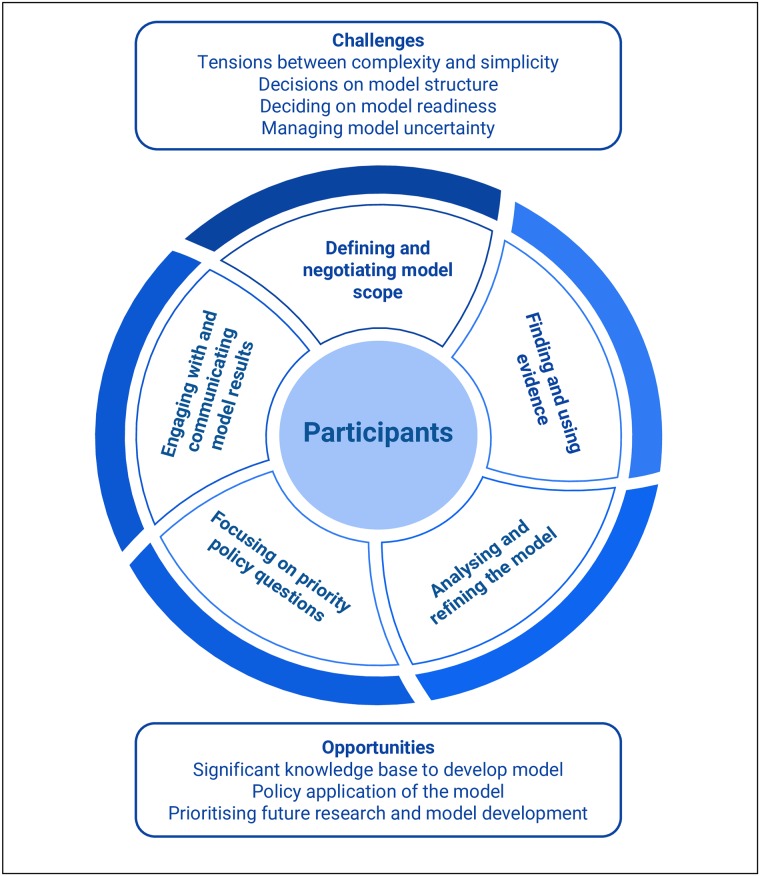
The key analytic objectives and decision-making processes included: defining the model scope; analysing and refining the model structure to maximise local relevance and utility; reviewing and incorporating evidence to inform model parameters and assumptions; focusing the model on priority policy questions; communicating results and applying the models to policy processes. These stages did not occur sequentially; the model development was cyclical and iterative with decisions being re-visited and refined throughout the process. Storytelling was an effective strategy to both communicate and resolve concerns about the model logic and structure, and to communicate the outputs of the model to a broader audience.

CONCLUSION

The in-depth analysis reported here examined the application of participatory modelling methods to move beyond qualitative conceptual mapping to the development of a rigorously quantified and policy relevant, complex dynamic simulation model. The analytic objectives and decision-making themes identified provide guidance for interpreting, understanding and reporting future participatory modelling projects and methods.

摘要

背景

系统科学方法越来越多地被用于探索复杂的公共卫生问题。定量方法,如参与式动态模拟建模,可以调动知识为卫生政策决策提供信息。然而,将合作开发的定性系统图转化为严格且与政策相关的定量动态模拟模型所需的分析和实践步骤尚未得到很好的描述。本文报告了在一个关注妊娠糖尿病的应用卫生部门案例研究中,模型制作者和最终用户参与者之间接口处发生的过程、交互和决策。

方法

对澳大利亚卫生政策背景下参与式动态模拟建模案例研究中的定性数据进行了分析。对参与式模型开发研讨会和随后的会议记录进行了分析,并与实地笔记和其他讨论和决策的书面记录进行了三角分析。收集了案例研究小插曲来说明整个模型开发过程中的审议和决策。

结果

关键分析目标和决策过程包括:定义模型范围;分析和细化模型结构,以最大限度地提高本地相关性和实用性;审查和纳入证据以告知模型参数和假设;将模型重点放在优先政策问题上;沟通结果并将模型应用于政策过程。这些阶段不是顺序进行的;模型开发是循环和迭代的,在整个过程中重新审视和完善决策。讲故事是一种有效的策略,既可以传达和解决对模型逻辑和结构的担忧,也可以将模型的输出传达给更广泛的受众。

结论

这里报告的深入分析检查了参与式建模方法的应用,以超越定性概念映射,发展出严格的定量和与政策相关的复杂动态模拟模型。确定的分析目标和决策主题为解释、理解和报告未来的参与式建模项目和方法提供了指导。
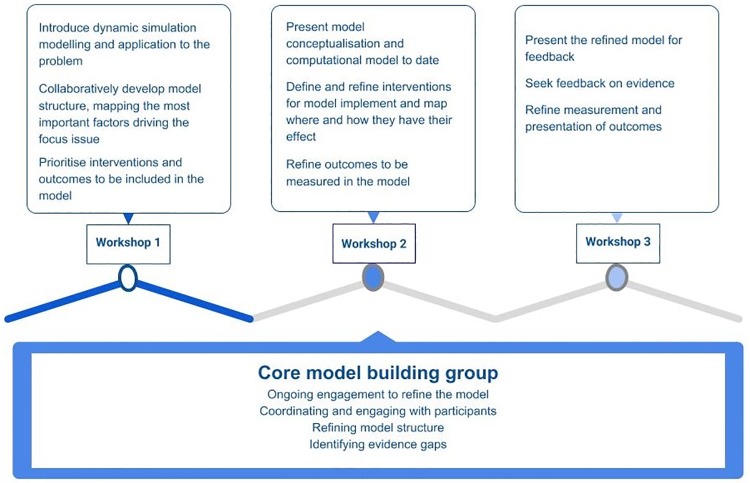
https://cdn.ncbi.nlm.nih.gov/pmc/blobs/3d2b/6597234/8e319f1cd144/pone.0218875.g005.jpg
https://cdn.ncbi.nlm.nih.gov/pmc/blobs/3d2b/6597234/c8a20fd47ebf/pone.0218875.g001.jpg
https://cdn.ncbi.nlm.nih.gov/pmc/blobs/3d2b/6597234/105d37d93b0c/pone.0218875.g002.jpg
https://cdn.ncbi.nlm.nih.gov/pmc/blobs/3d2b/6597234/b15f02e8bf64/pone.0218875.g003.jpg
https://cdn.ncbi.nlm.nih.gov/pmc/blobs/3d2b/6597234/66340059ffb1/pone.0218875.g004.jpg
https://cdn.ncbi.nlm.nih.gov/pmc/blobs/3d2b/6597234/8e319f1cd144/pone.0218875.g005.jpg
https://cdn.ncbi.nlm.nih.gov/pmc/blobs/3d2b/6597234/c8a20fd47ebf/pone.0218875.g001.jpg
https://cdn.ncbi.nlm.nih.gov/pmc/blobs/3d2b/6597234/105d37d93b0c/pone.0218875.g002.jpg
https://cdn.ncbi.nlm.nih.gov/pmc/blobs/3d2b/6597234/b15f02e8bf64/pone.0218875.g003.jpg
https://cdn.ncbi.nlm.nih.gov/pmc/blobs/3d2b/6597234/66340059ffb1/pone.0218875.g004.jpg
https://cdn.ncbi.nlm.nih.gov/pmc/blobs/3d2b/6597234/8e319f1cd144/pone.0218875.g005.jpg

相似文献

1
Turning conceptual systems maps into dynamic simulation models: An Australian case study for diabetes in pregnancy.将概念系统图转化为动态模拟模型:澳大利亚妊娠糖尿病案例研究。
PLoS One. 2019 Jun 27;14(6):e0218875. doi: 10.1371/journal.pone.0218875. eCollection 2019.
2
Decision makers' experience of participatory dynamic simulation modelling: methods for public health policy.决策者参与式动态模拟建模的经验:公共卫生政策方法。
BMC Med Inform Decis Mak. 2018 Dec 12;18(1):131. doi: 10.1186/s12911-018-0707-6.
3
Avoiding and identifying errors in health technology assessment models: qualitative study and methodological review.避免和识别健康技术评估模型中的错误:定性研究和方法学综述。
Health Technol Assess. 2010 May;14(25):iii-iv, ix-xii, 1-107. doi: 10.3310/hta14250.
4
Knowledge mobilisation for policy development: implementing systems approaches through participatory dynamic simulation modelling.政策制定中的知识调动:通过参与式动态模拟建模实施系统方法
Health Res Policy Syst. 2017 Oct 2;15(1):83. doi: 10.1186/s12961-017-0245-1.
5
Enhancing implementation science by applying best principles of systems science.通过应用系统科学的最佳原则来加强实施科学。
Health Res Policy Syst. 2016 Oct 4;14(1):74. doi: 10.1186/s12961-016-0146-8.
6
Participatory simulation modelling to inform public health policy and practice: Rethinking the evidence hierarchies.参与式模拟建模以告知公共卫生政策和实践:重新思考证据层级。
J Public Health Policy. 2017 May;38(2):203-215. doi: 10.1057/s41271-016-0061-9.
7
Simulation modelling as a tool for knowledge mobilisation in health policy settings: a case study protocol.模拟建模作为卫生政策环境中知识调动的工具:一项案例研究方案
Health Res Policy Syst. 2016 Sep 21;14(1):71. doi: 10.1186/s12961-016-0143-y.
8
Applications of system dynamics modelling to support health policy.系统动力学建模在支持卫生政策方面的应用。
Public Health Res Pract. 2015 Jul 9;25(3):e2531531. doi: 10.17061/phrp2531531.
9
Dynamic simulation modelling of policy responses to reduce alcohol-related harms: rationale and procedure for a participatory approach.减少酒精相关危害的政策应对动态模拟建模:参与式方法的基本原理和程序
Public Health Res Pract. 2017 Feb 15;27(1):2711707. doi: 10.17061/phrp2711707.
10
Integrated decision-making about housing, energy and wellbeing: a qualitative system dynamics model.关于住房、能源与福祉的综合决策:一个定性系统动力学模型
Environ Health. 2016 Mar 8;15 Suppl 1(Suppl 1):37. doi: 10.1186/s12940-016-0098-z.

引用本文的文献

1
Insights from a codesigned dynamic modelling study of child and adolescent obesity in Australia.澳大利亚一项关于儿童和青少年肥胖问题的联合设计动态建模研究的见解。
BMJ Public Health. 2025 Jan 11;3(1):e001164. doi: 10.1136/bmjph-2024-001164. eCollection 2025 Jan.
2
Early COVID-19 Pandemic Preparedness: Informing Public Health Interventions and Hospital Capacity Planning Through Participatory Hybrid Simulation Modeling.早期新冠疫情防范:通过参与式混合模拟建模为公共卫生干预措施和医院容量规划提供信息
Int J Environ Res Public Health. 2024 Dec 30;22(1):39. doi: 10.3390/ijerph22010039.
3
Participatory Modeling for High Complexity, Multi-System Issues: Challenges and Recommendations for Balancing Qualitative Understanding and Quantitative Questions.

本文引用的文献

1
Decision makers' experience of participatory dynamic simulation modelling: methods for public health policy.决策者参与式动态模拟建模的经验:公共卫生政策方法。
BMC Med Inform Decis Mak. 2018 Dec 12;18(1):131. doi: 10.1186/s12911-018-0707-6.
2
Knowledge translation for realist reviews: a participatory approach for a review on scaling up complex interventions.知识转化在现实主义评价中的应用:一项关于复杂干预措施推广的评价参与式方法。
Health Res Policy Syst. 2018 Oct 22;16(1):101. doi: 10.1186/s12961-018-0374-1.
3
Learning from the emergence of NIHR Collaborations for Leadership in Applied Health Research and Care (CLAHRCs): a systematic review of evaluations.
针对高度复杂的多系统问题的参与式建模:平衡定性理解与定量问题的挑战与建议
Syst Dyn Rev. 2024 Oct-Dec;40(4). doi: 10.1002/sdr.1765. Epub 2024 Feb 22.
4
Considerations for using participatory systems modeling as a tool for implementation mapping in chronic disease prevention.将参与式系统建模用作慢性病预防实施规划工具的考量因素。
Ann Epidemiol. 2025 Jan;101:42-51. doi: 10.1016/j.annepidem.2024.12.002. Epub 2024 Dec 15.
5
Health economic analysis of polygenic risk score use in primary prevention of coronary artery disease - A system dynamics model.多基因风险评分用于冠心病一级预防的健康经济分析——一个系统动力学模型
Am J Prev Cardiol. 2024 May 18;18:100672. doi: 10.1016/j.ajpc.2024.100672. eCollection 2024 Jun.
6
A competency framework on simulation modelling-supported decision-making for Master of Public Health graduates.公共卫生硕士毕业生模拟建模支持决策能力框架
J Public Health (Oxf). 2024 Feb 23;46(1):127-135. doi: 10.1093/pubmed/fdad248.
7
Can participatory processes lead to changes in the configuration of local mental health networks? A social network analysis.参与式过程能否导致地方心理健康网络结构发生变化?一项社会网络分析。
Front Public Health. 2023 Nov 8;11:1282662. doi: 10.3389/fpubh.2023.1282662. eCollection 2023.
8
Conceptualising the value of simulation modelling for public engagement with policy: a critical literature review.概念化模拟建模在公众参与政策方面的价值:批判性文献回顾。
Health Res Policy Syst. 2023 Nov 27;21(1):123. doi: 10.1186/s12961-023-01069-4.
9
Systems Thinking and Complexity Science Methods and the Policy Process in Non-communicable Disease Prevention: A Systematic Scoping Review.系统思维和复杂性科学方法与非传染性疾病预防政策过程:系统范围综述。
Int J Health Policy Manag. 2023;12:6772. doi: 10.34172/ijhpm.2023.6772. Epub 2023 Feb 26.
10
The use of participatory systems mapping as a research method in the context of non-communicable diseases and risk factors: a scoping review.参与式系统图在非传染性疾病和风险因素研究中的应用:范围综述。
Health Res Policy Syst. 2023 Jul 6;21(1):69. doi: 10.1186/s12961-023-01020-7.
从 NIHR 合作在应用健康研究和护理中的领导力的出现中学习(CLAHRCs):评估的系统评价。
Implement Sci. 2018 Aug 15;13(1):111. doi: 10.1186/s13012-018-0805-y.
4
The post-HAPO situation with gestational diabetes: the bright and dark sides.妊娠期糖尿病的 HAPO 后情况:光明面和黑暗面。
Acta Diabetol. 2018 Sep;55(9):885-892. doi: 10.1007/s00592-018-1146-7. Epub 2018 May 4.
5
Impacts of licensed premises trading hour policies on alcohol-related harms.持牌场所营业时间政策对与酒精相关的危害的影响。
Addiction. 2018 Jul;113(7):1244-1251. doi: 10.1111/add.14178. Epub 2018 Mar 2.
6
Thinking about complexity in health: A systematic review of the key systems thinking and complexity ideas in health.关于健康领域的复杂性:对健康领域关键系统思维和复杂性理念的系统综述。
J Eval Clin Pract. 2018 Jun;24(3):600-606. doi: 10.1111/jep.12856. Epub 2018 Jan 30.
7
Static metrics of impact for a dynamic problem: The need for smarter tools to guide suicide prevention planning and investment.静态的影响指标应对动态的问题:需要更智能的工具来指导预防自杀的规划和投资。
Aust N Z J Psychiatry. 2018 Jul;52(7):660-667. doi: 10.1177/0004867417752866. Epub 2018 Jan 23.
8
Diabetes in pregnancy: a new decade of challenges ahead.妊娠期糖尿病:未来十年的新挑战。
Diabetologia. 2018 May;61(5):1012-1021. doi: 10.1007/s00125-018-4545-y. Epub 2018 Jan 22.
9
Using systems science to understand the determinants of inequities in healthy eating.运用系统科学理解健康饮食方面不平等现象的决定因素。
PLoS One. 2017 Nov 30;12(11):e0188872. doi: 10.1371/journal.pone.0188872. eCollection 2017.
10
Harnessing advances in computer simulation to inform policy and planning to reduce alcohol-related harms.利用计算机模拟技术的进步为减少酒精相关危害的政策和规划提供信息。
Int J Public Health. 2018 May;63(4):537-546. doi: 10.1007/s00038-017-1041-y. Epub 2017 Oct 19.