Tønnessen Espen, Sylta Øystein, Haugen Thomas A, Hem Erlend, Svendsen Ida S, Seiler Stephen
The Norwegian Olympic Federation, Oslo, Norway.
Faculty of Health and Sport Sciences, University of Agder, Kristiansand, Norway.
PLoS One. 2014 Jul 14;9(7):e101796. doi: 10.1371/journal.pone.0101796. eCollection 2014.
To describe training variations across the annual cycle in Olympic and World Champion endurance athletes, and determine whether these athletes used tapering strategies in line with recommendations in the literature.
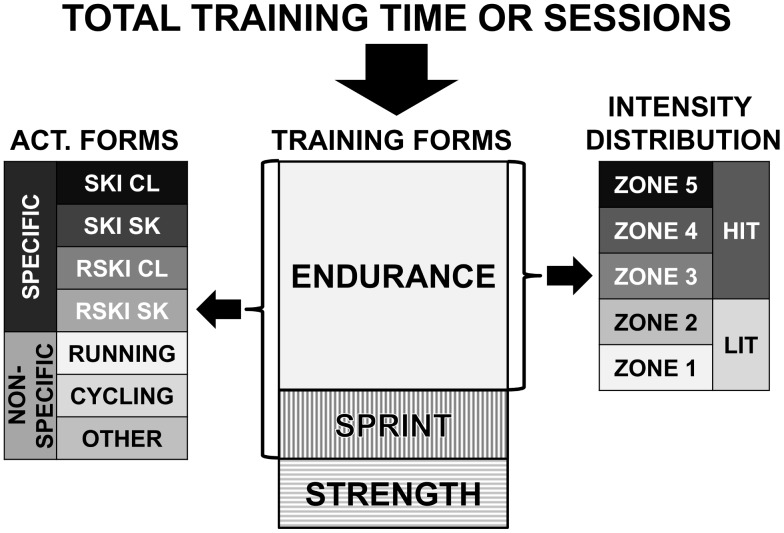
Eleven elite XC skiers and biathletes (4 male; 28±1 yr, 85±5 mL x min(-1) x kg(-1) VO2max, 7 female, 25±4 yr, 73±3 mL x min(-1) x kg(-1) VO2max) reported one year of day-to-day training leading up to the most successful competition of their career. Training data were divided into periodization and peaking phases and distributed into training forms, intensity zones and endurance activity forms.
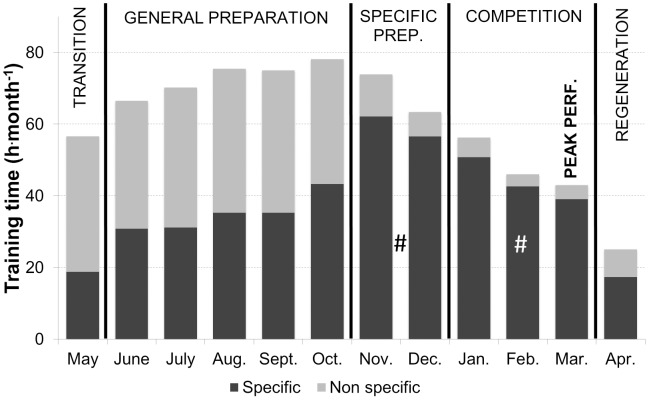
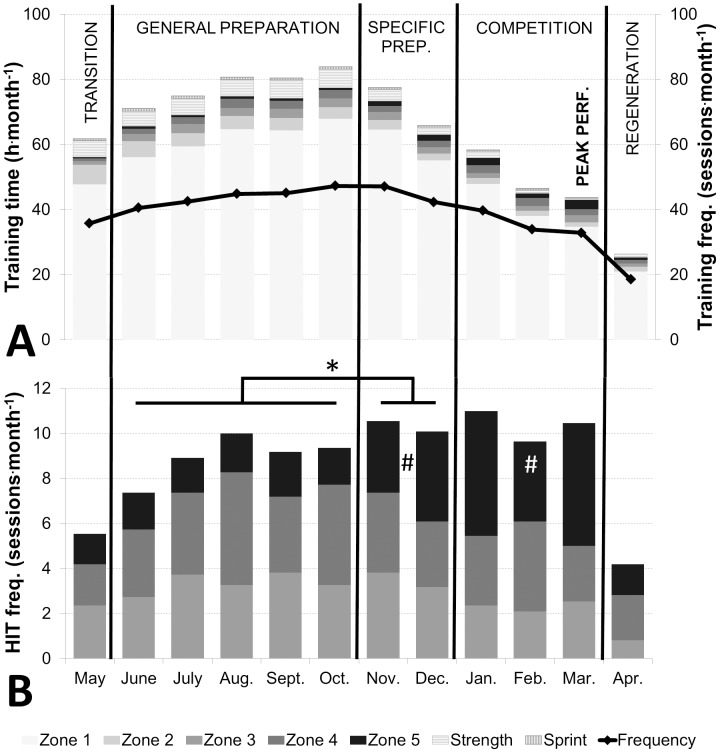
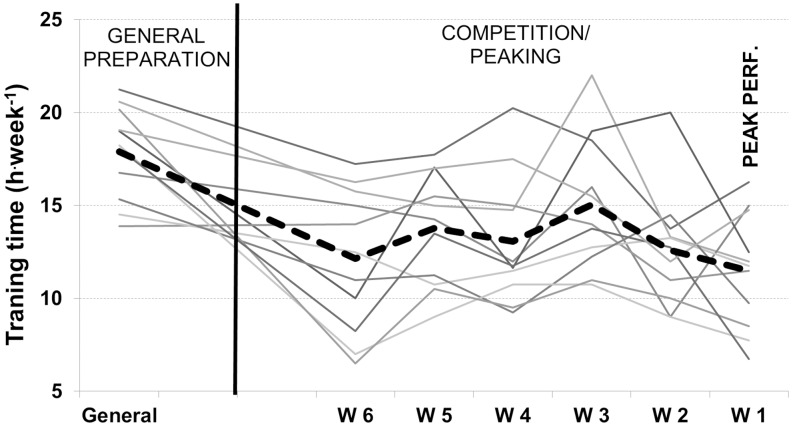
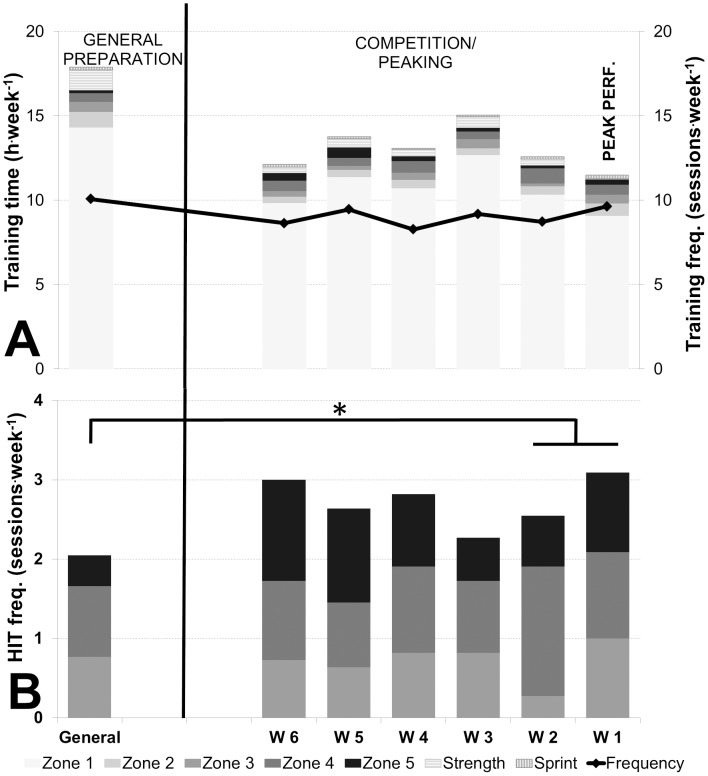
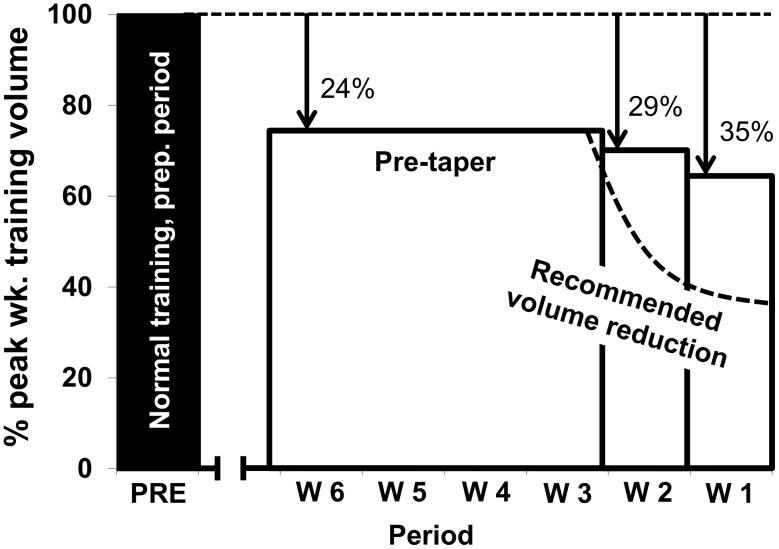
Athletes trained ∼800 h/500 sessions x year(-1), including ∼500 h x year(-1) of sport-specific training. Ninety-four percent of all training was executed as aerobic endurance training. Of this, ∼90% was low intensity training (LIT, below the first lactate threshold) and 10% high intensity training (HIT, above the first lactate threshold) by time. Categorically, 23% of training sessions were characterized as HIT with primary portions executed at or above the first lactate turn point. Training volume and specificity distribution conformed to a traditional periodization model, but absolute volume of HIT remained stable across phases. However, HIT training patterns tended to become more polarized in the competition phase. Training volume, frequency and intensity remained unchanged from pre-peaking to peaking period, but there was a 32±15% (P<.01) volume reduction from the preparation period to peaking phase.
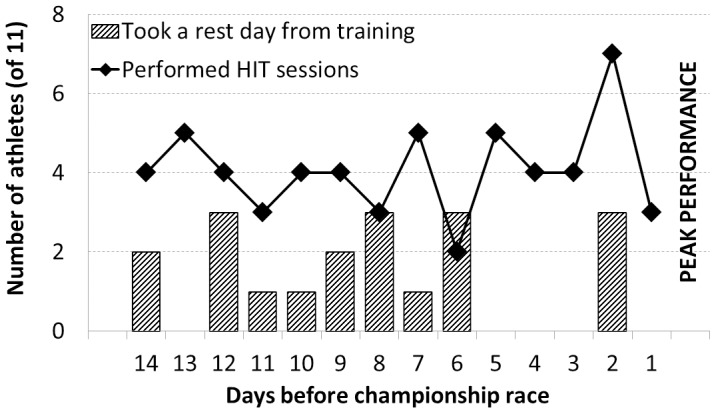
The annual training data for these Olympic and World champion XC skiers and biathletes conforms to previously reported training patterns of elite endurance athletes. During the competition phase, training became more sport-specific, with 92% performed as XC skiing. However, they did not follow suggested tapering practice derived from short-term experimental studies. Only three out of 11 athletes took a rest day during the final 5 days prior to their most successful competition.
描述奥运会和世界冠军耐力运动员在年度周期内的训练变化,并确定这些运动员是否采用了符合文献建议的减量策略。
11名精英越野滑雪运动员和冬季两项运动员(4名男性,年龄28±1岁,最大摄氧量85±5 mL·min⁻¹·kg⁻¹;7名女性,年龄25±4岁,最大摄氧量73±3 mL·min⁻¹·kg⁻¹)报告了其职业生涯中最成功比赛前一年的日常训练情况。训练数据分为周期化和巅峰阶段,并按训练形式、强度区域和耐力活动形式进行分类。
运动员每年训练约800小时/500次训练课,其中约500小时/年为专项运动训练。所有训练的94%为有氧耐力训练。其中,按时间计算,约90%为低强度训练(LIT,低于第一个乳酸阈值),10%为高强度训练(HIT,高于第一个乳酸阈值)。按类别划分,23%的训练课被归类为HIT,主要部分在第一个乳酸拐点或以上强度进行。训练量和专项性分布符合传统的周期化模型,但HIT的绝对量在各阶段保持稳定。然而,HIT训练模式在比赛阶段趋于更加两极分化。从赛前到巅峰期,训练量、频率和强度保持不变,但从准备期到巅峰期,训练量减少了32±15%(P<0.01)。
这些奥运会和世界冠军越野滑雪运动员和冬季两项运动员的年度训练数据符合先前报道的精英耐力运动员的训练模式。在比赛阶段,训练变得更加专项化,92%的训练以越野滑雪形式进行。然而,他们并未遵循短期实验研究提出的减量做法。11名运动员中只有3人在最成功的比赛前最后5天休息了一天。