Department of Molecular and Cell Biology , University of California , Berkeley , California 94720 , United States.
Innovative Genomics Institute , University of California , Berkeley , California 94704 , United States.
Biochemistry. 2019 Aug 6;58(31):3365-3376. doi: 10.1021/acs.biochem.9b00237. Epub 2019 Jul 22.
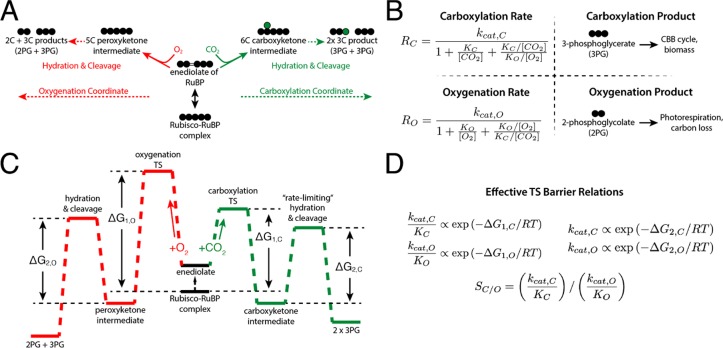
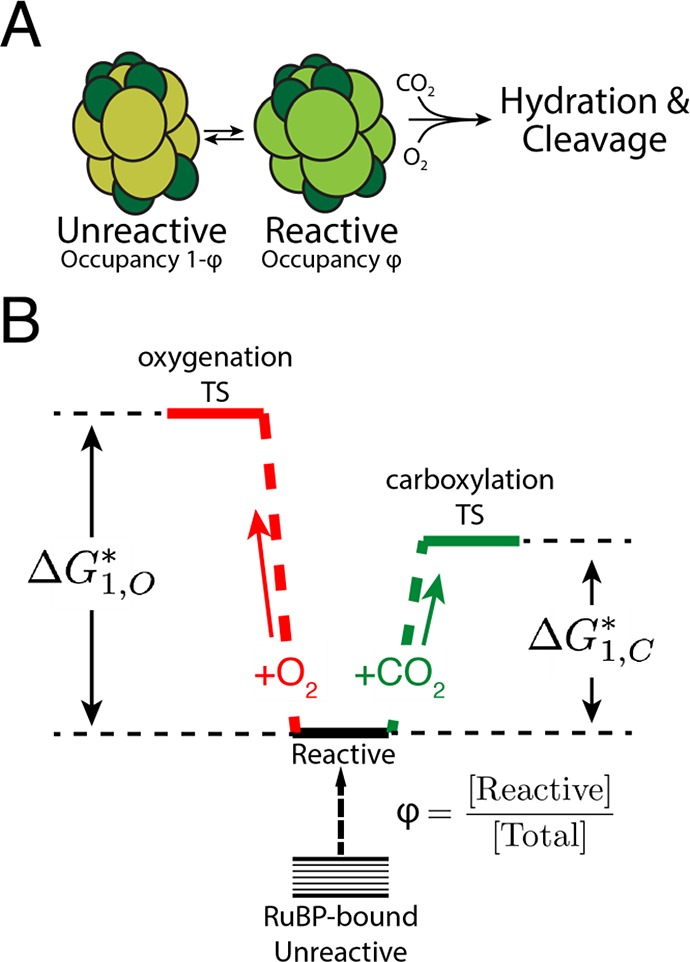
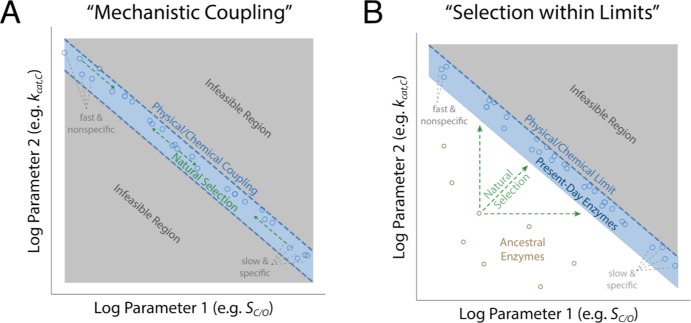
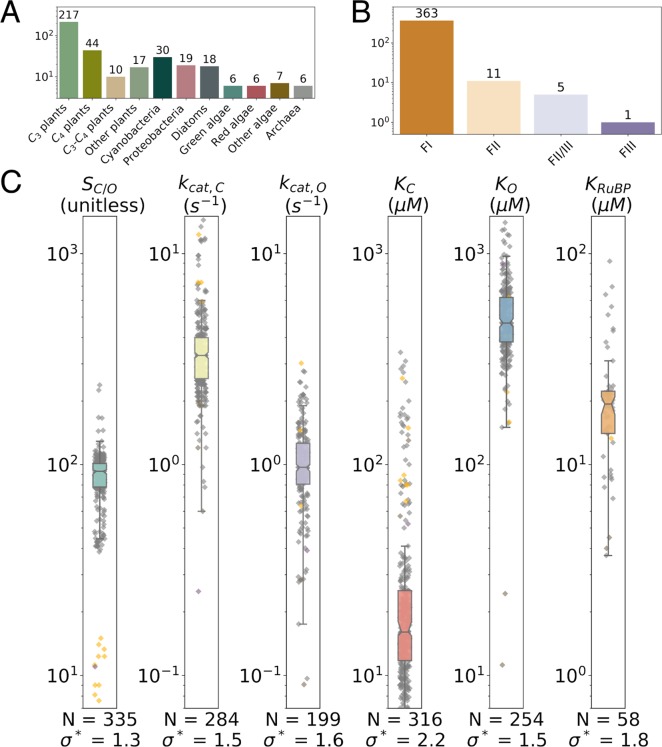
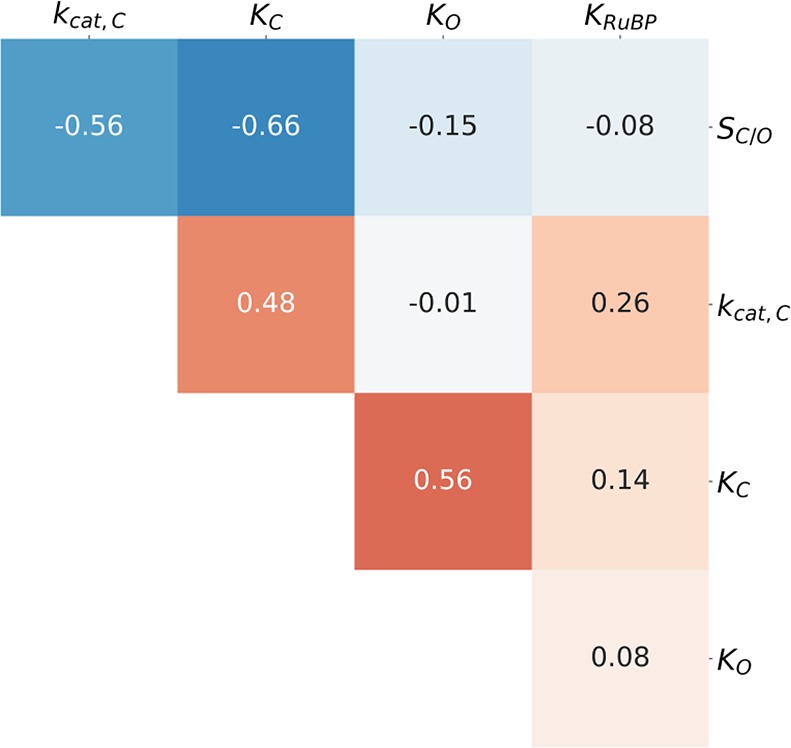
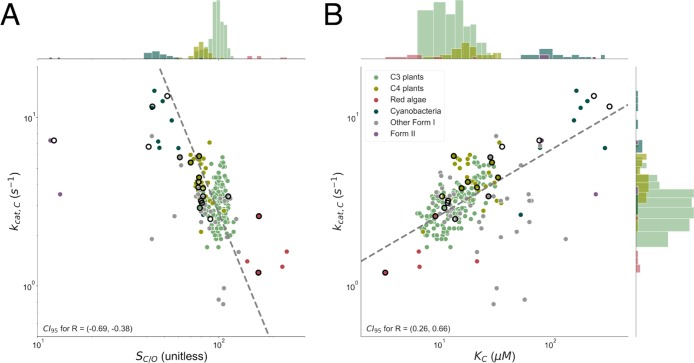
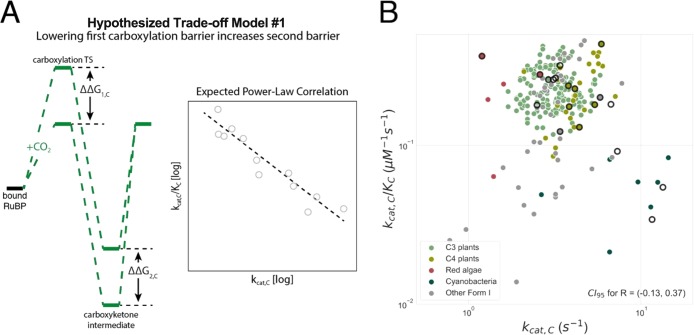
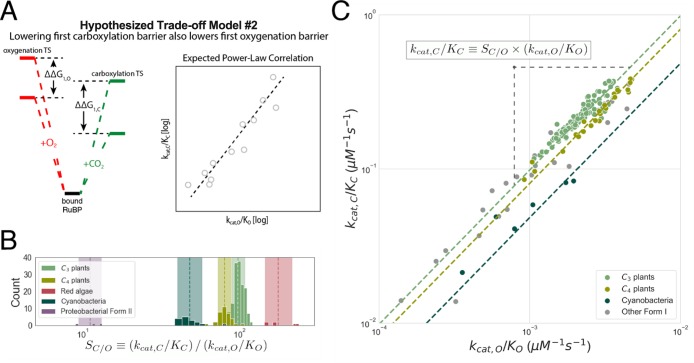
Rubisco is the primary carboxylase of the Calvin cycle, the most abundant enzyme in the biosphere, and one of the best-characterized enzymes. On the basis of correlations between Rubisco kinetic parameters, it is widely posited that constraints embedded in the catalytic mechanism enforce trade-offs between CO specificity, , and maximum carboxylation rate, . However, the reasoning that established this view was based on data from ≈20 organisms. Here, we re-examine models of trade-offs in Rubisco catalysis using a data set from ≈300 organisms. Correlations between kinetic parameters are substantially attenuated in this larger data set, with the inverse relationship between and being a key example. Nonetheless, measured kinetic parameters display extremely limited variation, consistent with a view of Rubisco as a highly constrained enzyme. More than 95% of values are between 1 and 10 s, and no measured exceeds 15 s. Similarly, varies by only 30% among Form I Rubiscos and <10% among C plant enzymes. Limited variation in forces a strong positive correlation between the catalytic efficiencies (/) for carboxylation and oxygenation, consistent with a model of Rubisco catalysis in which increasing the rate of addition of CO to the enzyme-substrate complex requires an equal increase in the O addition rate. Altogether, these data suggest that Rubisco evolution is tightly constrained by the physicochemical limits of CO/O discrimination.
核酮糖-1,5-二磷酸羧化酶/加氧酶(Rubisco)是卡尔文循环的主要羧化酶,是生物圈中丰度最高的酶之一,也是研究最为透彻的酶之一。基于 Rubisco 动力学参数之间的相关性,人们广泛认为催化机制中固有的约束条件在 CO2 特异性、Rubisco 活性和最大羧化速率之间产生了权衡。然而,这种观点的推理依据是来自大约 20 种生物的相关数据。在这里,我们使用来自大约 300 种生物的数据集重新检验了 Rubisco 催化作用中的权衡模型。在这个更大的数据集里,动力学参数之间的相关性显著减弱, 和 之间的反比关系是一个关键的例子。尽管如此,测量得到的动力学参数显示出非常有限的变化,这与 Rubisco 作为一种高度受限制的酶的观点是一致的。超过 95%的 值在 1 到 10 s 之间,并且没有测量到的 值超过 15 s。同样,I 型 Rubisco 的 值变化幅度仅为 30%,C3 植物酶的 值变化幅度小于 10%。 值的有限变化导致羧化和加氧的催化效率 (/ )之间存在强烈的正相关,这与 Rubisco 催化作用的模型一致,该模型认为增加 CO 与酶-底物复合物的加成速率需要同等增加 O 的加成速率。总而言之,这些数据表明 Rubisco 的进化受到 CO/O 区分的物理化学限制的严格约束。