Department of Dermatology, School of Medical Sciences, Laboratory of Skin Cell Cultures-Pediatric Research Center, University of Campinas - UNICAMP, Campinas, São Paulo, Brazil.
PLoS One. 2019 Jul 3;14(7):e0219165. doi: 10.1371/journal.pone.0219165. eCollection 2019.
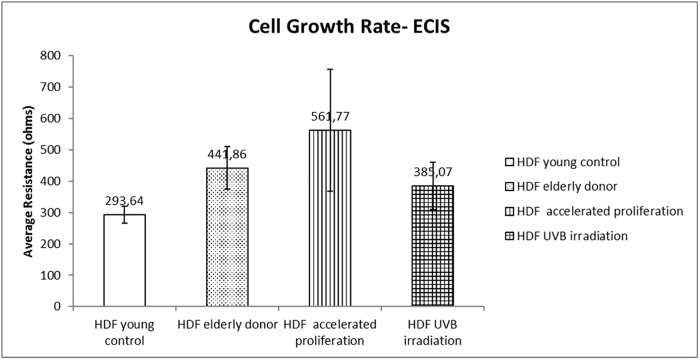
Skin aging is a complex process, and alterations in human skin due to aging have distinct characteristic as compared to other organs. The aging of dermal cells and the biological mechanisms involved in this process are key areas to understand skin aging. A large number of biological mechanisms, such as decreasing of protein synthesis of extracellular matrix or increasing of degradation, are known to be altered through skin aging. However, environmental influence can accelerate this characteristic phenotype. In this study, we analyzed primary human dermal fibroblasts in three different in-vitro aging models-UVB irradiation and accelerated proliferation of human dermal fibroblasts from young donors as well as from elderly donors-for the gene expression of COL1A1, COL1A2, COL3A1, COL4A1, COL7A1, MMP1, MMP2, MMP3, MMP7, MMP8, MMP9, MMP10, MMP12, MMP13, MMP14, TIMP1, TIMP2, TIMP3, TIMP4, IL1B, IL1A, IL6, IL8, IL10, PTGS2, TP53, CASP3, LMNA, SIRT1. We compared the gene expression levels with young control. Furthermore, the behavior of skin fibroblasts was also evaluated using cell growth rate. The findings reveal that the gene expression levels in skin fibroblasts was altered in the process of aging in all three in-vitro aging models, and the cell growth rate was reduced, suggesting that these methods can be employed to understand skin aging mechanisms as well as drug discovery screening method.
皮肤老化是一个复杂的过程,与其他器官相比,人类皮肤因衰老而发生的改变具有明显的特征。真皮细胞的老化和涉及这一过程的生物学机制是理解皮肤老化的关键领域。大量的生物学机制,如细胞外基质蛋白合成减少或降解增加,已知会随着皮肤老化而改变。然而,环境的影响可以加速这一特征表型。在这项研究中,我们分析了三种不同的体外老化模型中的原代人真皮成纤维细胞-UVB 照射和年轻供体以及老年供体的人真皮成纤维细胞的加速增殖-COL1A1、COL1A2、COL3A1、COL4A1、COL7A1、MMP1、MMP2、MMP3、MMP7、MMP8、MMP9、MMP10、MMP12、MMP13、MMP14、TIMP1、TIMP2、TIMP3、TIMP4、IL1B、IL1A、IL6、IL8、IL10、PTGS2、TP53、CASP3、LMNA、SIRT1 的基因表达。我们将基因表达水平与年轻对照组进行了比较。此外,还通过细胞生长速率评估了皮肤成纤维细胞的行为。研究结果表明,在所有三种体外老化模型中,皮肤成纤维细胞的基因表达水平在老化过程中发生了改变,细胞生长速率降低,这表明这些方法可用于了解皮肤老化机制以及药物发现筛选方法。