De Silva Nileththi A, Gregory Michael A, Venkateshan Shree S, Verschoor Chris P, Kuspinar Ayse
Department of Interdisciplinary Sciences, McMaster University, Hamilton, ON, Canada L8S 4L8.
School of Rehabilitation Science, McMaster University, Hamilton, ON, Canada L8S 1C7.
J Aging Res. 2019 Jun 2;2019:3923574. doi: 10.1155/2019/3923574. eCollection 2019.
The purpose of this review is to investigate the relationship between life-space mobility and cognition in older adults.
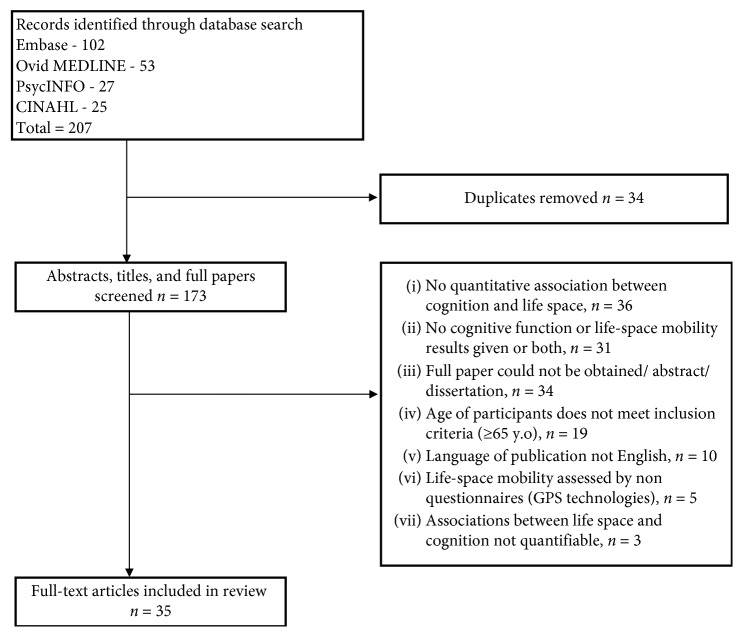
MEDLINE, Embase, CINAHL, and PsycINFO were searched through December 2018 for studies containing measures of life-space mobility and cognitive function. Two independent reviewers screened studies. Eligible studies were combined using a random-effects model, and heterogeneity was assessed using the .
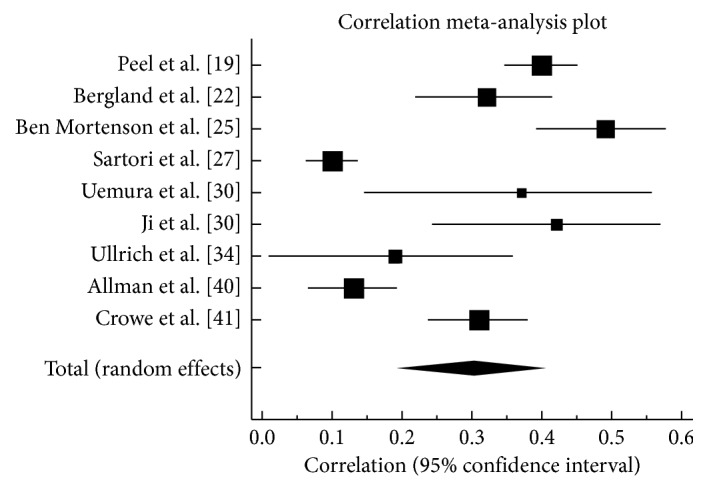
Thirty-five articles were identified for review. A moderate and statistically significant association (pooled = 0.30, 95% confidence interval 0.19 to 0.40.) was observed between life-space mobility and cognition among nine studies. Life-space mobility demonstrated small-to-moderate associations with domain-specific cognitive functioning, particularly executive function, learning, memory, and processing speed. Furthermore, individuals who had restricted life-space mobility (Life-Space Assessment ≤ 40) experienced a steeper decline in cognition ( = 0.56 and = 0.0471) compared to those who did not (Life-Space Assessment ≥ 41).
This review examined the association between life-space mobility and cognitive function in older adults. The results suggest that a moderate relationship between life-space mobility and cognition exists, whether adjusted or unadjusted for covariates such as sociodemographics, mental health, functional capacity, and comorbidities.
本综述旨在研究老年人生活空间移动性与认知之间的关系。
检索了截至2018年12月的MEDLINE、Embase、CINAHL和PsycINFO数据库,查找包含生活空间移动性和认知功能测量的研究。两名独立评审员筛选研究。符合条件的研究采用随机效应模型进行合并,并使用 评估异质性。
共识别出35篇文章进行综述。在9项研究中,观察到生活空间移动性与认知之间存在中度且具有统计学意义的关联(合并效应值=0.30,95%置信区间为0.19至0.40)。生活空间移动性与特定领域的认知功能,特别是执行功能、学习、记忆和处理速度之间呈现出小到中度的关联。此外,与生活空间移动性未受限的个体(生活空间评估≥41)相比,生活空间移动性受限的个体(生活空间评估≤40)认知能力下降更为明显(效应值=0.56,P=0.0471)。
本综述研究了老年人生活空间移动性与认知功能之间的关联。结果表明,无论是否对社会人口统计学、心理健康、功能能力和合并症等协变量进行调整,生活空间移动性与认知之间都存在中度关系。