
优化用于组织工程应用的温敏性聚(N-异丙基丙烯酰胺)电纺纳米纤维的对齐方式:析因实验设计方法。
Optimizing the alignment of thermoresponsive poly(N-isopropyl acrylamide) electrospun nanofibers for tissue engineering applications: A factorial design of experiments approach.
机构信息
Department of Chemical and Biomolecular Engineering, Lafayette College, Easton, Pennsylvania, United States of America.
出版信息
PLoS One. 2019 Jul 5;14(7):e0219254. doi: 10.1371/journal.pone.0219254. eCollection 2019.
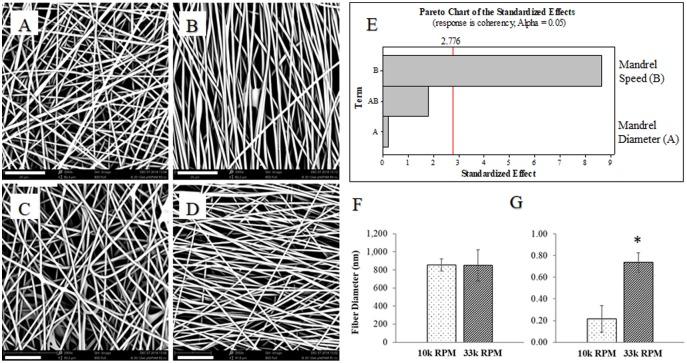
Thermoresponsive polymers, such as poly(N-isopropyl acrylamide) (PNIPAM), have been identified and used as cell culture substrates, taking advantage of the polymer's lower critical solution temperature (LCST) to mechanically harvest cells. This technology bypasses the use of biochemical enzymes that cleave important cell-cell and cell-matrix interactions. In this study, the process of electrospinning is used to fabricate and characterize aligned PNIPAM nanofiber scaffolds that are biocompatible and thermoresponsive. Nanofiber scaffolds produced by electrospinning possess a 3D architecture that mimics native extracellular matrix, providing physical and chemical cues to drive cell function and phenotype. We present a factorial design of experiments (DOE) approach to systematically determine the effects of different electrospinning process parameters on PNIPAM nanofiber diameter and alignment. Results show that high molecular weight PNIPAM can be successfully electrospun into both random and uniaxially aligned nanofiber mats with similar fiber diameters by simply altering the speed of the rotating mandrel collector from 10,000 to 33,000 RPM. PNIPAM nanofibers were crosslinked with OpePOSS, which was verified using FTIR. The mechanical properties of the scaffolds were characterized using dynamic mechanical analysis, revealing an order of magnitude difference in storage modulus (MPa) between cured and uncured samples. In summary, cross-linked PNIPAM nanofiber scaffolds were determined to be stable in aqueous culture, biocompatible, and thermoresponsive, enabling their use in diverse cell culture applications.
温敏聚合物,如聚(N-异丙基丙烯酰胺)(PNIPAM),已被鉴定并用作细胞培养基质,利用聚合物的低临界溶解温度(LCST)机械收获细胞。这项技术避免了使用生化酶来切割重要的细胞-细胞和细胞-基质相互作用。在这项研究中,使用静电纺丝工艺来制造和表征具有生物相容性和温敏性的定向 PNIPAM 纳米纤维支架。静电纺丝生产的纳米纤维支架具有模仿天然细胞外基质的 3D 结构,为细胞功能和表型提供物理和化学线索。我们提出了一种析因设计实验(DOE)方法,系统地确定不同静电纺丝工艺参数对 PNIPAM 纳米纤维直径和取向的影响。结果表明,通过简单地改变旋转芯轴收集器的速度从 10,000 到 33,000 RPM,可以将高分子量的 PNIPAM 成功地静电纺成随机和单轴取向的纳米纤维垫,其纤维直径相似。PNIPAM 纳米纤维用 OpePOSS 交联,使用傅里叶变换红外光谱(FTIR)进行了验证。使用动态力学分析对支架的机械性能进行了表征,结果显示固化和未固化样品之间的储能模量(MPa)存在数量级差异。总之,交联的 PNIPAM 纳米纤维支架在水培中稳定、生物相容且温敏,使其能够用于各种细胞培养应用。




 Zotero 插件