Gong Hai-Bo, Wu Xiu-Juan, Pu Xiong-Ming, Kang Xiao-Jing
Xinjiang Medical University, Urumqi, Xinjiang Uygur Autonomous Region.
Department of Dermatology, Central Hospital of Shanghai Xuhui District, Shanghai.
Medicine (Baltimore). 2019 Jul;98(27):e16277. doi: 10.1097/MD.0000000000016277.
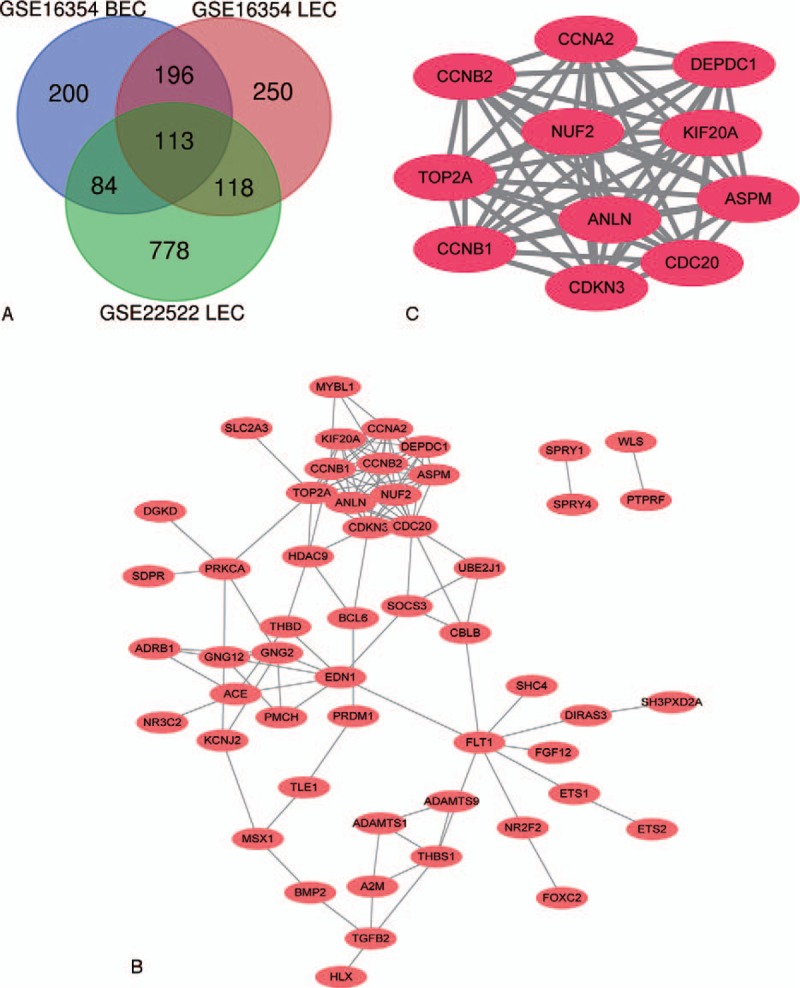
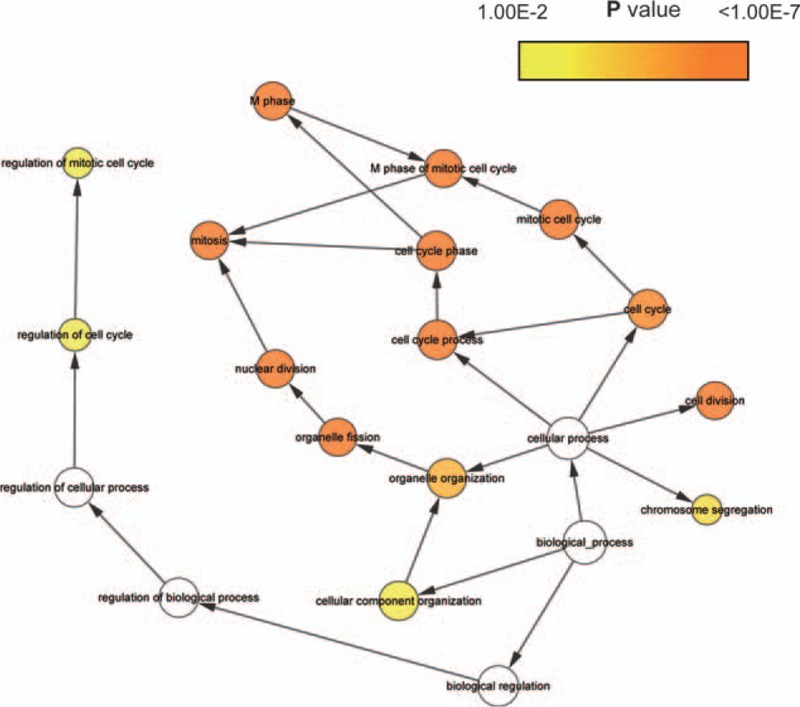
Kaposi sarcoma (KS) is an endothelial tumor etiologically related to Kaposi sarcoma herpesvirus (KSHV) infection. The aim of our study was to screen out candidate genes of KSHV infected endothelial cells and to elucidate the underlying molecular mechanisms by bioinformatics methods. Microarray datasets GSE16354 and GSE22522 were downloaded from Gene Expression Omnibus (GEO) database. the differentially expressed genes (DEGs) between endothelial cells and KSHV infected endothelial cells were identified. And then, functional enrichment analyses of gene ontology (GO) and Kyoto encyclopedia of genes and genomes (KEGG) pathway analysis were performed. After that, Search Tool for the Retrieval of Interacting Genes (STRING) was used to investigate the potential protein-protein interaction (PPI) network between DEGs, Cytoscape software was used to visualize the interaction network of DEGs and to screen out the hub genes. A total of 113 DEGs and 11 hub genes were identified from the 2 datasets. GO enrichment analysis revealed that most of the DEGs were enrichen in regulation of cell proliferation, extracellular region part and sequence-specific DNA binding; KEGG pathway enrichments analysis displayed that DEGs were mostly enrichen in cell cycle, Jak-STAT signaling pathway, pathways in cancer, and Insulin signaling pathway. In conclusion, the present study identified a host of DEGs and hub genes in KSHV infected endothelial cells which may serve as potential key biomarkers and therapeutic targets, helping us to have a better understanding of the molecular mechanism of KS.
卡波西肉瘤(KS)是一种与卡波西肉瘤疱疹病毒(KSHV)感染病因相关的内皮肿瘤。我们研究的目的是通过生物信息学方法筛选出KSHV感染内皮细胞的候选基因,并阐明其潜在的分子机制。从基因表达综合数据库(GEO)下载了微阵列数据集GSE16354和GSE22522。鉴定了内皮细胞与KSHV感染内皮细胞之间的差异表达基因(DEGs)。然后,进行了基因本体(GO)功能富集分析和京都基因与基因组百科全书(KEGG)通路分析。之后,使用检索相互作用基因的搜索工具(STRING)研究DEGs之间潜在的蛋白质-蛋白质相互作用(PPI)网络,利用Cytoscape软件可视化DEGs的相互作用网络并筛选出枢纽基因。从这两个数据集中共鉴定出113个DEGs和11个枢纽基因。GO富集分析表明,大多数DEGs富集于细胞增殖调控、细胞外区域部分和序列特异性DNA结合;KEGG通路富集分析显示,DEGs大多富集于细胞周期、Jak-STAT信号通路、癌症相关通路和胰岛素信号通路。总之,本研究在KSHV感染的内皮细胞中鉴定出了大量的DEGs和枢纽基因,它们可能作为潜在的关键生物标志物和治疗靶点,有助于我们更好地理解KS的分子机制。