Özduman Zümrüt Ceren, Kazak Magrur, Fildisi Mehmet Ali, Özlen Rümeysa Hatice, Dalkilic Evrim, Donmez Nazmiye
Department of Restorative Dentistry, Faculty of Dentistry, Bezmialem Vakif University, 34093 Istanbul, Turkey.
Bahcesehir University, School of Dental Medicine, Restorative Dentistry Department, Istanbul, Turkey.
Scanning. 2019 Jun 2;2019:2307305. doi: 10.1155/2019/2307305. eCollection 2019.
The aim of this study is to evaluate the microhardness and surface roughness of two different bulk-fill composites polymerized with light-curing unit (LCU) with different polymerization times before and after the application of a home bleaching agent.
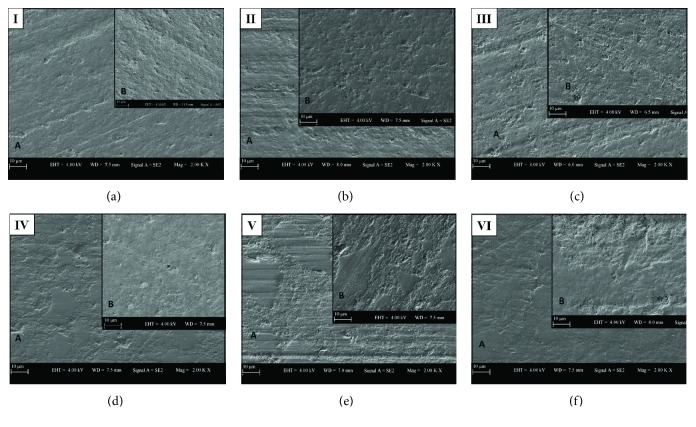
MATERIALS-METHODS: For both microhardness and surface roughness tests, 6 groups were prepared with bulk-fill materials (SonicFill, Filtek Bulk Fill) according to different polymerization times (10, 20, and 30 s). 102 specimens were prepared using Teflon molds (4 mm depth and 5 mm diameter) and polymerized with LCU. 30 specimens ( = 5) were assessed for microhardness. Before home bleaching agent application, the bottom/top (B/T) microhardness ratio was evaluated. After bleaching agent application, the microhardness measurements were performed on top surfaces. Roughness measurements were performed in 72 specimens ( = 12) before and after bleaching application. Additionally, for SEM analyses, two specimens from all tested groups were prepared before and after bleaching agent application. The data B/T microhardness ratio before bleaching was analyzed by two-way ANOVA and Tukey's HSD test. The data from the top surface of specimens' microhardness before and after bleaching were analyzed using Wilcoxon signed-rank test, Kruskal-Wallis, Mann-Whitney tests. The data from surface roughness tests were statistically analyzed by multivariate analysis of variance and Bonferroni test ( < 0.05).
The B/T microhardness ratio results revealed no significant differences between groups ( > 0.05). Comparing the microhardness values of the composites' top surfaces before and after bleaching, a significant decrease was observed exclusively in FB30s ( < 0.05). No significant differences in surface roughness values were observed when the groups were compared based on bulk-fill materials ( > 0.05) while the polymerization time affected the surface roughness of the SF20s and SF30s groups ( < 0.05). After bleaching, surface roughness values were significantly increased in the SF20s and SF30s groups ( < 0.05).
The clinicians should adhere to the polymerization time recommended by the manufacturer to ensure the durability of the composite material in the oral environment.
本研究旨在评估两种不同的大块充填复合树脂在使用家庭漂白剂前后,采用不同聚合时间通过光固化机(LCU)聚合后的显微硬度和表面粗糙度。
对于显微硬度和表面粗糙度测试,根据不同聚合时间(10、20和30秒),用大块充填材料(SonicFill、Filtek Bulk Fill)制备6组样本。使用聚四氟乙烯模具(4毫米深,5毫米直径)制备102个样本,并用LCU进行聚合。30个样本(每组5个)用于评估显微硬度。在使用家庭漂白剂之前,评估底部/顶部(B/T)显微硬度比。在使用漂白剂之后,则对样本顶部表面进行显微硬度测量。在使用漂白剂前后,对72个样本(每组12个)进行粗糙度测量。此外,为进行扫描电子显微镜(SEM)分析,在使用漂白剂前后,从所有测试组中各制备两个样本。对漂白前的B/T显微硬度比数据采用双向方差分析和Tukey's HSD检验。对样本漂白前后顶部表面的显微硬度数据采用Wilcoxon符号秩检验、Kruskal-Wallis检验、Mann-Whitney检验。对表面粗糙度测试数据采用多变量方差分析和Bonferroni检验进行统计学分析(P<0.05)。
B/T显微硬度比结果显示各组之间无显著差异(P>0.05)。比较复合树脂顶部表面漂白前后的显微硬度值,仅在FB30s组观察到显著降低(P<0.05)。当根据大块充填材料比较各组时,表面粗糙度值无显著差异(P>0.05),而聚合时间影响SF₂0s组和SF₃0s组的表面粗糙度(P<0.05)。漂白后,SF₂0s组和SF₃0s组的表面粗糙度值显著增加(P<0.05)。
临床医生应遵循制造商推荐的聚合时间,以确保复合材料在口腔环境中的耐久性。