1Department of Epidemiology, Colorado School of Public Health, Aurora, CO USA.
Lifecourse Epidemiology of Adiposity and Diabetes (LEAD) Center, Aurora, CO USA.
NPJ Biofilms Microbiomes. 2019 Jul 1;5(1):18. doi: 10.1038/s41522-019-0091-8. eCollection 2019.
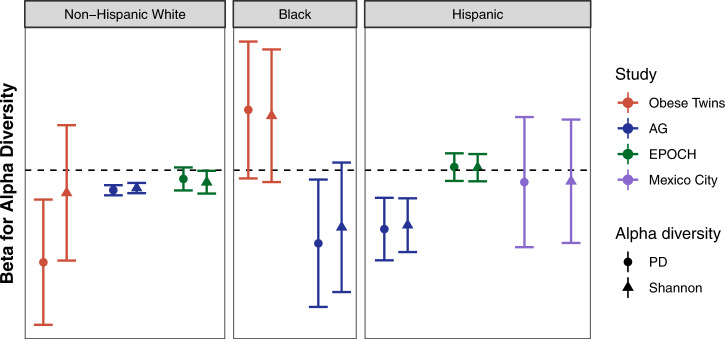
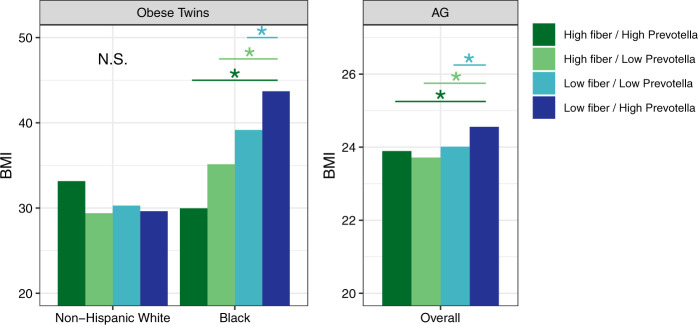
Obesity is a disease with a complex etiology and variable prevalence across different populations. While several studies have reported gut microbiota composition differences associated with obesity in humans, there has been a lack of consistency in the nature of the reported changes; it has been difficult to determine whether methodological differences between studies, underlying differences in the populations studied, or other factors are responsible for this discordance. Here we use 16 S rRNA data from previously published studies to explore how the gut microbiota-obesity relationship varies across heterogeneous Western populations, focusing mainly on the relationship between (1) alpha diversity and (2) relative abundance with BMI. We provide evidence that the relationship between lower alpha diversity and higher BMI may be most consistent in non-Hispanic white (NHW) populations and/or those with high socioeconomic status, while the relationship between higher relative abundance and BMI may be stronger among black and Hispanic populations. We further examine how diet may impact these relationships. This work suggests that gut microbiota phenotypes of obesity may differ with race/ethnicity or its correlates, such as dietary components or socioeconomic status. However, microbiome cohorts are often too small to study complex interaction effects and non-white individuals are greatly underrepresented, creating substantial challenges to understanding population-level patterns in the microbiome-obesity relationship. Further study of how population heterogeneity influences the relationship between the gut microbiota and obesity is warranted.
肥胖是一种病因复杂、在不同人群中流行率不同的疾病。虽然有几项研究报道了与人类肥胖相关的肠道微生物群落组成差异,但报告的变化性质缺乏一致性;很难确定导致这种不一致的原因是研究之间的方法学差异、所研究人群的潜在差异还是其他因素。在这里,我们使用来自先前发表的研究的 16S rRNA 数据来探索肠道微生物群与肥胖之间的关系在异质的西方人群中如何变化,主要关注(1)alpha 多样性和(2)与 BMI 的相对丰度之间的关系。我们提供的证据表明,较低的 alpha 多样性与较高的 BMI 之间的关系在非西班牙裔白人(NHW)人群和/或社会经济地位较高的人群中可能最一致,而较高的相对丰度与 BMI 之间的关系在黑人和西班牙裔人群中可能更强。我们进一步研究了饮食如何影响这些关系。这项工作表明,肥胖的肠道微生物群表型可能因种族/民族或其相关因素(如饮食成分或社会经济地位)而异。然而,微生物组队列通常太小,无法研究复杂的相互作用效应,而且非白人群体的代表性严重不足,这给理解微生物组与肥胖之间的人群水平模式带来了巨大挑战。进一步研究人群异质性如何影响肠道微生物群和肥胖之间的关系是有必要的。