Gupta Vinod K, Paul Sandip, Dutta Chitra
Structural Biology and Bioinformatics Division, CSIR-Indian Institute of Chemical BiologyKolkata, India.
Academy of Scientific and Innovative ResearchKolkata, India.
Front Microbiol. 2017 Jun 23;8:1162. doi: 10.3389/fmicb.2017.01162. eCollection 2017.
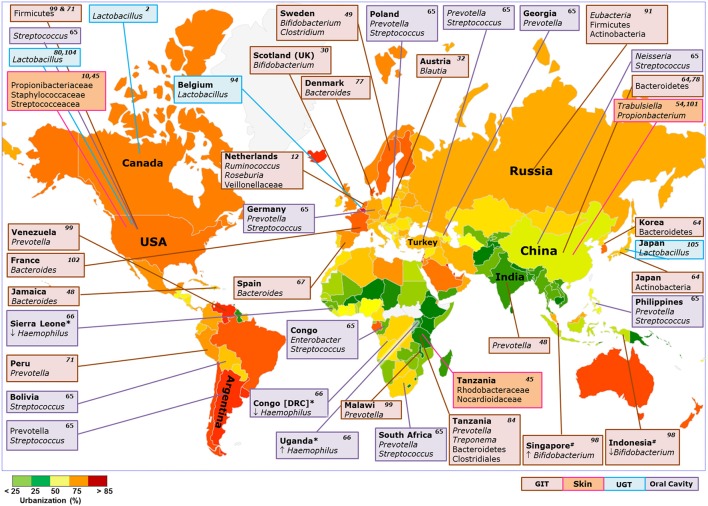
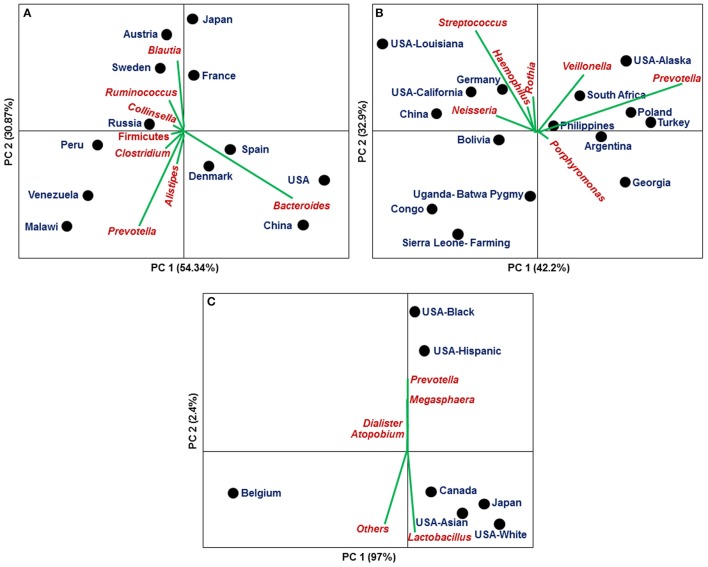
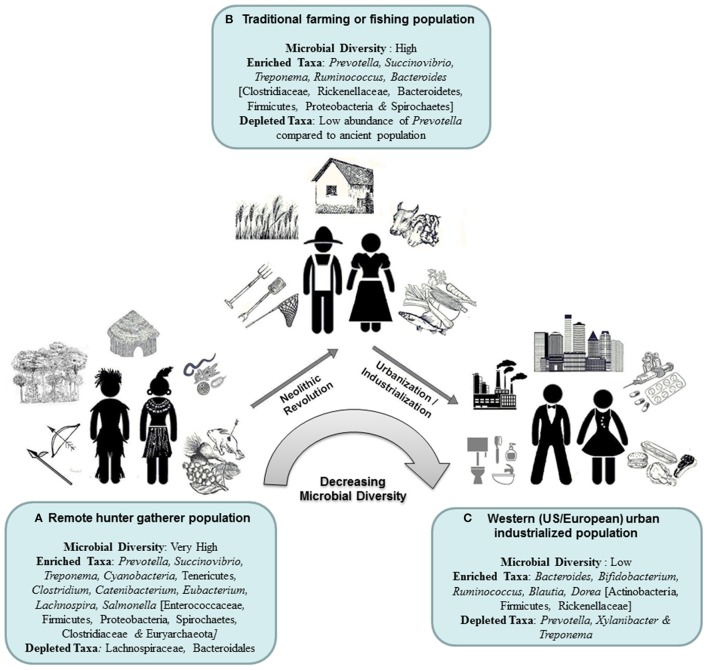
One of the fundamental issues in the microbiome research is characterization of the healthy human microbiota. Recent studies have elucidated substantial divergences in the microbiome structure between healthy individuals from different race and ethnicity. This review provides a comprehensive account of such geography, ethnicity or life-style-specific variations in healthy microbiome at five major body habitats-Gut, Oral-cavity, Respiratory Tract, Skin, and Urogenital Tract (UGT). The review focuses on the general trend in the human microbiome evolution-a gradual transition in the gross compositional structure along with a continual decrease in diversity of the microbiome, especially of the gut microbiome, as the human populations passed through three stages of subsistence like foraging, rural farming and industrialized urban western life. In general, gut microbiome of the hunter-gatherer populations is highly abundant with , Proteobacteria, Spirochaetes, Clostridiales, ., while those of the urban communities are often enriched in , and Firmicutes. The oral and skin microbiome are the next most diverse among different populations, while respiratory tract and UGT microbiome show lesser variations. Higher microbiome diversity is observed for oral-cavity in hunter-gatherer group with higher prevalence of than agricultural group. In case of skin microbiome, rural and urban Chinese populations show variation in abundance of and . On the basis of published data, we have characterized the core microbiota-the set of genera commonly found in all populations, irrespective of their geographic locations, ethnicity or mode of subsistence. We have also identified the major factors responsible for geography-based alterations in microbiota; though it is not yet clear which factor plays a dominant role in shaping the microbiome-nature or nurture, host genetics or his environment. Some of the geographical/racial variations in microbiome structure have been attributed to differences in host genetics and innate/adaptive immunity, while in many other cases, cultural/behavioral features like diet, hygiene, parasitic load, environmental exposure etc. overshadow genetics. The ethnicity or population-specific variations in human microbiome composition, as reviewed in this report, question the universality of the microbiome-based therapeutic strategies and recommend for geographically tailored community-scale approaches to microbiome engineering.
微生物组研究的基本问题之一是对健康人类微生物群进行表征。最近的研究已经阐明了不同种族和族裔的健康个体之间微生物组结构的显著差异。本综述全面介绍了在肠道、口腔、呼吸道、皮肤和泌尿生殖道(UGT)这五个主要身体部位,健康微生物组在地理、种族或生活方式方面的特定差异。该综述关注人类微生物组进化的总体趋势——随着人类群体经历觅食、农村农耕和工业化城市西方生活这三个生存阶段,微生物组的总体组成结构逐渐转变,多样性持续下降,尤其是肠道微生物组。一般来说,狩猎采集人群的肠道微生物组中,变形菌门、螺旋体门、梭菌目等含量丰富,而城市社区人群的肠道微生物组中,拟杆菌门和厚壁菌门往往更为丰富。口腔和皮肤微生物组在不同人群中多样性次之,而呼吸道和泌尿生殖道微生物组的差异较小。在狩猎采集人群的口腔中观察到更高的微生物组多样性,其中普氏菌属的患病率高于农业人群。就皮肤微生物组而言,中国农村和城市人群在葡萄球菌属和丙酸杆菌属的丰度上存在差异。根据已发表的数据,我们已经确定了核心微生物群——即在所有人群中普遍存在的一组属,无论其地理位置、种族或生存方式如何。我们还确定了导致微生物群基于地理的变化的主要因素;尽管尚不清楚哪个因素在塑造微生物组方面起主导作用——是天性还是养育、宿主基因还是其环境。微生物组结构的一些地理/种族差异归因于宿主基因以及先天/适应性免疫的差异,而在许多其他情况下,饮食、卫生、寄生虫负荷、环境暴露等文化/行为特征比基因更具影响力。如本报告所述,人类微生物组组成中的种族或人群特异性差异对基于微生物组的治疗策略的普遍性提出了质疑,并建议采用针对不同地理区域量身定制的社区规模微生物组工程方法。