School of Primary Care and Population Sciences, Faculty of Medicine, University of Southampton, Southampton, UK.
Department of Obstetrics and Gynaecology, University of Copenhagen, Zealand University Hospital, Roskilde, Denmark.
BMJ Open. 2019 Jul 9;9(7):e026220. doi: 10.1136/bmjopen-2018-026220.
Maternal overweight and obesity during pregnancy increases the risk of large-for-gestational age (LGA) birth and childhood obesity. We aimed to investigate the association between maternal weight change between subsequent pregnancies and risk of having a LGA birth.
Population-based cohort.
Routinely collected antenatal healthcare data between January 2003 and September 2017 at University Hospital Southampton, England.
Health records of women with their first two consecutive singleton live-birth pregnancies were analysed (n=15 940).
Risk of LGA, recurrent LGA and new LGA births in the second pregnancy.
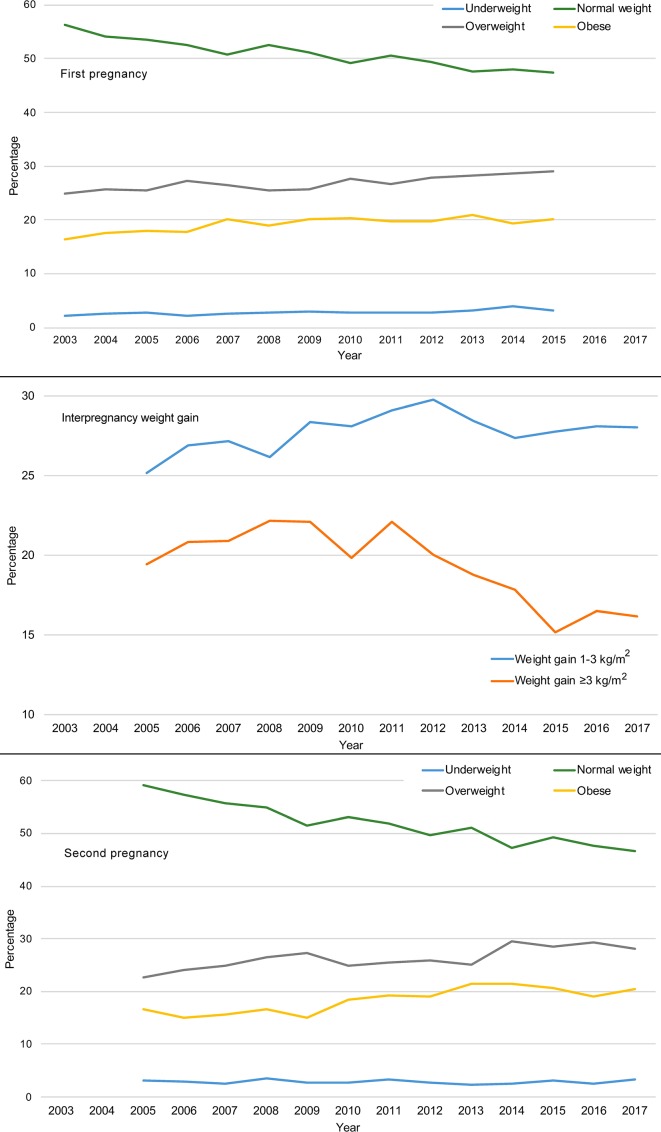
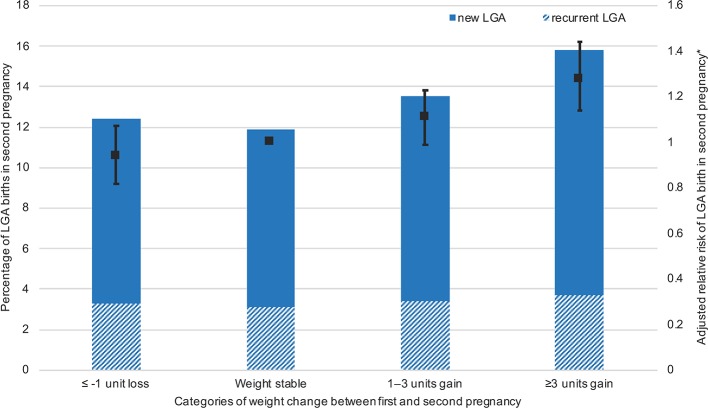
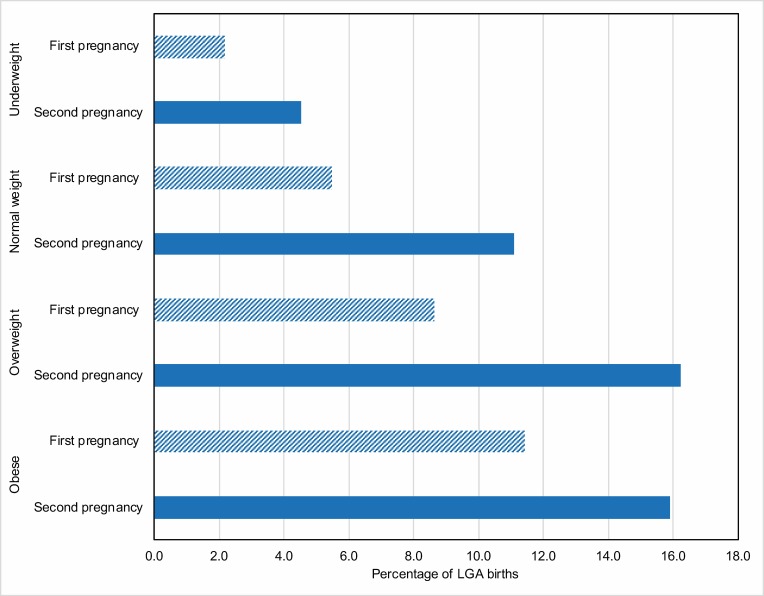
Of the 15 940 women, 16.0% lost and 47.7% gained weight (≥1 kg/m) between pregnancies. A lower proportion of babies born to women who lost ≥1 kg/m (12.4%) and remained weight stable between -1 and 1 kg/m (11.9%) between pregnancies were LGA compared with 13.5% and 15.9% in women who gained 1-3 and ≥3 kg/m, respectively. The highest proportion was in obese women who gained ≥3 kg/m (21.2%). Overweight women had a reduced risk of recurrent LGA in the second pregnancy if they lost ≥1 kg/m (adjusted relative risk (aRR) 0.69, 95% CI 0.48 to 0.97) whereas overweight women who gained ≥3 kg/m were at increased risk of new LGA after having a non-LGA birth in their first pregnancy (aRR 1.35, 95% CI 1.05 to 1.75). Normal-weight women who gained weight were also at increased risk of new LGA in the second pregnancy (aRR 1.26, 95% CI 1.06 to 1.50 with gain of 1-3 kg/m and aRR 1.34, 95% CI 1.09 to 1.65 with gain of ≥3 kg/m).
Losing weight after an LGA birth was associated with a reduced LGA risk in the next pregnancy in overweight women, while interpregnancy weight gain was associated with an increased new LGA risk. Preventing weight gain between pregnancies is an important measure to achieve better maternal and offspring outcomes.
孕期母体超重和肥胖会增加巨大儿(LGA)出生和儿童肥胖的风险。本研究旨在探讨随后妊娠期间母体体重变化与 LGA 出生风险之间的关系。
基于人群的队列研究。
英格兰南安普顿大学医院 2003 年 1 月至 2017 年 9 月间常规收集的产前保健数据。
分析了首次连续两次单胎活产妊娠的妇女的健康记录(n=15940)。
第二次妊娠中 LGA、复发性 LGA 和新 LGA 出生的风险。
在 15940 名妇女中,16.0%的人在两次妊娠之间减轻了体重(≥1kg/m),47.7%的人增加了体重(≥1kg/m)。与体重增加 1-3kg/m 和≥3kg/m 的妇女相比,体重减轻≥1kg/m(12.4%)和两次妊娠之间体重稳定在-1kg/m 至 1kg/m(11.9%)的妇女所生婴儿 LGA 的比例较低。在体重增加≥3kg/m 的肥胖妇女中比例最高(21.2%)。如果超重妇女在第二次妊娠中体重减轻≥1kg/m,则 LGA 的复发风险降低(调整后的相对风险(aRR)0.69,95%CI 0.48 至 0.97),而体重增加≥3kg/m 的超重妇女在第一次妊娠中生育非 LGA 婴儿后,LGA 的新发病风险增加(aRR 1.35,95%CI 1.05 至 1.75)。体重正常的妇女如果在第二次妊娠中增加体重,也会增加新的 LGA 风险(体重增加 1-3kg/m 时 aRR 为 1.26,95%CI 为 1.06 至 1.50,体重增加≥3kg/m 时 aRR 为 1.34,95%CI 为 1.09 至 1.65)。
LGA 出生后减轻体重与超重妇女下次妊娠中 LGA 风险降低有关,而两次妊娠之间的体重增加与新 LGA 风险增加有关。防止妊娠期间体重增加是实现母婴更好结局的重要措施。