
一项针对儿童的肥胖预防计划的经济学评价:在学校中进行的 WAVES 集群随机对照试验的结果。
Economic evaluation of a childhood obesity prevention programme for children: Results from the WAVES cluster randomised controlled trial conducted in schools.
机构信息
Institute of Applied Health Research, University of Birmingham, Birmingham, United Kingdom.
出版信息
PLoS One. 2019 Jul 10;14(7):e0219500. doi: 10.1371/journal.pone.0219500. eCollection 2019.
BACKGROUND
Childhood obesity is a serious public health challenge and schools have been identified as an ideal place to implement prevention interventions. The aim of this study was to measure the cost-effectiveness of a multi-faceted school-based obesity prevention intervention targeting children aged 6-7 years when compared to 'usual activities'.
METHODS
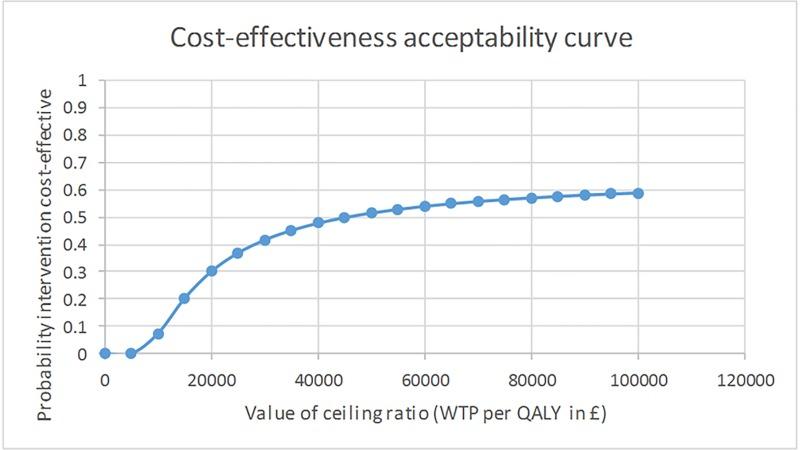
A cluster randomised controlled trial in 54 schools across the West Midlands (UK) was conducted. The 12-month intervention aimed to increase physical activity by 30 minutes per day and encourage healthy eating. Costs were captured from a public sector perspective and utility-based health related outcomes measured using the CHU-9D. Multiple imputation using chained equations was used to address missing data. The cost effectiveness was measured at 30 months from baseline using a hierarchical net-benefit regression framework, that controlled for clustering and prespecified covariates. Any uncertainty in the results was characterised using cost-effectiveness acceptability curves.
RESULTS
At 30 months, the total adjusted incremental mean cost of the intervention was £155 (95% confidence interval [CI]: £139, £171), and the incremental mean QALYs gained was 0.006 (95% CI: -0.024, 0.036), per child. The incremental cost-effectiveness at 30 months was £26,815 per QALY and using a standard willingness to pay threshold of £30,000 per QALY, there was a 52% chance that the intervention was cost-effective.
CONCLUSIONS
The cost-effectiveness of the school-based WAVES intervention was subject to substantial uncertainty. We therefore recommend more research to explore obesity prevention within schools as part of a wider systems approach to obesity prevention.
TRIAL REGISTRATION
This paper uses data collected by the WAVES trial: Controlled trials ISRCTN97000586 (registered May 2010).
背景
儿童肥胖是一个严重的公共卫生挑战,学校已被确定为实施预防干预的理想场所。本研究旨在测量针对 6-7 岁儿童的多方面基于学校的肥胖预防干预措施与“常规活动”相比的成本效益。
方法
在英国西米德兰兹地区的 54 所学校进行了一项群组随机对照试验。为期 12 个月的干预旨在每天增加 30 分钟的身体活动并鼓励健康饮食。从公共部门的角度捕获成本,并使用 CHU-9D 测量基于效用的健康相关结果。使用链式方程的多重插补来处理缺失数据。使用分层净效益回归框架,在从基线开始 30 个月时测量成本效益,该框架控制了聚类和预先指定的协变量。使用成本效益接受曲线来描述结果的任何不确定性。
结果
在 30 个月时,干预措施的总调整后增量平均成本为 155 英镑(95%置信区间[CI]:139 英镑,171 英镑),每儿童增量平均 QALY 增加 0.006(95%CI:-0.024,0.036)。30 个月时的增量成本效益为每 QALY 26,815 英镑,使用 30,000 英镑/QALY 的标准意愿支付阈值,干预措施有 52%的可能性具有成本效益。
结论
基于学校的 WAVES 干预措施的成本效益存在很大的不确定性。因此,我们建议进行更多的研究,探索学校内的肥胖预防措施,作为肥胖预防的更广泛系统方法的一部分。
试验注册
本文使用 WAVES 试验收集的数据:对照试验 ISRCTN97000586(2010 年 5 月注册)。

 Zotero 插件