Adab Peymane, Pallan Miranda J, Lancashire Emma R, Hemming Karla, Frew Emma, Barrett Tim, Bhopal Raj, Cade Janet E, Canaway Alastair, Clarke Joanne L, Daley Amanda, Deeks Jonathan J, Duda Joan L, Ekelund Ulf, Gill Paramjit, Griffin Tania, McGee Eleanor, Hurley Kiya, Martin James, Parry Jayne, Passmore Sandra, Cheng K K
Institute of Applied Health Research, University of Birmingham, Birmingham, UK
Institute of Applied Health Research, University of Birmingham, Birmingham, UK.
BMJ. 2018 Feb 7;360:k211. doi: 10.1136/bmj.k211.
To assess the effectiveness of a school and family based healthy lifestyle programme (WAVES intervention) compared with usual practice, in preventing childhood obesity.
Cluster randomised controlled trial.
UK primary schools from the West Midlands.
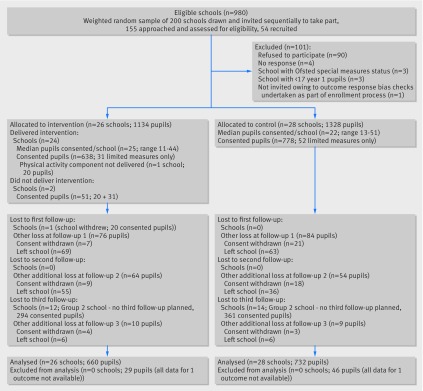
200 schools were randomly selected from all state run primary schools within 35 miles of the study centre (n=980), oversampling those with high minority ethnic populations. These schools were randomly ordered and sequentially invited to participate. 144 eligible schools were approached to achieve the target recruitment of 54 schools. After baseline measurements 1467 year 1 pupils aged 5 and 6 years (control: 28 schools, 778 pupils) were randomised, using a blocked balancing algorithm. 53 schools remained in the trial and data on 1287 (87.7%) and 1169 (79.7%) pupils were available at first follow-up (15 month) and second follow-up (30 month), respectively.
The 12 month intervention encouraged healthy eating and physical activity, including a daily additional 30 minute school time physical activity opportunity, a six week interactive skill based programme in conjunction with Aston Villa football club, signposting of local family physical activity opportunities through mail-outs every six months, and termly school led family workshops on healthy cooking skills.
The protocol defined primary outcomes, assessed blind to allocation, were between arm difference in body mass index (BMI) z score at 15 and 30 months. Secondary outcomes were further anthropometric, dietary, physical activity, and psychological measurements, and difference in BMI z score at 39 months in a subset.
Data for primary outcome analyses were: baseline, 54 schools: 1392 pupils (732 controls); first follow-up (15 months post-baseline), 53 schools: 1249 pupils (675 controls); second follow-up (30 months post-baseline), 53 schools: 1145 pupils (621 controls). The mean BMI z score was non-significantly lower in the intervention arm compared with the control arm at 15 months (mean difference -0.075 (95% confidence interval -0.183 to 0.033, P=0.18) in the baseline adjusted models. At 30 months the mean difference was -0.027 (-0.137 to 0.083, P=0.63). There was no statistically significant difference between groups for other anthropometric, dietary, physical activity, or psychological measurements (including assessment of harm).
The primary analyses suggest that this experiential focused intervention had no statistically significant effect on BMI z score or on preventing childhood obesity. Schools are unlikely to impact on the childhood obesity epidemic by incorporating such interventions without wider support across multiple sectors and environments.
Current Controlled Trials ISRCTN97000586.
评估一项基于学校和家庭的健康生活方式项目(WAVES干预)与常规做法相比,在预防儿童肥胖方面的效果。
整群随机对照试验。
西米德兰兹郡的英国小学。
从研究中心35英里范围内的所有公立小学中随机选取200所学校(n = 980),对少数族裔人口多的学校进行过度抽样。这些学校被随机排序并依次邀请参与。共联系了144所符合条件的学校,以达到54所学校的目标招募数量。在进行基线测量后,使用区组平衡算法将1467名5至6岁的一年级学生(对照组:28所学校,778名学生)进行随机分组。53所学校继续参与试验,分别有1287名(87.7%)和1169名(79.7%)学生在首次随访(15个月)和第二次随访(30个月)时的数据可用。
为期12个月的干预鼓励健康饮食和体育活动,包括每天额外增加30分钟的校内体育活动时间、与阿斯顿维拉足球俱乐部合作开展的为期六周的基于技能的互动项目、每六个月通过邮寄宣传当地家庭体育活动机会,以及学校定期举办的关于健康烹饪技能的家庭工作坊。
方案定义的主要结局,在分配情况未知的情况下进行评估,为15个月和30个月时两组间体重指数(BMI)z评分的差异。次要结局包括进一步的人体测量、饮食、体育活动和心理测量,以及一个子集在39个月时BMI z评分的差异。
主要结局分析的数据如下:基线时,54所学校:1392名学生(732名对照组);首次随访(基线后15个月),53所学校:1249名学生(675名对照组);第二次随访(基线后30个月),53所学校:1145名学生(621名对照组)。在基线调整模型中,干预组的平均BMI z评分在15个月时比对照组略低,但无统计学意义(平均差异 -0.075(95%置信区间 -0.183至0.033,P = 0.18))。在30个月时,平均差异为 -0.027(-0.137至0.083,P = 0.63)。在其他人体测量、饮食、体育活动或心理测量(包括危害评估)方面,两组之间没有统计学上的显著差异。
主要分析表明,这种以体验为重点的干预对BMI z评分或预防儿童肥胖没有统计学上的显著效果。如果没有多个部门和环境的更广泛支持,学校通过纳入此类干预措施不太可能对儿童肥胖流行产生影响。
当前对照试验ISRCTN97000586。