State Key Laboratory for Conservation and Utilization of Bio-Resources in Yunnan, Yunnan University, Kunming, 650091, China.
School of Ecology and Environmental Science, Yunnan University, Kunming, 650091, China.
BMC Microbiol. 2019 Jul 10;19(1):158. doi: 10.1186/s12866-019-1501-z.
Gastrodia elata is a widely distributed achlorophyllous orchid and is highly valued as both medicine and food. Gastrodia elata produces dust-like seeds and relies on mycorrhizal fungi for its germination and growth. In its life cycle, G. elata is considered to switch from a specific single-fungus relationship (Mycena) to another single-fungus relationship (Armillaria). However, no studies have investigated the changes in the plant-fungus relationship during the growth of G. elata in the wild. In this study, high-throughput sequencing was used to characterize the fungal community of tubers in different growth phases as well as the soils surrounding G. elata.
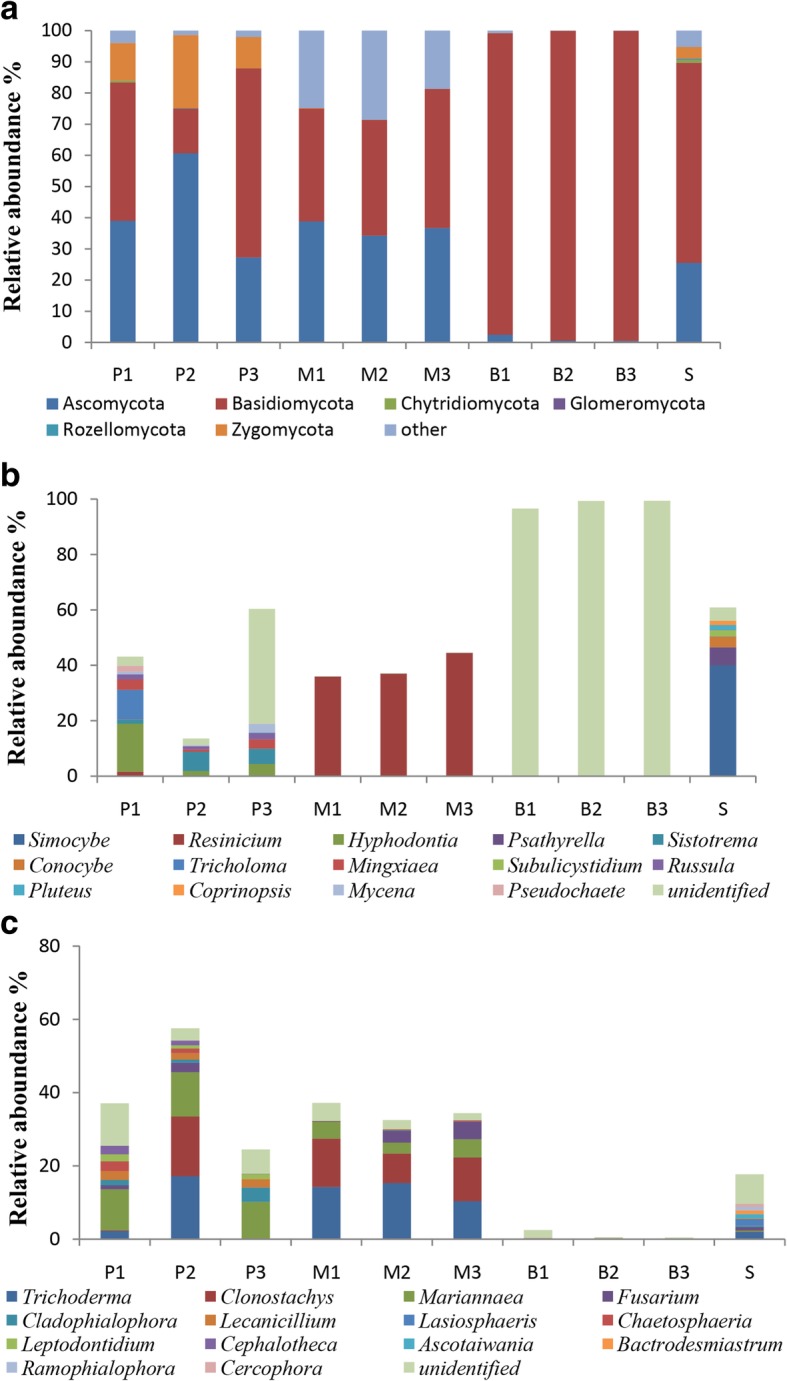
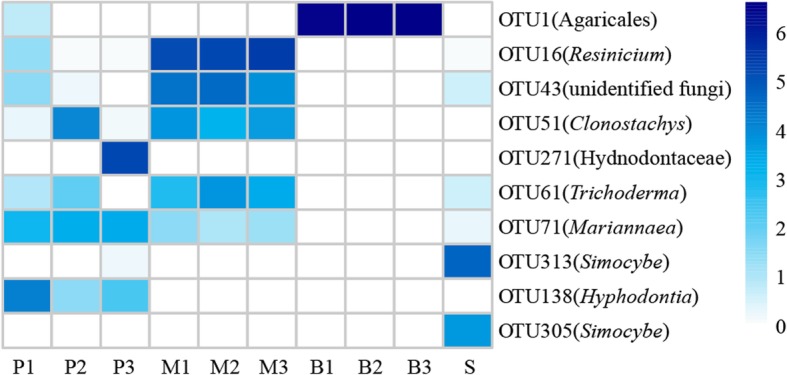
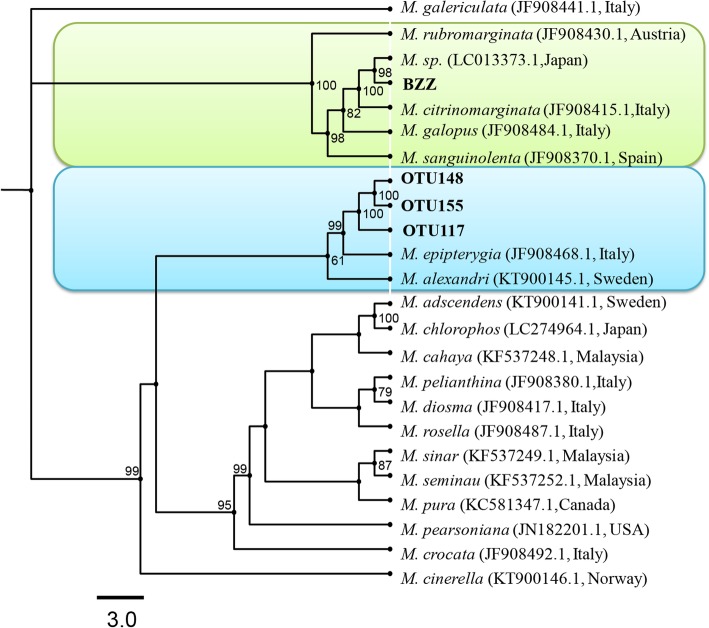
The predominant fungi were Basidiomycota (60.44%) and Ascomycota (26.40%), which exhibited changes in abundance and diversity with the growth phases of G. elata. Diverse basidiomycetes in protocorms (phase P) were Hyphodontia, Sistotrema, Tricholoma, Mingxiaea, Russula, and Mycena, but the community changed from a large proportion of Resinicium bicolor (40%) in rice-like tubers (phase M) to an unidentified Agaricales operational taxonomic unit 1(OTU1,98.45%) in propagation vegetation tubers (phase B). The soil fungi primarily included Simocybe, Psathyrella, Conocybe, and Subulicystidium. Three Mycena OTUs obtained in this study were differentially distributed among the growth phases of G. elata, accounting for less than 1.0% of the total reads, and were phylogenetically close to Mycena epipterygia and M. alexandri.
Our data indicated that G. elata interacts with a broad range of fungi beyond the Mycena genus. These fungi changed with the growth phases of G. elata. In addition, these data suggested that the development of the fungal community during the growth of G. elata was more complex than previously assumed and that at least two different fungi could be involved in development before the arrival of Armillaria.
天麻是一种分布广泛的无叶绿素兰花,既是药材又是食品,具有很高的价值。天麻产生尘状的种子,依靠菌根真菌来萌发和生长。在其生命周期中,天麻被认为从特定的单真菌关系(蜜环菌属)转变为另一种单真菌关系(蜜环菌属)。然而,尚无研究调查天麻在野外生长过程中植物-真菌关系的变化。在这项研究中,使用高通量测序来描述不同生长阶段块茎和天麻周围土壤中的真菌群落。
优势真菌为担子菌门(60.44%)和子囊菌门(26.40%),它们的丰度和多样性随天麻生长阶段而变化。原球茎(阶段 P)中多样化的担子菌包括密环菌属、密环菌属、乳菇属、明夏氏菌属、红菇属和蜜环菌属,但群落从米粒状块茎(阶段 M)中占比 40%的大比例双色树脂菌(Resinicium bicolor)变为繁殖植被块茎(阶段 B)中未鉴定的伞菌目操作分类单元 1(OTU1,98.45%)。土壤真菌主要包括丝盖伞属、斑褶菇属、丝盖伞属和拟珊瑚菌属。本研究中获得的三个蜜环菌属 OTU 在天麻的生长阶段中存在差异分布,占总读数的比例不到 1.0%,与蜜环菌属 epipterygia 和 M. alexandri 亲缘关系较近。
我们的数据表明,天麻与除蜜环菌属以外的广泛真菌相互作用。这些真菌随天麻的生长阶段而变化。此外,这些数据表明,天麻生长过程中真菌群落的发展比之前假设的更为复杂,至少有两种不同的真菌可能在蜜环菌属到来之前参与发育。