Department of Pharmacology and Therapeutics, College of Medicine and Health Sciences, United Arab Emirates University, Al-Ain, UAE.
Department of Neurology, University of New Mexico Health Sciences Center, Albuquerque, NM, 87131, USA.
J Neuroinflammation. 2019 Jul 10;16(1):142. doi: 10.1186/s12974-019-1516-2.
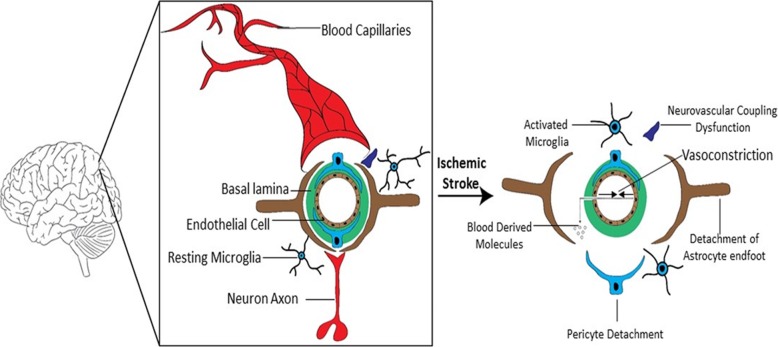
Stroke, the third leading cause of death and disability worldwide, is undergoing a change in perspective with the emergence of new ideas on neurodegeneration. The concept that stroke is a disorder solely of blood vessels has been expanded to include the effects of a detrimental interaction between glia, neurons, vascular cells, and matrix components, which is collectively referred to as the neurovascular unit. Following the acute stroke, the majority of which are ischemic, there is secondary neuroinflammation that both promotes further injury, resulting in cell death, but conversely plays a beneficial role, by promoting recovery. The proinflammatory signals from immune mediators rapidly activate resident cells and influence infiltration of a wide range of inflammatory cells (neutrophils, monocytes/macrophages, different subtypes of T cells, and other inflammatory cells) into the ischemic region exacerbating brain damage. In this review, we discuss how neuroinflammation has both beneficial as well as detrimental roles and recent therapeutic strategies to combat pathological responses. Here, we also focus on time-dependent entry of immune cells to the ischemic area and the impact of other pathological mediators, including oxidative stress, excitotoxicity, matrix metalloproteinases (MMPs), high-mobility group box 1 (HMGB1), arachidonic acid metabolites, mitogen-activated protein kinase (MAPK), and post-translational modifications that could potentially perpetuate ischemic brain damage after the acute injury. Understanding the time-dependent role of inflammatory factors could help in developing new diagnostic, prognostic, and therapeutic neuroprotective strategies for post-stroke inflammation.
中风是全球第三大致死和致残原因,随着神经退行性疾病新观念的出现,其研究视角正在发生变化。中风仅为血管疾病的概念已扩展到包括神经胶质细胞、神经元、血管细胞和基质成分之间有害相互作用的影响,这些统称为神经血管单元。大多数中风是缺血性中风,在急性中风后会发生继发性神经炎症,它既促进了进一步的损伤,导致细胞死亡,又通过促进恢复起到有益的作用。免疫介质的促炎信号迅速激活驻留细胞,并影响多种炎症细胞(中性粒细胞、单核细胞/巨噬细胞、不同亚型的 T 细胞和其他炎症细胞)浸润到缺血区域,从而加重脑损伤。在这篇综述中,我们讨论了神经炎症如何具有有益和有害的作用,以及最近用于对抗病理性反应的治疗策略。在这里,我们还重点关注免疫细胞进入缺血区域的时间依赖性以及其他病理介质的影响,包括氧化应激、兴奋毒性、基质金属蛋白酶(MMPs)、高迁移率族蛋白 B1(HMGB1)、花生四烯酸代谢物、丝裂原活化蛋白激酶(MAPK)和翻译后修饰,这些因素可能会在急性损伤后使缺血性脑损伤持续存在。了解炎症因子的时间依赖性作用可能有助于为中风后炎症开发新的诊断、预后和治疗性神经保护策略。