University of Chicago Medicine Hematology/Oncology Section, 5841 S Maryland Ave, Chicago, IL, 60637, USA.
J Immunother Cancer. 2019 Jul 10;7(1):175. doi: 10.1186/s40425-019-0611-3.
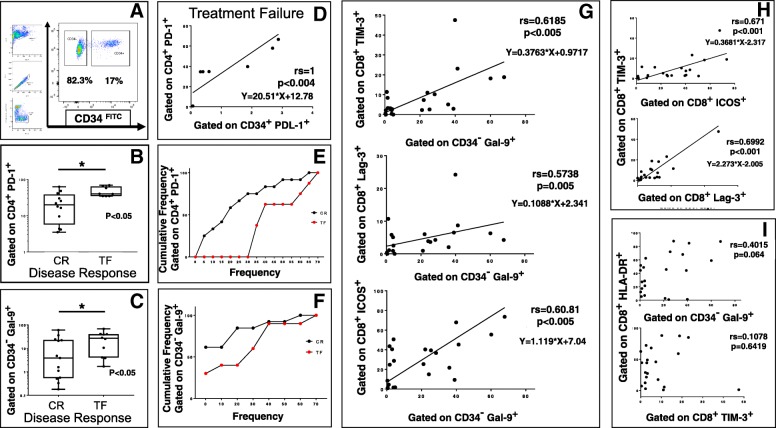
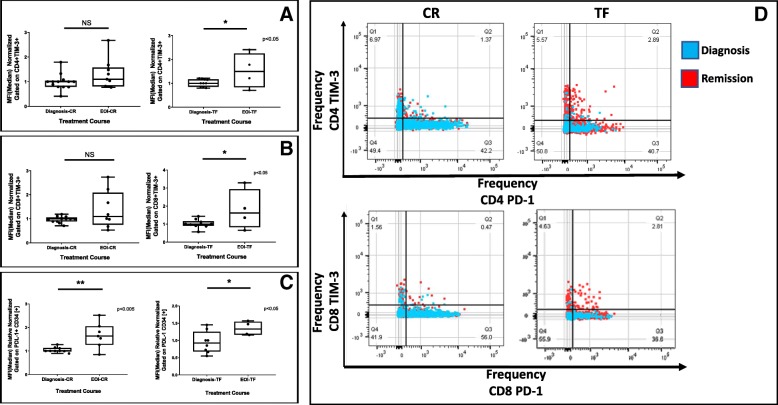
Immune checkpoint pathways active in Acute Myeloid Leukemia (AML) patients, especially during the course of remission induction chemotherapy, have not been well studied. Although dominant in mediating T cell dysfunction in cancer, it is now well-accepted that interruption of PD-1/PD-L1 axes alone does not always completely restore T cell function, indicating the involvement of additional negative regulatory pathways, such as TIM-3/Gal-9, in promoting T cell exhaustion.Here, we characterized these pathways in AML patients enrolled in a phase I dose escalation trial that combined Selinexor, a Selective Inhibitor of Nuclear Export (SINE), with high-dose cytarabine (HiDAC) and mitoxantrone (Mito) (NCT02573363) as induction therapy.To monitor changes in expression of immune checkpoint receptors, multi-parameter flow cytometry was performed on peripheral blood and bone marrow biopsy specimens at diagnosis and following induction therapy in 26 AML patients. Expression of CD47, PD-L1, PD-L2 and Gal9 was assessed on CD34 AML blasts, as well as on CD34 cell populations. In parallel, we evaluated expression of inhibitory (PD1, CTLA4, LAG3, TIM-3) and stimulatory (CD28, ICOS, CD137, OX40, CD40L, HLA-DR) co-receptors on CD4 and CD8 T cell subsets.Compared to baseline, the frequency of Gal9 CD34 cells was significantly higher in patients with treatment failure (TF) than in those in complete remission (CR), and this finding correlated with increased TIM-3 expression on marrow-resident T cells in TF patients. Moreover, when we measured the expression level of PD-1 and TIM-3 in bone marrow samples compared to peripheral blood, TIM-3 was significantly higher in BM specimens.Our results suggest that targeting the Gal9/Tim-3 axis could be effective in combination with induction chemotherapy to increase the likelihood of complete remission in AML patients.
在急性髓系白血病(AML)患者中,免疫检查点通路活跃,尤其是在缓解诱导化疗过程中,但这些通路尚未得到充分研究。虽然 PD-1/PD-L1 轴在介导 T 细胞功能障碍方面占据主导地位,但现在人们已经认识到,单独阻断 PD-1/PD-L1 轴并不总是完全恢复 T 细胞功能,这表明在促进 T 细胞耗竭方面,还存在其他负性调节途径,如 TIM-3/Gal-9。在这里,我们在一项 I 期剂量递增试验中对 AML 患者进行了这些通路的特征描述,该试验将 Selinexor(一种选择性核输出抑制剂 [SINE])与高剂量阿糖胞苷(HiDAC)和米托蒽醌(Mito)联合用于诱导治疗(NCT02573363)。为了监测免疫检查点受体表达的变化,我们对 26 名 AML 患者的外周血和骨髓活检标本在诊断时以及诱导治疗后进行了多参数流式细胞术检测。在 CD34 AML blasts 以及 CD34 细胞群上评估了 CD47、PD-L1、PD-L2 和 Gal9 的表达。同时,我们评估了抑制性(PD1、CTLA4、LAG3、TIM-3)和刺激性(CD28、ICOS、CD137、OX40、CD40L、HLA-DR)共受体在 CD4 和 CD8 T 细胞亚群上的表达。与基线相比,治疗失败(TF)患者的 Gal9 CD34 细胞频率明显高于完全缓解(CR)患者,并且这一发现与 TF 患者骨髓中驻留 T 细胞 TIM-3 表达增加相关。此外,当我们将骨髓样本与外周血样本中的 PD-1 和 TIM-3 表达水平进行比较时,发现 TIM-3 在 BM 标本中明显更高。我们的结果表明,靶向 Gal9/Tim-3 轴可能与诱导化疗相结合,以提高 AML 患者完全缓解的可能性。