Department of Respiratory Diseases and Thoracic Oncology, APHP - Hopital Ambroise Pare, Boulogne-Billancourt, France.
EA 4340, UVSQ, Université Paris-Saclay, Boulogne-Billancourt, France.
J Immunother Cancer. 2019 Jul 10;7(1):176. doi: 10.1186/s40425-019-0658-1.
Recent data suggested a role of gut microbiota and antibiotic use on immune checkpoint inhibitors efficacy. We aimed to evaluate the impact of early use of antibiotic (EUA), blood microbiome and plasmatic citrulline (marker of the intestinal barrier) on nivolumab efficacy in non-small cell lung cancer (NSCLC).
We included all consecutive patients with advanced NSCLC treated with nivolumab in our Department between 2014 and 2017. Blood microbiome was analyzed at month (M) M0 and M2. Citrulline rates were evaluated at M0, M2, M4 and M6.
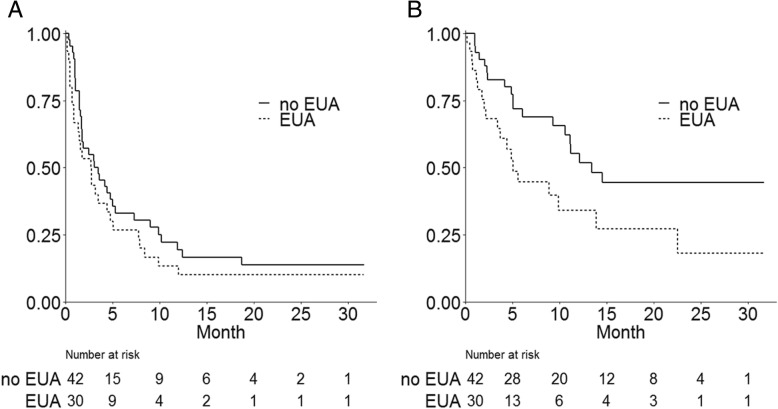
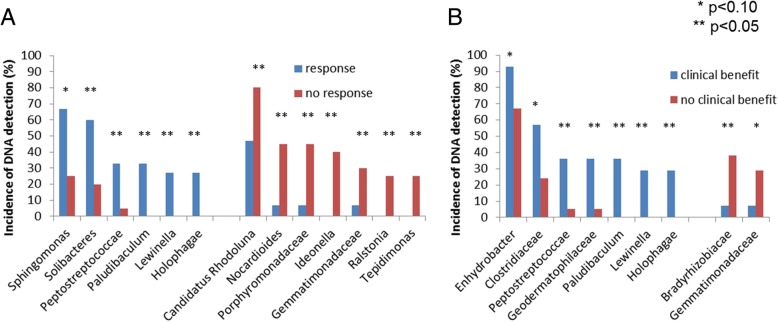
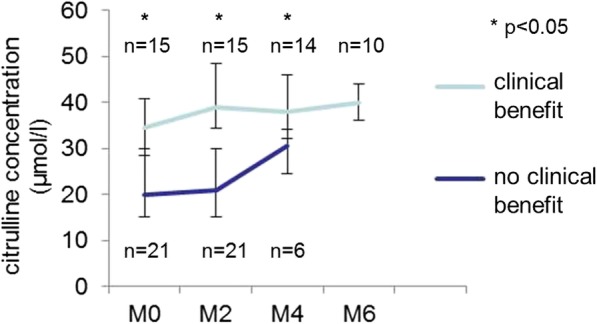
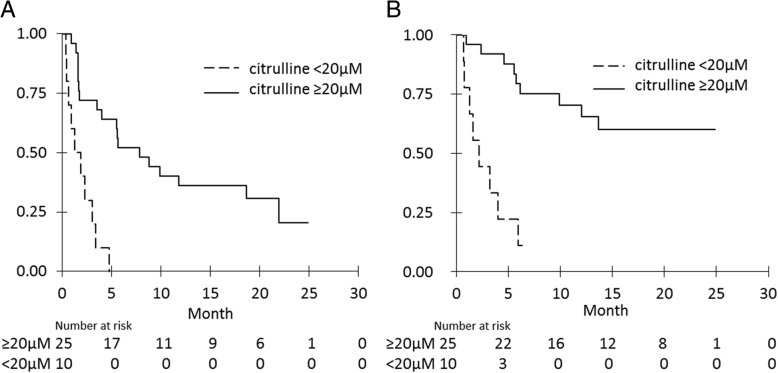
Seventy-two patients were included (EUA in 42%). Overall survival (OS) was longer without EUA (median 13.4 months) than with EUA (5.1 months, p = 0.03). Thirty-five patients (49%) had plasma samples available. High citrulline rate (≥20 μM) at M0 was associated with tumor response (p = 0.084) and clinical benefit (nivolumab > 6 months) (p = 0.002). Median progression-free survival (PFS) was 7.9 months (high citrulline) vs 1.6 months (low citrulline) (p < 0.0001), and median OS were respectively non reached vs 2.2 months (p < 0.0001). Patients with EUA had lower median citrulline rates at M0: 21 μM (IQR 15.0-30.8) vs 32 μM (IQR 24.0-42.0) without EUA (p = 0.044). The presence of specific bacterial DNA in blood at M0 was associated with response and clinical benefit (Peptostreptococcae, Paludibaculum, Lewinella) or with tumor progression (Gemmatimonadaceae). Multivariate analyses on PFS and OS confirmed the prognostic role of citrulline and blood microbiome.
EUA is associated with shorter OS with nivolumab and lower citrulline rates. Plasma citrulline and blood microbiome appear to be promising predictive factors of nivolumab efficacy.
最近的数据表明,肠道微生物群和抗生素的使用与免疫检查点抑制剂的疗效有关。我们旨在评估早期使用抗生素(EUA)、血液微生物组和血浆瓜氨酸(肠道屏障的标志物)对非小细胞肺癌(NSCLC)患者纳武利尤单抗疗效的影响。
我们纳入了 2014 年至 2017 年间在我科接受纳武利尤单抗治疗的所有晚期 NSCLC 连续患者。在 M0 和 M2 时分析血液微生物组。在 M0、M2、M4 和 M6 时评估瓜氨酸水平。
共纳入 72 例患者(EUA 组 42%)。无 EUA 组(中位 13.4 个月)的总生存期(OS)长于有 EUA 组(5.1 个月,p=0.03)。35 例患者(49%)有血浆样本可用。M0 时高瓜氨酸率(≥20μM)与肿瘤反应(p=0.084)和临床获益(纳武利尤单抗>6 个月)相关(p=0.002)。中位无进展生存期(PFS)分别为 7.9 个月(高瓜氨酸)和 1.6 个月(低瓜氨酸)(p<0.0001),中位 OS 分别为未达到和 2.2 个月(p<0.0001)。EUA 组患者 M0 时中位瓜氨酸水平较低:21μM(IQR 15.0-30.8)vs 无 EUA 组 32μM(IQR 24.0-42.0)(p=0.044)。M0 时血液中特定细菌 DNA 的存在与反应和临床获益相关(消化链球菌属、苍白杆菌属、鲁维氏菌属)或与肿瘤进展相关(动弯杆菌科)。PFS 和 OS 的多变量分析证实了瓜氨酸和血液微生物组的预后作用。
EUA 与纳武利尤单抗的 OS 较短有关,且瓜氨酸水平较低。血浆瓜氨酸和血液微生物组似乎是纳武利尤单抗疗效的有前途的预测因子。