Institute for Tuberculosis Research, College of Pharmacy, University of Illinois at Chicago, Chicago, IL, USA.
Department of Medicinal Chemistry & Pharmacognosy, College of Pharmacy, University of Illinois at Chicago, Chicago, IL, USA.
J Antibiot (Tokyo). 2019 Oct;72(10):719-728. doi: 10.1038/s41429-019-0205-9. Epub 2019 Jul 11.
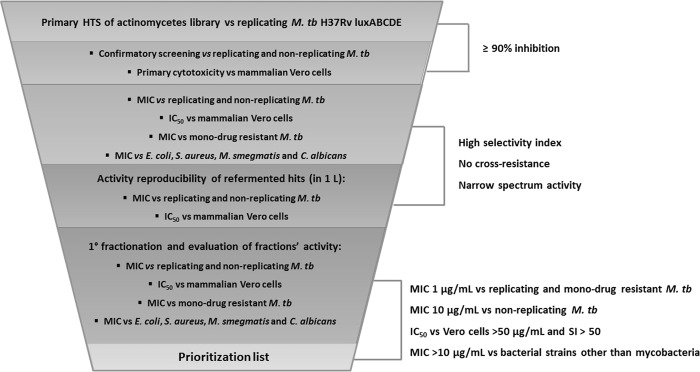
The rise of multi- and extensively drug-resistant Mycobacterium tuberculosis (M. tb) strains and co-infection with human immunodeficiency virus has escalated the need for new anti-M. tb drugs. Numerous challenges associated with the M. tb, in particular slow growth and pathogenicity level 3, discouraged use of this organism in past primary screening efforts. From current knowledge of the physiology and drug susceptibility of mycobacteria in general and M. tb specifically, it can be assumed that many potentially useful drug leads were missed by failing to screen directly against this pathogen. This review discusses recent high-throughput phenotypic screening strategies for anti-M. tb drug discovery. Emphasis is placed on prioritization of hits, including their extensive biological and chemical profiling, as well as the development status of promising drug candidates discovered with phenotypic screening.
耐多药和广泛耐药结核分枝杆菌(M. tb)菌株的出现以及与人类免疫缺陷病毒的合并感染,加剧了对新型抗结核药物的需求。结核分枝杆菌,特别是生长缓慢和致病性 3 级,与结核分枝杆菌相关的诸多挑战,过去在初次筛选中阻止了这种生物的使用。从目前对分枝杆菌生理和药物敏感性的了解,特别是结核分枝杆菌,可以假设,如果没有直接针对这种病原体进行筛选,许多潜在有用的药物先导物可能会被遗漏。本综述讨论了最近用于抗结核药物发现的高通量表型筛选策略。重点是对命中物的优先级排序,包括对它们的广泛的生物学和化学分析,以及通过表型筛选发现的有前途的候选药物的开发状况。