Pernègre Camille, Duquette Antoine, Leclerc Nicole
Research Centre of the University of Montreal Hospital (CRCHUM), Montréal, QC, Canada.
Département de Neurosciences, Faculty of Medicine, Université de Montréal, Montréal, QC, Canada.
Front Neurosci. 2019 Jun 26;13:649. doi: 10.3389/fnins.2019.00649. eCollection 2019.
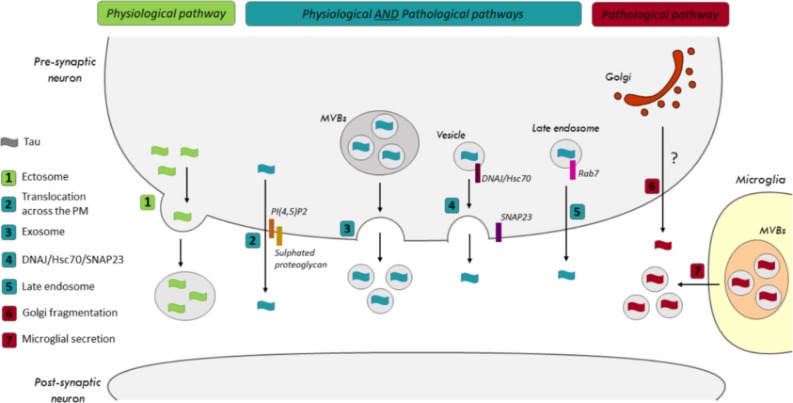
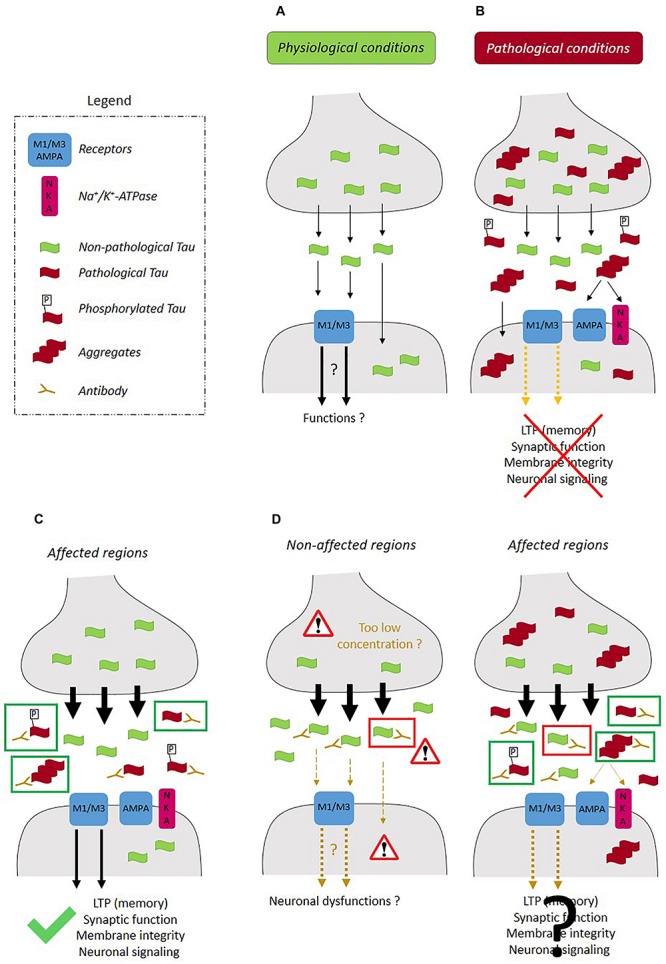
In Alzheimer's disease (AD), neurofibrillary tangles (NFTs), lesions composed of hyperphosphorylated and aggregated tau, spread from the transentorhinal cortex to the hippocampal formation and neocortex. Growing evidence indicates that tau pathology propagates synaptically, implying that pathological tau released by pre-synaptic neurons is taken up by post-synaptic neurons where it accumulates and aggregates. Observations such as the presence of tau in the cerebrospinal fluid (CSF) from control individuals and in the CSF of transgenic mice overexpressing human tau before the detection of neuronal death indicate that tau can be secreted by neurons. The increase of tau in the CSF in pathological conditions such as AD suggests that tau secretion is enhanced and/or other secretory pathways take place when neuronal function is compromised. In physiological conditions, extracellular tau could exert beneficial effects as observed for other cytosolic proteins also released in the extracellular space. In such a case, blocking tau secretion could have negative effects on neurons unless the mechanism of tau secretion are different in physiological and pathological conditions allowing the prevention of pathological tau secretion without affecting the secretion of physiological tau. Furthermore, distinct extracellular tau species could be secreted in physiological and pathological conditions, species having the capacity to induce tau pathology being only secreted in the latter condition. In the present review, we will focus on the mechanisms and function of tau secretion in both physiological and pathological conditions and how this information can help to elaborate an efficient therapeutic strategy to prevent tau pathology and its propagation.
在阿尔茨海默病(AD)中,神经原纤维缠结(NFTs)是由过度磷酸化和聚集的tau蛋白组成的病变,从内嗅皮质扩散至海马结构和新皮质。越来越多的证据表明,tau蛋白病变通过突触进行传播,这意味着突触前神经元释放的病理性tau蛋白被突触后神经元摄取,并在其中积累和聚集。诸如在未检测到神经元死亡之前,对照个体的脑脊液(CSF)以及过表达人类tau蛋白的转基因小鼠的脑脊液中存在tau蛋白等观察结果表明,tau蛋白可由神经元分泌。在AD等病理条件下,脑脊液中tau蛋白的增加表明,当神经元功能受损时,tau蛋白分泌增强和/或发生了其他分泌途径。在生理条件下,细胞外tau蛋白可能发挥有益作用,正如在细胞外空间中释放的其他胞质蛋白所观察到的那样。在这种情况下,阻断tau蛋白分泌可能会对神经元产生负面影响,除非生理和病理条件下tau蛋白分泌机制不同,从而能够在不影响生理tau蛋白分泌的情况下预防病理性tau蛋白的分泌。此外,在生理和病理条件下可能分泌不同的细胞外tau蛋白种类,只有在病理条件下才会分泌具有诱导tau蛋白病变能力的种类。在本综述中,我们将重点关注生理和病理条件下tau蛋白分泌的机制和功能,以及这些信息如何有助于制定有效的治疗策略,以预防tau蛋白病变及其传播。