Gao Chun-Hui, Mortimer Monika, Zhang Ming, Holden Patricia A, Cai Peng, Wu Shan, Xin Yuexing, Wu Yichao, Huang Qiaoyun
State Key Laboratory of Agricultural Microbiology, College of Resources and Environment, Huazhong Agricultural University, Wuhan, China.
Bren School of Environmental Science and Management, Earth Research Institute and University of California Center for the Environmental Implications of Nanotechnology (UC CEIN), University of California, Santa Barbara, Santa Barbara, CA, USA.
PeerJ. 2019 Jun 27;7:e7228. doi: 10.7717/peerj.7228. eCollection 2019.
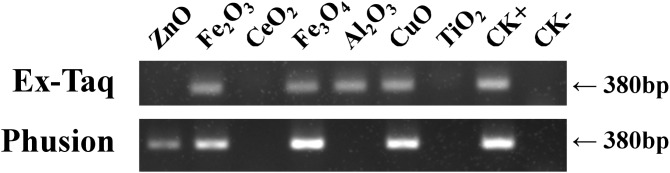
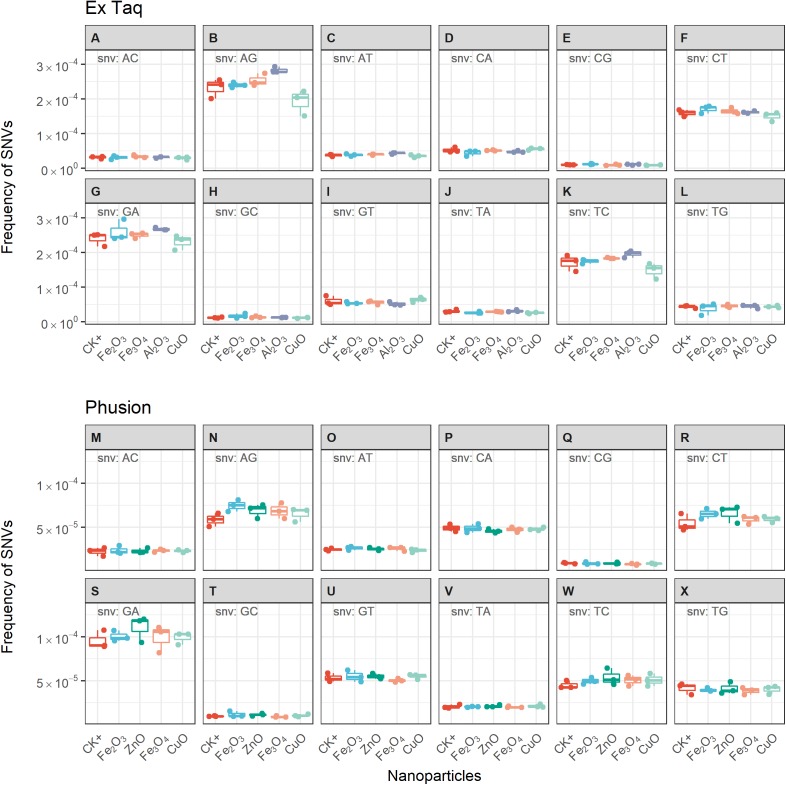
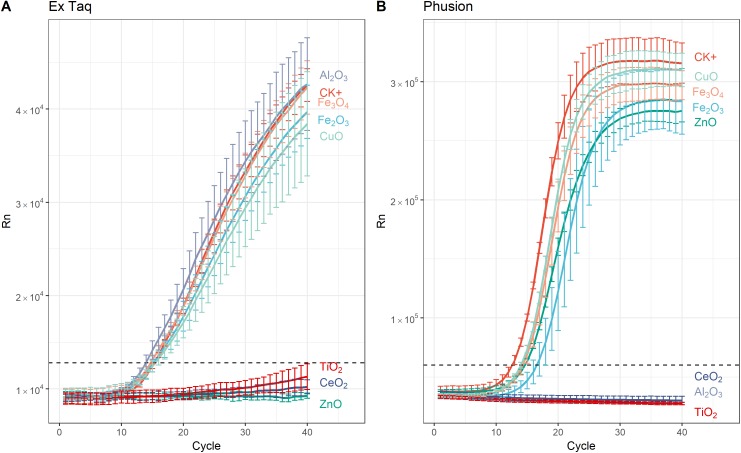
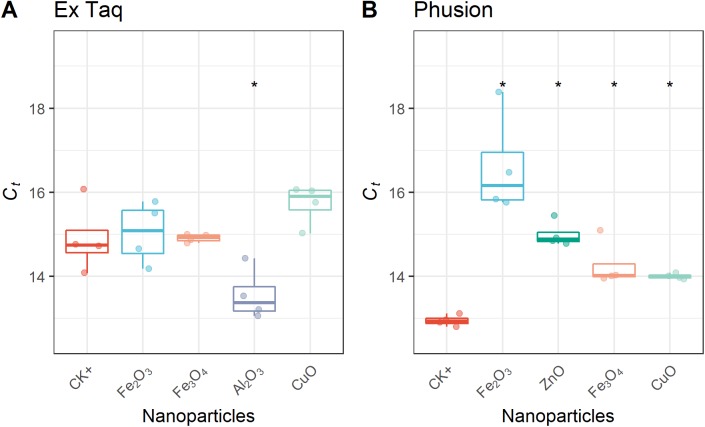
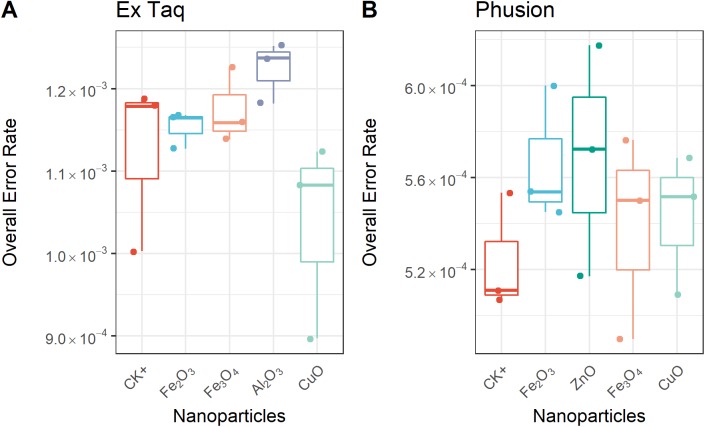
Polymerase chain reaction (PCR) is used as an in vitro model system of DNA replication to assess the genotoxicity of nanoparticles (NPs). Prior results showed that several types of NPs inhibited PCR efficiency and increased amplicon error frequency. In this study, we examined the effects of various metal oxide NPs on inhibiting PCR, using high- vs. low-fidelity DNA polymerases; we also examined NP-induced DNA mutation bias at the single nucleotide level. The effects of seven major types of metal oxide NPs (FeO, ZnO, CeO, FeO, AlO, CuO, and TiO) on PCR replication via a low-fidelity DNA polymerase (Ex Taq) and a high-fidelity DNA polymerase (Phusion) were tested. The successfully amplified PCR products were subsequently sequenced using high-throughput amplicon sequencing. Using consistent proportions of NPs and DNA, we found that the effects of NPs on PCR yield differed depending on the DNA polymerase. Specifically, the efficiency of the high-fidelity DNA polymerase (Phusion) was significantly inhibited by NPs during PCR; such inhibition was not evident in reactions with Ex Taq. Amplicon sequencing showed that the overall error rate of NP-amended PCR was not significantly different from that of PCR without NPs ( > 0.05), and NPs did not introduce single nucleotide polymorphisms during PCR. Thus, overall, NPs inhibited PCR amplification in a DNA polymerase-specific manner, but mutations were not introduced in the process.
聚合酶链反应(PCR)被用作DNA复制的体外模型系统,以评估纳米颗粒(NPs)的遗传毒性。先前的结果表明,几种类型的纳米颗粒会抑制PCR效率并增加扩增子错误频率。在本研究中,我们使用高保真和低保真DNA聚合酶,研究了各种金属氧化物纳米颗粒对抑制PCR的影响;我们还在单核苷酸水平上研究了纳米颗粒诱导的DNA突变偏向性。测试了七种主要类型的金属氧化物纳米颗粒(FeO、ZnO、CeO、FeO、AlO、CuO和TiO)通过低保真DNA聚合酶(Ex Taq)和高保真DNA聚合酶(Phusion)对PCR复制的影响。随后,使用高通量扩增子测序对成功扩增的PCR产物进行测序。使用一致比例的纳米颗粒和DNA,我们发现纳米颗粒对PCR产量的影响因DNA聚合酶而异。具体而言,在PCR过程中,高保真DNA聚合酶(Phusion)的效率受到纳米颗粒的显著抑制;在与Ex Taq的反应中,这种抑制并不明显。扩增子测序表明,纳米颗粒修饰的PCR的总体错误率与无纳米颗粒的PCR的总体错误率没有显著差异(>0.05),并且纳米颗粒在PCR过程中没有引入单核苷酸多态性。因此,总体而言,纳米颗粒以DNA聚合酶特异性方式抑制PCR扩增,但在此过程中不会引入突变。