Kohl Yvonne, Rundén-Pran Elise, Mariussen Espen, Hesler Michelle, El Yamani Naouale, Longhin Eleonora Marta, Dusinska Maria
Fraunhofer Institute for Biomedical Engineering IBMT, 66280 Sulzbach, Germany.
Health Effects Laboratory, NILU-Norwegian Institute for Air Research, 2007 Kjeller, Norway.
Nanomaterials (Basel). 2020 Sep 25;10(10):1911. doi: 10.3390/nano10101911.
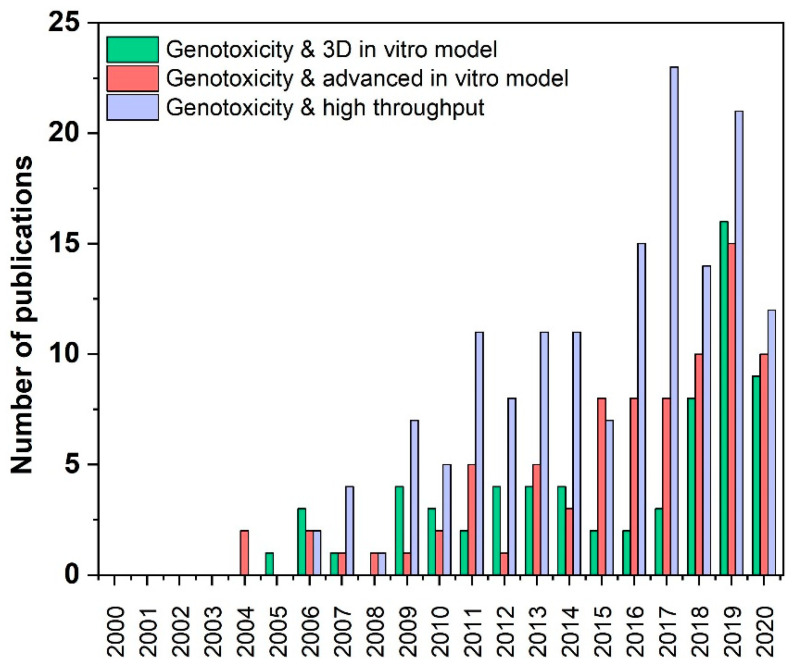
Changes in the genetic material can lead to serious human health defects, as mutations in somatic cells may cause cancer and can contribute to other chronic diseases. Genotoxic events can appear at both the DNA, chromosomal or (during mitosis) whole genome level. The study of mechanisms leading to genotoxicity is crucially important, as well as the detection of potentially genotoxic compounds. We consider the current state of the art and describe here the main endpoints applied in standard human in vitro models as well as new advanced 3D models that are closer to the in vivo situation. We performed a literature review of in vitro studies published from 2000-2020 (August) dedicated to the genotoxicity of nanomaterials (NMs) in new models. Methods suitable for detection of genotoxicity of NMs will be presented with a focus on advances in miniaturization, organ-on-a-chip and high throughput methods.
遗传物质的变化会导致严重的人类健康缺陷,因为体细胞中的突变可能会引发癌症,并可能导致其他慢性疾病。基因毒性事件可出现在DNA、染色体或(有丝分裂期间)全基因组水平。研究导致基因毒性的机制以及检测潜在的基因毒性化合物至关重要。我们考虑了当前的技术水平,并在此描述了标准人类体外模型以及更接近体内情况的新型先进3D模型中应用的主要终点。我们对2000年至2020年8月发表的关于新型模型中纳米材料(NMs)基因毒性的体外研究进行了文献综述。将介绍适用于检测纳米材料基因毒性的方法,重点是小型化、芯片器官和高通量方法的进展。