Sayers Ellie, MacGregor Alex, Carding Simon R
Gut Health and Food Safety Programme, Quadram Institute Bioscience, Norwich, Norfolk, NR4 7UA, UK.
Norwich Medical School, Faculty of Medicine and Health Sciences, University of East Anglia, Norwich, Norfolk, NR4 7TJ, UK.
AIMS Microbiol. 2018 Oct 26;4(4):642-654. doi: 10.3934/microbiol.2018.4.642. eCollection 2018.
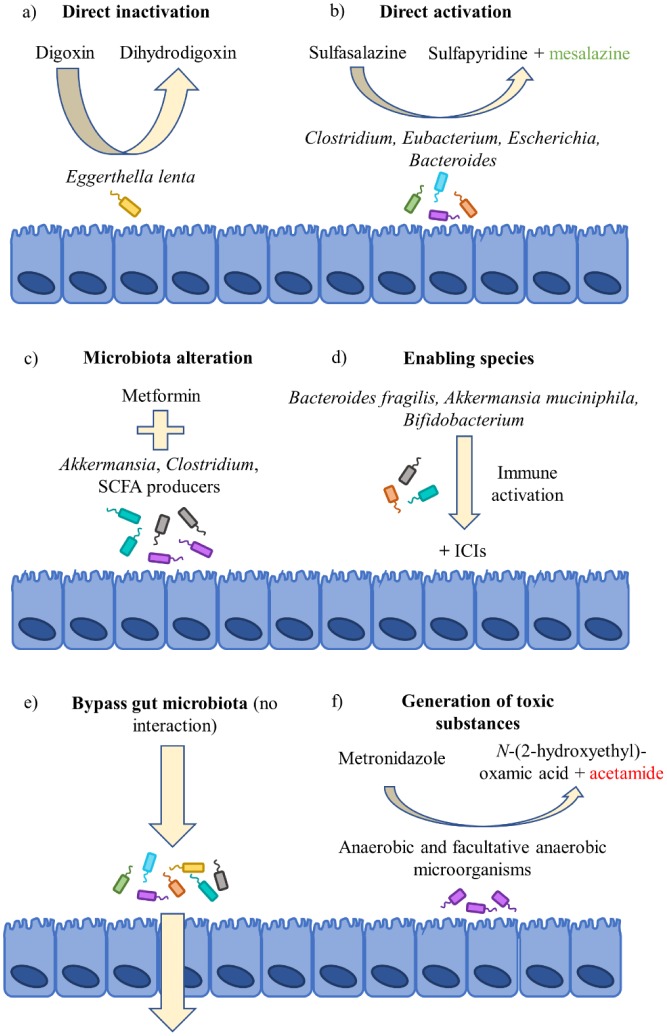
Knowledge about associations between changes in the structure and/or function of intestinal microbes (the microbiota) and the pathogenesis of various diseases is expanding. However, interactions between the intestinal microbiota and different pharmaceuticals and the impact of these on responses to treatment are less well studied. Several mechanisms are known by which drug-microbiota interactions can influence drug bioavailability, efficacy, and/or toxicity. This includes direct activation or inactivation of drugs by microbial enzymes which can enhance or reduce drug effectiveness. The extensive metabolic capabilities of the intestinal microbiota make it a hotspot for drug modification. However, drugs can also influence the microbiota profoundly and change the outcome of interactions with the host. Additionally, individual microbiota signatures are unique, leading to substantial variation in host responses to particular drugs. In this review, we describe several known and emerging examples of how drug-microbiota interactions influence the responses of patients to treatment for various diseases, including inflammatory bowel disease, type 2 diabetes and cancer. Focussing on rheumatoid arthritis (RA), a chronic inflammatory disease of the joints which has been linked with microbial dysbiosis, we propose mechanisms by which the intestinal microbiota may affect responses to treatment with methotrexate which are highly variable. Furthering our knowledge of this subject will eventually lead to the adoption of new treatment strategies incorporating microbiota signatures to predict or improve treatment outcomes.
关于肠道微生物(微生物群)结构和/或功能变化与各种疾病发病机制之间关联的知识正在不断扩展。然而,肠道微生物群与不同药物之间的相互作用以及这些相互作用对治疗反应的影响却鲜少得到研究。已知有几种机制表明药物 - 微生物群相互作用可影响药物的生物利用度、疗效和/或毒性。这包括微生物酶对药物的直接激活或失活,这可增强或降低药物疗效。肠道微生物群广泛的代谢能力使其成为药物修饰的热点。然而,药物也可深刻影响微生物群并改变与宿主相互作用的结果。此外,个体微生物群特征是独特的,导致宿主对特定药物的反应存在很大差异。在本综述中,我们描述了一些已知的和新出现的例子,说明药物 - 微生物群相互作用如何影响患者对各种疾病治疗的反应,包括炎症性肠病、2型糖尿病和癌症。以类风湿性关节炎(RA)为例,这是一种与微生物失调有关的关节慢性炎症性疾病,我们提出了肠道微生物群可能影响甲氨蝶呤治疗反应的机制,而甲氨蝶呤的治疗反应具有高度变异性。增进我们对这一主题的了解最终将导致采用纳入微生物群特征的新治疗策略,以预测或改善治疗结果。