Liu Hao, Song Ying, Qiu Huishi, Liu Yanzhen, Luo Kai, Yi Yanmei, Jiang Guanmin, Lu Minying, Zhang Zhijie, Yin Jiang, Zeng Shanshan, Chen Xiangzhou, Deng Min, Jia Xiaoting, Gu Yixue, Chen Danyang, Zheng Guopei, He Zhimin
Affiliated Cancer Hospital and Institute of Guangzhou Medical University, Guangzhou Key Laboratory of "Translational Medicine on Malignant Tumor Treatment", Guangzhou, Guangdong, China.
Department of Radiation Oncology, The Sixth Affiliated Hospital of Guangzhou Medical University, Qingyuan, 511500, Guangdong, China.
Cell Death Differ. 2020 Mar;27(3):966-983. doi: 10.1038/s41418-019-0389-3. Epub 2019 Jul 11.
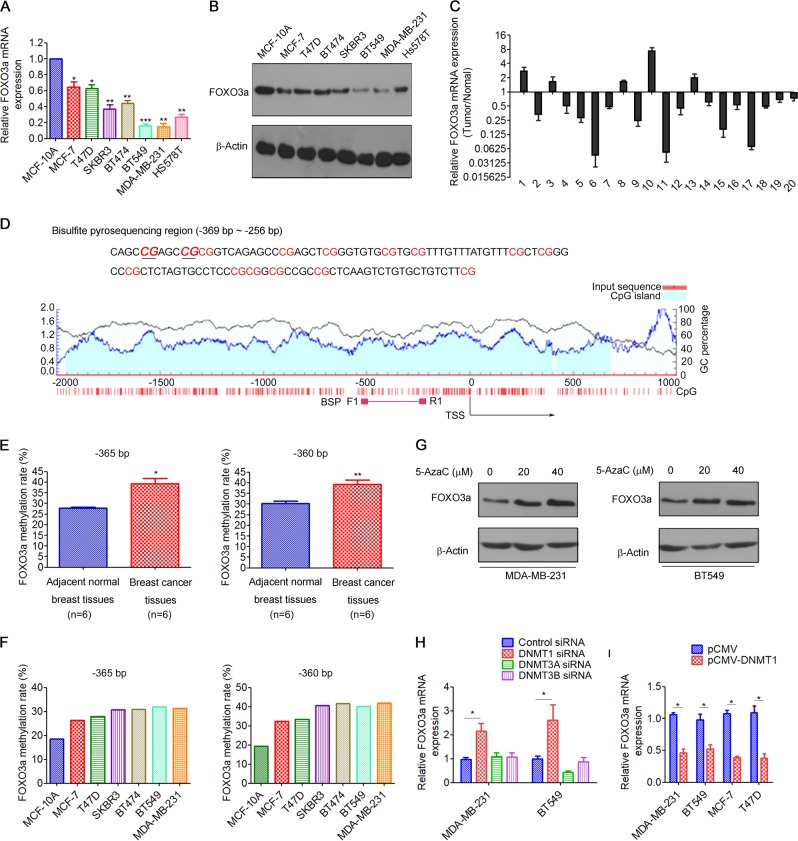
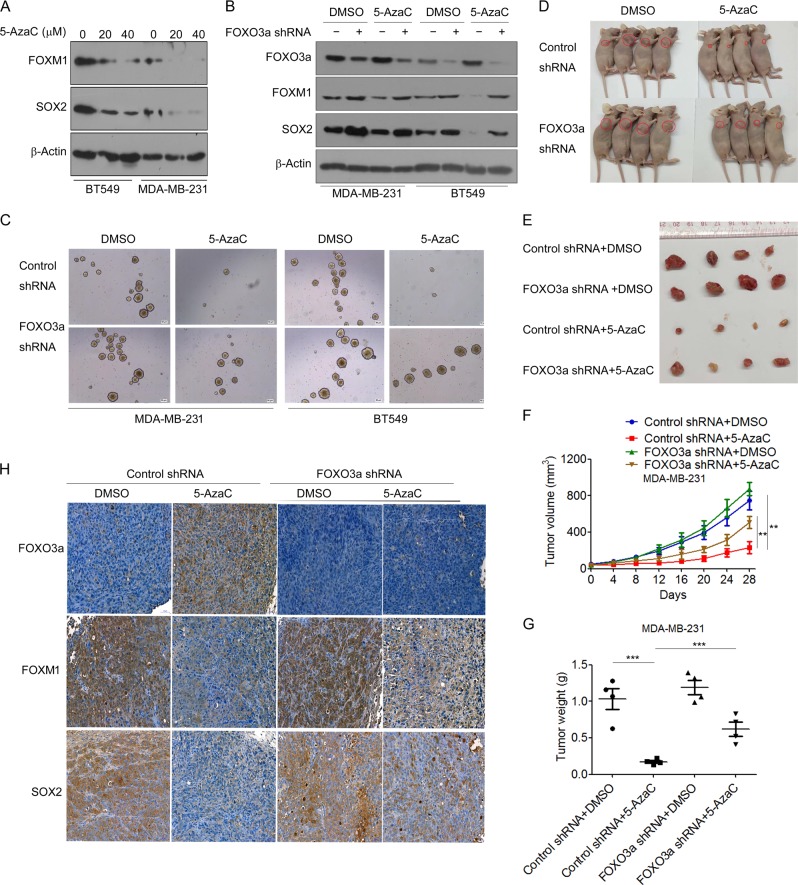
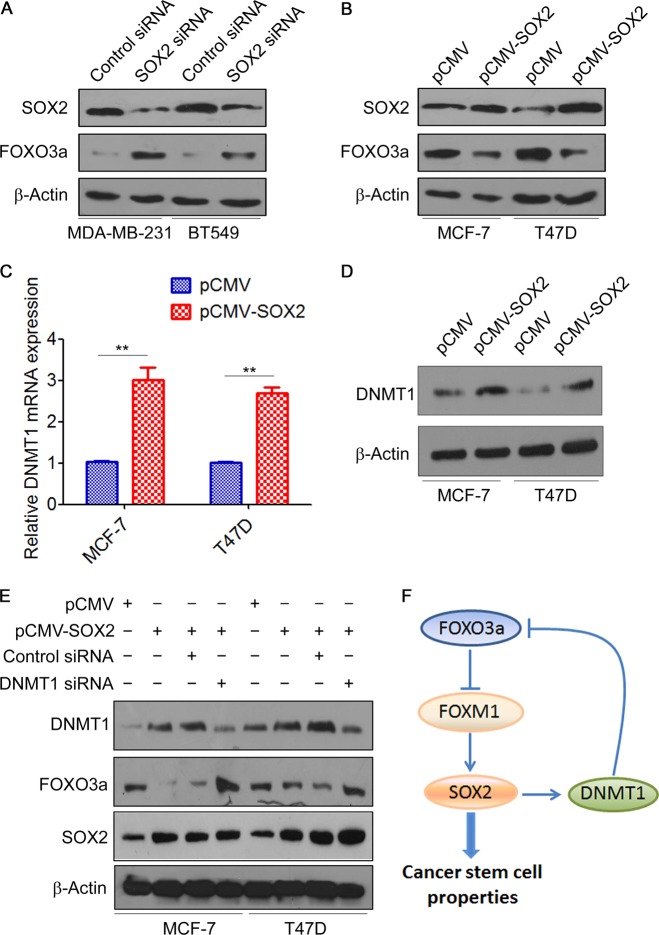
Breast cancer stem cells (BCSCs) are tumor initiating cells that can self-renew and are highly tumorigenic and chemoresistant. Therefore, the identification of factors critical for BCSC function is vital for the development of therapies. Here, we report that DNMT1-mediated FOXO3a promoter hypermethylation leads to downregulation of FOXO3a expression in breast cancer. FOXO3a is functionally related to the inhibition of FOXM1/SOX2 signaling and to the consequent suppression of BCSCs properties and tumorigenicity. Moreover, we found that SOX2 directly transactivates DNMT1 expression and thereby alters the methylation landscape, which in turn feedback inhibits FOXO3a expression. Inhibition of DNMT activity suppressed tumor growth via regulation of FOXO3a/FOXM1/SOX2 signaling in breast cancer. Clinically, we observed a significant inverse correlation between FOXO3a and FOXM1/SOX2/DNMT1 expression levels, and loss of FOXO3a expression or increased expression of FOXM1, SOX2, and DNMT1 predicted poor prognosis in breast cancer. Collectively, our findings suggest an important role of the DNMT1/FOXO3a/FOXM1/SOX2 pathway in regulating BCSCs properties, suggesting potential therapeutic targets for breast cancer.
乳腺癌干细胞(BCSCs)是具有自我更新能力、高度致瘤性且对化疗耐药的肿瘤起始细胞。因此,鉴定对BCSC功能至关重要的因子对于开发治疗方法至关重要。在此,我们报告DNMT1介导的FOXO3a启动子高甲基化导致乳腺癌中FOXO3a表达下调。FOXO3a在功能上与抑制FOXM1/SOX2信号传导以及随后抑制BCSCs特性和致瘤性相关。此外,我们发现SOX2直接反式激活DNMT1表达,从而改变甲基化格局,进而反馈抑制FOXO3a表达。抑制DNMT活性通过调节乳腺癌中的FOXO3a/FOXM1/SOX2信号传导抑制肿瘤生长。临床上,我们观察到FOXO3a与FOXM1/SOX2/DNMT1表达水平之间存在显著负相关,FOXO3a表达缺失或FOXM1、SOX2和DNMT1表达增加预示着乳腺癌预后不良。总体而言,我们的研究结果表明DNMT1/FOXO3a/FOXM1/SOX2途径在调节BCSCs特性中起重要作用,提示乳腺癌潜在的治疗靶点。