Sun Kan, Lin Diaozhu, Feng Qiling, Li Feng, Qi Yiqin, Feng Wanting, Yang Chuan, Yan Li, Ren Meng, Liu Dan
Department of Endocrinology, Sun Yat-sen Memorial Hospital, Sun Yat-sen University, 107 Yanjiang West Road, Guangzhou, 510120 People's Republic of China.
Diabetol Metab Syndr. 2019 Jun 27;11:51. doi: 10.1186/s13098-019-0450-x. eCollection 2019.
Rational measures in estimating adiposity distribution in diabetic patients has yet to be validated. This study aims to provide insight about the possible links between routinely available body adiposity parameters and the development of both diabetes and insulin resistance.
We performed a population-based cross-sectional study in 9496 subjects aged 40 years or older. All of the body adiposity measures including body mass index (BMI), waist circumference (WC), waist-hip ratio (WHR), waist-height ratio (WHtR), visceral adiposity index (VAI), body adiposity index (BAI) and lipid accumulation product index (LAP) were separately evaluated according to standard measurement methods. Diabetes was diagnosed according to the American Diabetes Association 2010 criteria.
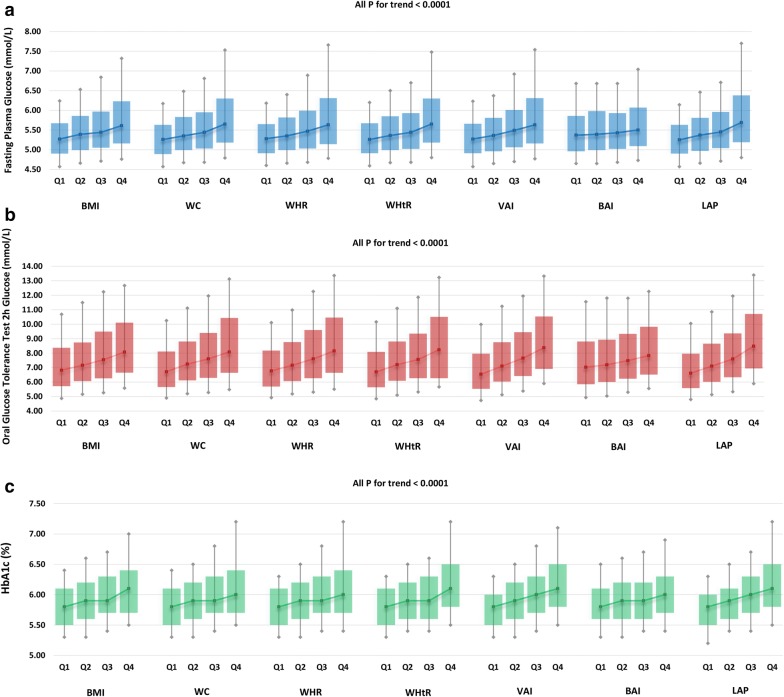
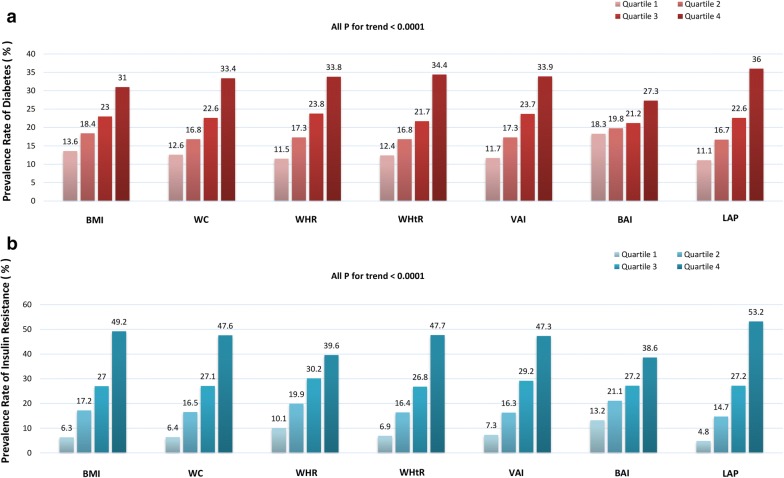
All tested body adiposity measurements were significantly associated with fasting plasma glucose (FPG), oral glucose tolerance test (OGTT) 2 h glucose, HbA1c and fasting insulin. Compared with other adiposity phenotypes, LAP have shown the relatively strongest while BAI have shown the relatively weakest association with increased odds of both diabetes and insulin resistance across all logistic regression models. Additionally, LAP provided the best discrimination accuracy for diabetes [area under the curve (AUC): 0.658 95% confidence intervals (CI) 0.645-0.671] and insulin resistance (AUC: 0.781 95% CI 0.771-0.792) when compared with other body adiposity parameters.
The LAP index seems to be a better indicator than other adiposity measures tested in the study to evaluate the association of visceral fat mass with diabetes and insulin resistance, which should be given more consideration in the clinical practice.
评估糖尿病患者肥胖分布的合理方法尚未得到验证。本研究旨在深入了解常规可用的身体肥胖参数与糖尿病和胰岛素抵抗发展之间的可能联系。
我们对9496名40岁及以上的受试者进行了一项基于人群的横断面研究。根据标准测量方法分别评估了所有身体肥胖指标,包括体重指数(BMI)、腰围(WC)、腰臀比(WHR)、腰高比(WHtR)、内脏脂肪指数(VAI)、身体脂肪指数(BAI)和脂质蓄积产物指数(LAP)。根据美国糖尿病协会2010年标准诊断糖尿病。
所有测试的身体肥胖测量指标均与空腹血糖(FPG)、口服葡萄糖耐量试验(OGTT)2小时血糖、糖化血红蛋白(HbA1c)和空腹胰岛素显著相关。与其他肥胖表型相比,在所有逻辑回归模型中,LAP与糖尿病和胰岛素抵抗增加几率的关联相对最强,而BAI的关联相对最弱。此外,与其他身体肥胖参数相比,LAP对糖尿病[曲线下面积(AUC):0.658,95%置信区间(CI)0.645 - 0.671]和胰岛素抵抗(AUC:0.781,95%CI 0.771 - 0.792)的判别准确性最佳。
LAP指数似乎比本研究中测试的其他肥胖测量指标更能评估内脏脂肪量与糖尿病和胰岛素抵抗的关联,在临床实践中应给予更多考虑。