
谁将受益于计算机认知矫正治疗?来自精神分裂症多中心随机对照研究的证据。
Who will benefit from computerized cognitive remediation therapy? Evidence from a multisite randomized controlled study in schizophrenia.
机构信息
Beijing HuiLongGuan Hospital, Peking University HuiLongGuan Clinical Medical School, Beijing100096, P.R. China.
Beijing Anding Hospital of Capital Medical University, Beijing100088, P.R. China.
出版信息
Psychol Med. 2020 Jul;50(10):1633-1643. doi: 10.1017/S0033291719001594. Epub 2019 Jul 12.
BACKGROUND
Computerized cognitive remediation therapy (CCRT) is generally effective for the cognitive deficits of schizophrenia. However, there is much uncertainty about what factors mediate or moderate effectiveness and are therefore important to personalize treatment and boost its effects.
METHOD
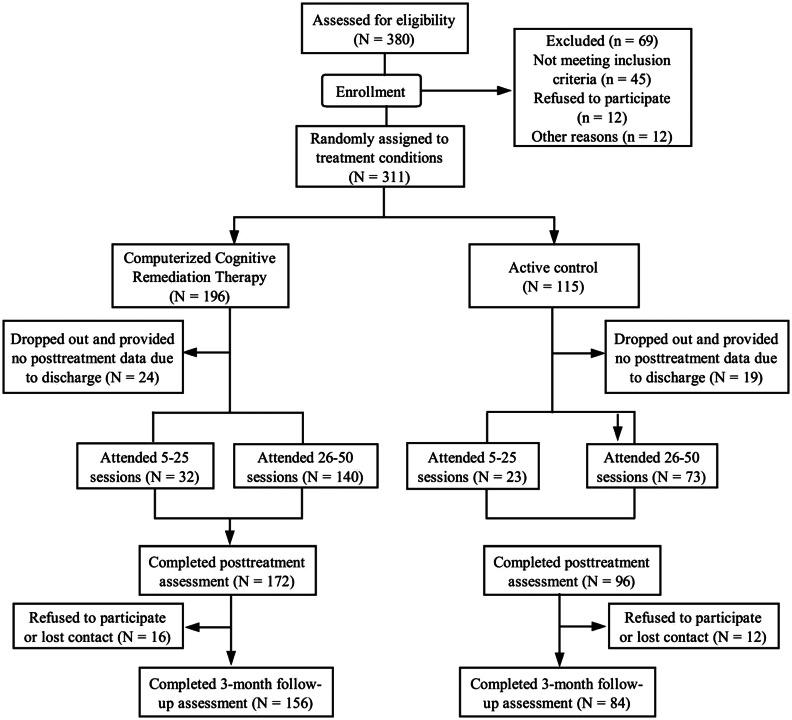
In total, 311 Chinese inpatients with Diagnostic and Statistical Manual of Mental Disorders-IV schizophrenia were randomized to receive CCRT or Active control for 12 weeks with four to five sessions per week. All participants were assessed at baseline, post-treatment and 3-month follow-up. The outcomes were cognition, clinical symptoms and functional outcomes.
RESULTS
There was a significant benefit in the MATRICS Consensus Cognitive Battery (MCCB) total score for CCRT (F1,258 = 5.62; p = 0.02; effect size was 0.27, 95% confidence interval 0.04-0.49). There were no specific moderators of CCRT improvements. However, across both groups, Wisconsin Card Sort Test improvement mediated a positive effect on functional capacity and Digit Span benefit mediated decreases in positive symptoms. In exploratory analyses younger and older participants showed cognitive improvements but on different tests (younger on Symbol Coding Test, while older on the Spatial Span Test). Only the older age group showed MSCEIT benefits at post-treatment. In addition, cognition at baseline negatively correlated with cognitive improvement and those whose MCCB baseline total score was around 31 seem to derive the most benefit.
CONCLUSIONS
CCRT can improve the cognitive function of patients with schizophrenia. Changes in cognitive outcomes also contributed to improvements in functional outcomes either directly or solely in the context of CCRT. Age and the basic cognitive level of the participants seem to affect the cognitive benefits from CCRT.
背景
计算机认知矫正治疗(CCRT)通常对精神分裂症的认知缺陷有效。然而,对于什么因素可以调节或缓冲疗效,存在很大的不确定性,因此这些因素对于个性化治疗和提高疗效很重要。
方法
共有 311 名符合精神障碍诊断与统计手册第四版(DSM-IV)精神分裂症的中国住院患者被随机分为 CCRT 组或活动对照组,接受为期 12 周的治疗,每周 4-5 次。所有参与者在基线、治疗后和 3 个月随访时进行评估。结果为认知、临床症状和功能结局。
结果
CCRT 在 MATRICS 共识认知电池(MCCB)总分上有显著获益(F1,258 = 5.62;p = 0.02;效应量为 0.27,95%置信区间为 0.04-0.49)。CCRT 改善没有特定的调节因素。然而,在两组中,威斯康星卡片分类测试的改善都介导了对功能能力的积极影响,数字跨度的改善介导了阳性症状的减少。在探索性分析中,年轻和年长的参与者都表现出认知改善,但在不同的测试中(年轻组在符号编码测试中,年长组在空间跨度测试中)。只有年长组在治疗后表现出 MSCEIT 的益处。此外,基线时的认知与认知改善呈负相关,而那些 MCCB 基线总分约为 31 的患者似乎获益最大。
结论
CCRT 可以改善精神分裂症患者的认知功能。认知结果的变化也直接或仅在 CCRT 背景下有助于功能结果的改善。年龄和参与者的基本认知水平似乎会影响他们从 CCRT 中获得的认知益处。

 Zotero 插件