Westerdijk Fungal Biodiversity Institute, Uppsalalaan 8, 3584 CT Utrecht, the Netherlands.
Laboratory of Phytopathology, Wageningen University & Research, Droevendaalsesteeg 1, 6708 PB, Wageningen, the Netherlands.
FEMS Microbiol Rev. 2019 Nov 1;43(6):591-607. doi: 10.1093/femsre/fuz018.
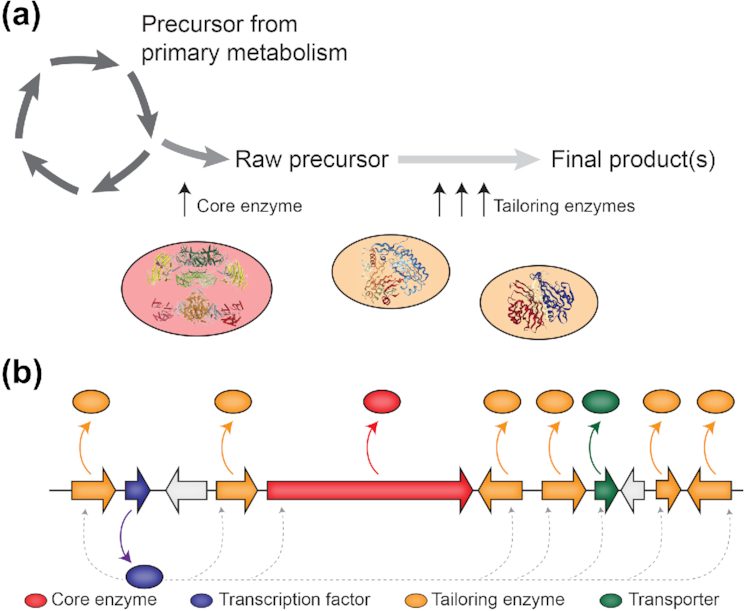
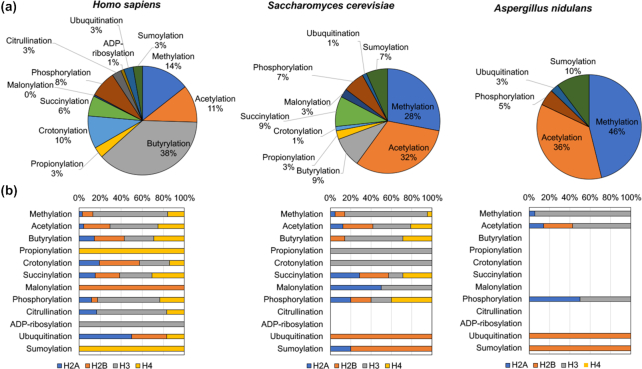
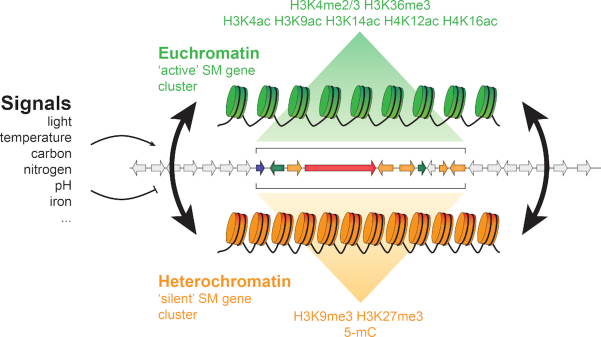
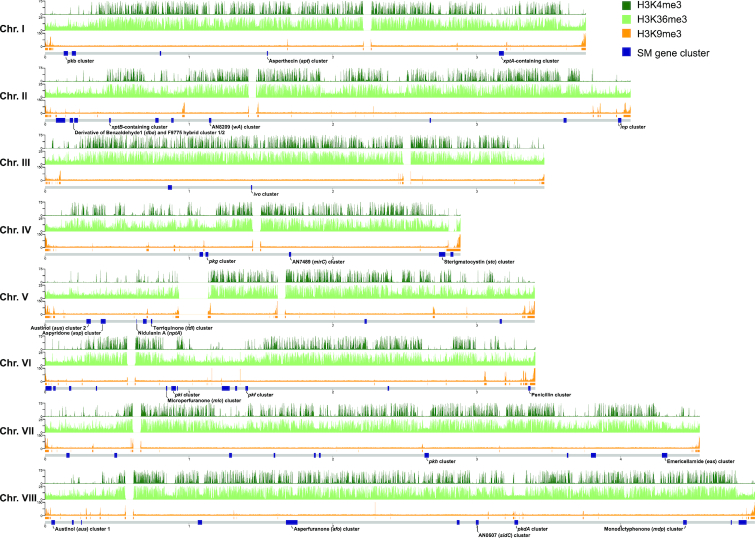
Fungal secondary metabolites are small molecules that exhibit diverse biological activities exploited in medicine, industry and agriculture. Their biosynthesis is governed by co-expressed genes that often co-localize in gene clusters. Most of these secondary metabolite gene clusters are inactive under laboratory conditions, which is due to a tight transcriptional regulation. Modifications of chromatin, the complex of DNA and histone proteins influencing DNA accessibility, play an important role in this regulation. However, tinkering with well-characterised chemical and genetic modifications that affect chromatin alters the expression of only few biosynthetic gene clusters, and thus the regulation of the vast majority of biosynthetic pathways remains enigmatic. In the past, attempts to activate silent gene clusters in fungi mainly focused on histone acetylation and methylation, while in other eukaryotes many other post-translational modifications are involved in transcription regulation. Thus, how chromatin regulates the expression of gene clusters remains a largely unexplored research field. In this review, we argue that focusing on only few well-characterised chromatin modifications is significantly hampering our understanding of the chromatin-based regulation of biosynthetic gene clusters. Research on underexplored chromatin modifications and on the interplay between different modifications is timely to fully explore the largely untapped reservoir of fungal secondary metabolites.
真菌次生代谢产物是具有多种生物活性的小分子,可用于医学、工业和农业。它们的生物合成受共同表达的基因控制,这些基因通常在基因簇中共同定位。在实验室条件下,这些次生代谢物基因簇中的大多数是无活性的,这是由于转录调控非常紧密。影响 DNA 可及性的染色质(DNA 和组蛋白蛋白复合物)修饰在这种调控中起着重要作用。然而,对影响染色质的经过充分研究的化学和遗传修饰进行调整,仅能改变少数生物合成基因簇的表达,因此,绝大多数生物合成途径的调控仍然是一个谜。过去,真菌中激活沉默基因簇的尝试主要集中在组蛋白乙酰化和甲基化上,而在其他真核生物中,许多其他翻译后修饰参与转录调控。因此,染色质如何调节基因簇的表达仍然是一个很大程度上未被探索的研究领域。在这篇综述中,我们认为,仅关注少数经过充分研究的染色质修饰,极大地阻碍了我们对生物合成基因簇基于染色质的调控的理解。对未充分研究的染色质修饰以及不同修饰之间相互作用的研究,对于充分挖掘真菌次生代谢产物这一巨大的未开发资源是及时的。