Taylor Joanna, Pagliari Claudia
eHealth Research Group, Usher Institute for Population Health Sciences and Informatics, University of Edinburgh, Edinburgh, EH8 9AG UK.
NPJ Digit Med. 2019 Jun 10;2:51. doi: 10.1038/s41746-019-0124-y. eCollection 2019.
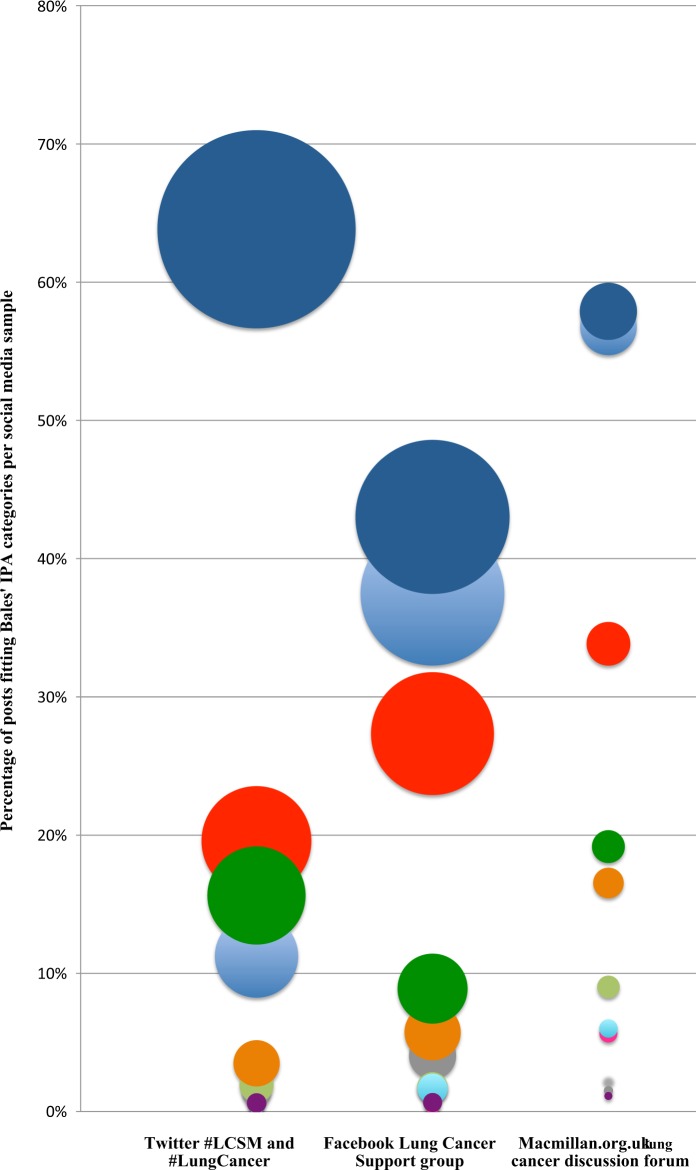
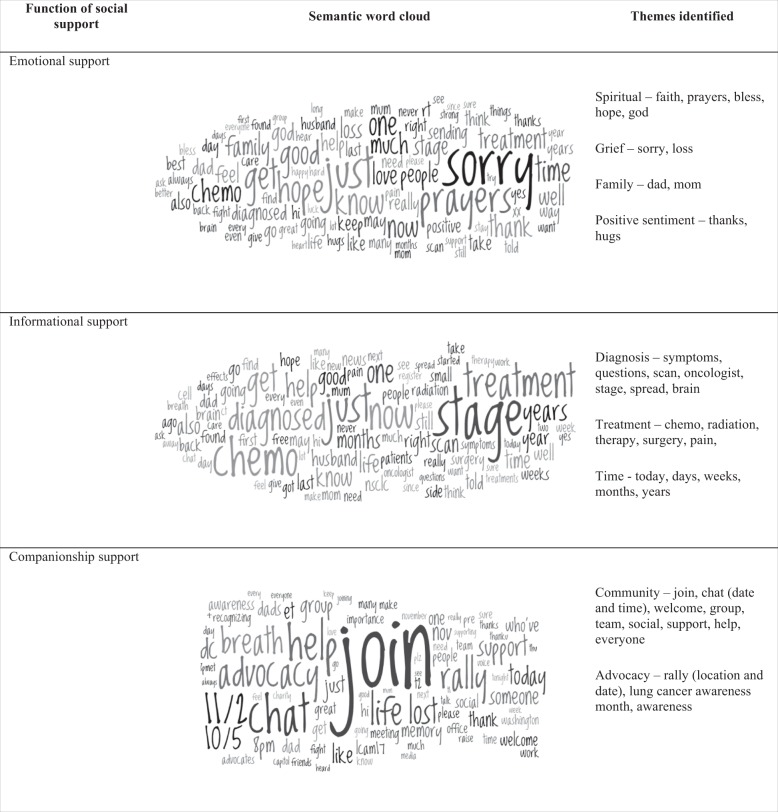
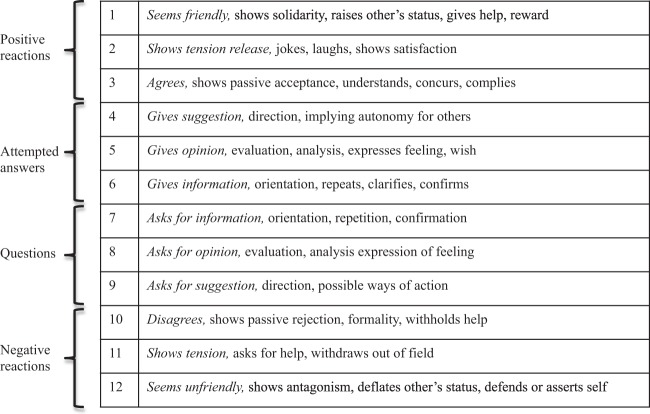
People with lung cancer and others affected by the condition are using social media to share information and support, but little is known about how these behaviours vary between different platforms. To investigate this, we extracted posts from Twitter (using relevant hashtags), the Lung Cancer Support Group on Facebook and the Macmillan.org.uk lung cancer discussion forum for a single month. Interaction Process Analysis revealed that all three platforms were used more for giving than seeking information, opinion or suggestions. However, interaction types (including sentiment) varied between platforms, reflecting their digital architectures, user-base and inclusion of a moderator. For example, a higher percentage of information-seeking and sentiment marked the Macmillan.org.uk, compared with Twitter and the Facebook Group. Further analysis of the messages using a four-dimensional typology of social support revealed that emotional and informational support types were most prevalent on the Macmillan.org.uk forum, closely followed by the Facebook Group. Contrary to expectations, Twitter posts showed the most companionship support, reflecting the use of hashtags as user-generated signals of community belonging and interests. Qualitative analysis revealed an unanticipated sub-category of spiritual support, which featured uniquely in the Lung Cancer Support Group on Facebook. There was little evidence of trolling or stigma, although some users remarked that lung cancer was unfairly resourced compared with other cancers. These findings provide new insights about how people affected by lung cancer use social media and begin to elucidate the value of different platforms as channels for patient engagement and support, or as potential research data sources.
肺癌患者及其他受该疾病影响的人正在利用社交媒体分享信息并相互支持,但对于这些行为在不同平台之间如何变化却知之甚少。为了对此进行调查,我们在一个月内从推特(使用相关主题标签)、脸书上的肺癌支持小组以及Macmillan.org.uk肺癌讨论论坛提取了帖子。互动过程分析表明,所有这三个平台更多地用于提供信息,而非寻求信息、意见或建议。然而,互动类型(包括情绪)在不同平台之间有所不同,这反映了它们的数字架构、用户群体以及是否有管理员。例如,与推特和脸书小组相比,Macmillan.org.uk上寻求信息和带有情绪标记的帖子比例更高。使用社会支持的四维类型学对这些信息进行的进一步分析表明,情感支持和信息支持类型在Macmillan.org.uk论坛上最为普遍,脸书小组紧随其后。与预期相反,推特帖子显示出最多的陪伴支持,这反映了主题标签被用作由用户生成的社区归属感和兴趣的信号。定性分析揭示了一个意外的精神支持子类别,它在脸书上的肺癌支持小组中具有独特的特征。几乎没有证据表明存在恶意捣乱或污名化现象,尽管一些用户指出与其他癌症相比,肺癌获得的资源不公平。这些发现为受肺癌影响的人如何使用社交媒体提供了新的见解,并开始阐明不同平台作为患者参与和支持的渠道或潜在研究数据源的价值。