Ortiz-Guerra Ruben Alejandro, Jaime-Casas Salvador, Martinez-Cannon Bertha Alejandra, Ariza-Avila Jose C, González-Morales Ana P, Bardan-Duarte Andrea, Remolina-Bonilla Yuly A, Spiess Philippe E, Bourlon Maria T
Department of Hematology and Oncology, Instituto Nacional de Ciencias Medicas y Nutricion Salvador Zubiran, Mexico City, Mexico.
School of Medicine, Universidad Panamericana, Mexico City, Mexico.
Front Oncol. 2023 Dec 11;13:1301973. doi: 10.3389/fonc.2023.1301973. eCollection 2023.
Social media platforms (SMP) are an emerging resource that allows physicians, patients, and families to converse on cancer prevention, diagnosis, and treatment. We aimed to characterize penile cancer (PC) content shared on SMP.
We searched PC posts on Twitter, Facebook, and Instagram from July 1st, 2021, through June 30th, 2022. Two independent, blinded reviewers analyzed the hashtags: #PenileCancer, #PenileCancerAwareness, and #PenileNeoplasm. Descriptive statistics were used for posts characterization, Pearson´s correlation coefficient for associations, and Cohen's weighted kappa coefficient for inter-rater agreement rate.
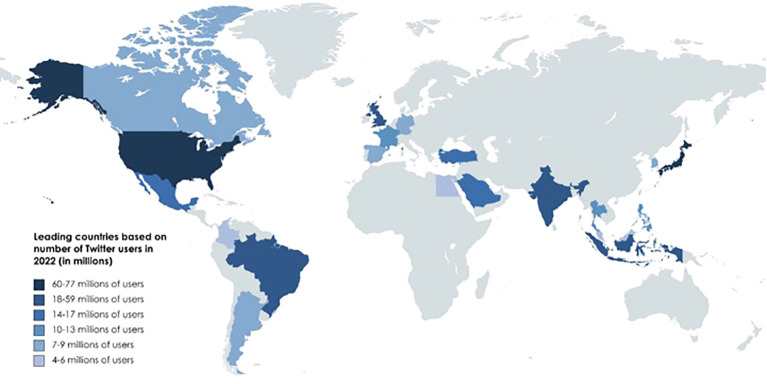
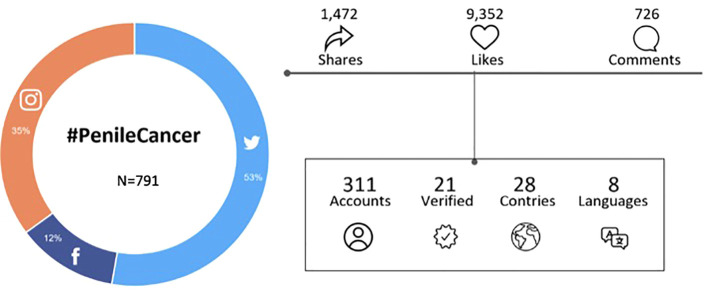
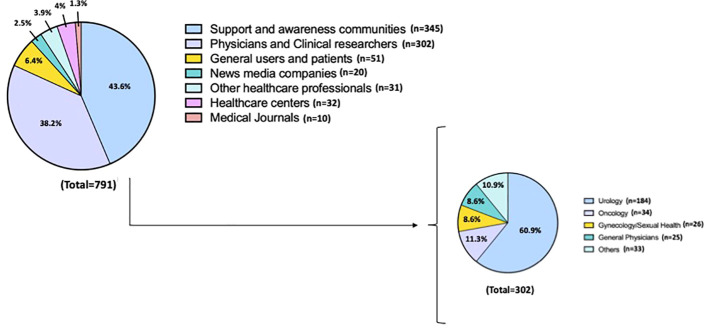
A total of 791 posts were analyzed, with Twitter accounting for 52%, Facebook for 12.2%, and Instagram for 35.5%, and. Most posts originated from high-income countries, such as the United Kingdom (48.8%). We found no correlation between the number of posts with PC incidence (p = 0.64) or users on SMP (p = 0.27). Most accounts were classified as "support and awareness communities" (43.6%) and "physicians and clinical researchers" (38.2%). Urology was the most common medical specialty to post (60.9%), followed by oncology (11.3%). Most posts were classified as "prevention and awareness for users" (45.1%). Global inter-reviewer agreement rate was almost perfect (k=0.95; p ≤ 0.01). On Twitter, "physicians and clinical researchers" shared more content on "treatment updates and medical papers published in medical journals," while on Facebook and Instagram, "support and awareness communities" focused on "personal and support comments."
Overall, the number of PC posts was low compared to other neoplasms across the SMP evaluated in this study. "Physicians and clinical researchers" shared more content on Twitter, while "support and awareness communities" on Facebook and Instagram. Encouraging the use of a common SMP among the medical community and general users could lead to a more effective communication between physicians, patients, and support groups, and to increased awareness of PC.
社交媒体平台是一种新兴资源,它使医生、患者及其家属能够就癌症预防、诊断和治疗进行交流。我们旨在描述在社交媒体平台上分享的阴茎癌相关内容。
我们检索了2021年7月1日至2022年6月30日期间在推特、脸书和照片墙(Instagram)上发布的阴茎癌相关帖子。两名独立的、不知情的评审员对标签#阴茎癌、#阴茎癌宣传和#阴茎肿瘤进行了分析。描述性统计用于帖子特征描述,皮尔逊相关系数用于关联分析,科恩加权卡帕系数用于评估评分者间的一致率。
共分析了791条帖子,其中推特占52%,脸书占12.2%,照片墙占35.5%。大多数帖子来自高收入国家,如英国(48.8%)。我们发现帖子数量与阴茎癌发病率之间(p = 0.64)以及与社交媒体平台上的用户数量之间(p = 0.27)均无相关性。大多数账号被归类为“支持与宣传社区”(43.6%)和“医生及临床研究人员”(38.2%)。泌尿外科是发布帖子最常见的医学专科(60.9%),其次是肿瘤学(11.3%)。大多数帖子被归类为“面向用户的预防与宣传”(45.1%)。全球评审员间的一致率几乎完美(k = 0.95;p≤0.01)。在推特上,“医生及临床研究人员”分享了更多关于“治疗进展和医学期刊发表的医学论文”的内容,而在脸书和照片墙上,“支持与宣传社区”则侧重于“个人及支持性评论”。
总体而言,与本研究评估的其他肿瘤相比,阴茎癌相关帖子的数量较少。“医生及临床研究人员”在推特上分享的内容更多,而“支持与宣传社区”在脸书和照片墙上分享的内容更多。鼓励在医学界和普通用户中使用通用的社交媒体平台,可能会促进医生、患者和支持团体之间更有效的沟通,并提高对阴茎癌的认识。